Share

Reductoniscus costulatus
🔤 Taxonomy
Reductoniscus costulatus Kesselyák, 1930 is the accepted name. Reductoniscus fritschii is a synonym in the world catalog. Its broad rounded body tubercles, hourglass-shaped telson and short square-ended uropods help distinguish it from the similarly tiny greenhouse pill woodlouse Buddelundiella cataractae.
📌 Description
At only about 2–3 mm, this is among the smallest terrestrial isopods maintained or encountered in glasshouses. It is pale reddish to brownish, strongly sculptured and able to roll into a sphere. Adults and mancae can be overlooked among peat particles.
British records and identification work provide useful size and habitat evidence, but no controlled species-specific husbandry limits were found. The care targets below are conservative extrapolations from tropical greenhouse and field microhabitats, not experimentally demonstrated optima.
🌍 Distribution
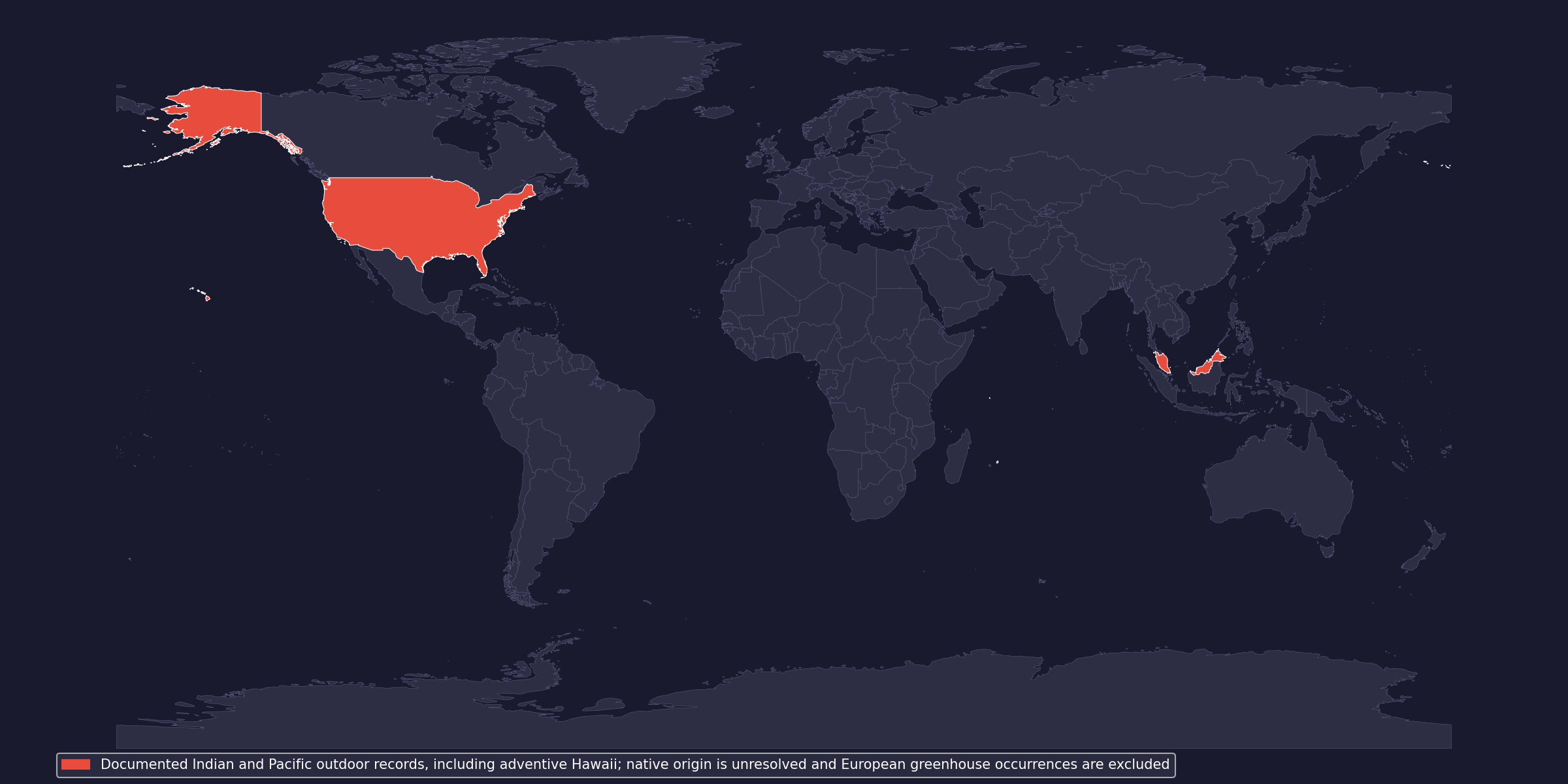
Wild records are published from Seychelles, Mauritius, Malaysia and the Hawaiian Islands. Hawaiian specimens occurred under stones and in leaf litter at low altitude, including coastal sites; the Hawaiian review treats the species as adventive. It has been transported with plants to heated European glasshouses, including Kew Gardens and the Eden Project, where colonies persisted for years.
The map shows documented Indian–Pacific outdoor records. Native origin and the extent of human transport remain unresolved; European greenhouse populations are excluded.
⚖️ Legal status
Local and national rules may still apply.
Checked on 2026-08-29: R. costulatus was not found in CITES, EU wildlife-trade Annexes A–D under Regulation (EU) 2026/1383, or Bern Appendices II–III. Plant-health, soil-movement, protected-area, greenhouse pest-control, import and invasive-organism rules may nevertheless apply.
Obtain traceable captive stock and contain every particle of culture substrate. Never discard it outdoors or into greenhouse planting beds.
🤌 Husbandry
A tightly closing 15 × 12 × 10 cm tub can hold a starter colony, but ventilation openings must be smaller than the animals. Use at least 5 cm of fine moisture-retentive substrate.
| Parameter | Conservative starting point |
|---|---|
| Adult length | 0.2–0.3 cm |
| Temperature | 21–27 °C |
| Moisture | mostly damp, with oxygenated surface litter |
| Main food | finely divided leaves and rotten wood |
| Evidence quality | good habitat records; captive limits sparse |
Quarantine for 60 days and examine material over a pale tray with magnification. Do not combine with larger isopods that compete for food or make population checks impossible.
💡 Lighting
UVB is unnecessary. Provide indirect light for 10–12 hours and permanent dark retreats. Even brief direct sun can overheat this small enclosure.
🌡 Heating and temperature
Use 21–27 °C with a 19–23 °C cooler area. These temperatures mirror heated tropical-house conditions rather than a published performance trial. Stable warmth is important, but avoid sustained temperatures above 28 °C.
If heating is needed, warm one side wall under thermostat control. Never place the culture directly on a heat mat: the only damp refuge can dry without warning.
💧 Humidity and water
Keep most substrate damp like a wrung sponge, with a less-saturated ventilated surface and no standing water. The Dutch greenhouse atlas suggests high soil moisture may be important. Add water by pipette into one corner; no dish is safe or useful.
Because the animals are almost invisible, use substrate weight, condensation and odour as well as behaviour. Anaerobic smell means immediate aeration and partial substrate renewal; dry, dusty leaf fragments mean the moisture reserve is failing.
🌿 Enclosure and decoration
Use fine pesticide-free topsoil, leaf mould, peat-free compost and crumbled rotten hardwood. Add thin bark, small decayed wood pieces, finely shredded leaves, moss and calcium. Leave pores and soft interfaces rather than heavy decoration.
Avoid fertilizers, systemic pesticides, imported nursery soil and coir alone. Fine mesh is safer than open ventilation holes; work inside a second container during maintenance.
🪳 Feeding
Provide powdered or finely crumbled leaf litter and rotten wood continuously. Offer tiny smears or crumbs of mushroom, squash, dried greens or balanced isopod food two or three times weekly, plus a minute protein ration weekly and fine calcium.
A portion the size used for ordinary isopods is excessive here. Remove uneaten wet food within 24 hours and reduce feeding at the first sign of mites.
🥚 Breeding
Females brood young in a marsupium and release minute mancae; metadata records the mode as viviparous. Species-specific brood counts and generation time are not well established in accessible sources.
Do not disturb individuals. Preserve stable humidity and microbial food, and assess population by photographing a fixed small sample of substrate. Split only a visibly thriving colony and transfer mature substrate with it.
🩺 Common problems
- Apparent colony loss: inspect with magnification before changing the enclosure.
- Drying: rehydrate one deep corner slowly; flooding can be equally lethal.
- Anaerobic substrate: increase fine cross-flow and replace only part of the medium.
- Mite bloom: remove supplemental food and retain only leaf/wood staples temporarily.
- Confusion with another tiny species: check the telson and uropods under magnification.
📌 Conclusion
Reductoniscus costulatus is an expert micro-culture, not a conventional display isopod. Its successful care depends on fine-scale moisture, oxygen, food and containment. Published greenhouse persistence supports a warm humid setup, but exact captive thresholds remain provisional.
📚 Sources and further reading
- GBIF: Reductoniscus costulatus
- World List of Isopoda: Reductoniscus costulatus
- Schmalfuss world catalog: synonymy and distribution
- British Myriapod and Isopod Group: identification and glasshouse records
- Gregory (2014): British identification account
- Taiti & Howarth: Hawaiian field records
- ReptiFiles site search completed; no species-specific guide found
- CITES Appendices
- EU wildlife-trade Annexes: Regulation (EU) 2026/1383
- Bern Convention appendices