Share

Pycnoscelus tenebrigera
🔤 Taxonomy
GBIF and the 2025 revision of the genus use Pycnoscelus tenebrigera (Walker, 1868), the spelling submitted in the source list. The current Blattodea Species File and ITIS instead render the combination P. tenebriger, treating Pycnoscelus as masculine. Because these live authorities disagree, this guide retains the GBIF-aligned form and records the alternative explicitly.
The original combination was Panchlora tenebrigera; Panchlora submarginata is a synonym. Hobby stock should not be identified from a dark color alone. Keep the supplier, locality and sex data with the colony.
📌 Description
This is a small soil- and cave-associated Pycnoscelus from the northwestern Indian subcontinent. A studied Pakistani stock measured 1.5-2.2 cm in females and 1.5-2 cm in males. Females are wingless; males are winged. All stages hide readily in substrate, so a healthy colony may be almost invisible by day.
Unlike P. surinamensis, P. tenebrigera reproduces sexually. Both sexes and overlapping age classes are therefore needed. The species is less forgiving of line loss than its parthenogenetic relative and is best treated as a documented breeding culture, not an anonymous cleanup colony.
| Care point | Practical target |
|---|---|
| Adult size | females 1.5-2.2 cm; males 1.5-2 cm |
| Small colony enclosure | 30 x 20 x 20 cm |
| Temperature | 22-27°C; warm end 26-28°C |
| Substrate | 8-12 cm, moist lower layer |
| Sexes | wingless females, winged males |
| Reproduction | sexual; ootheca brooded internally |
🌍 Distribution
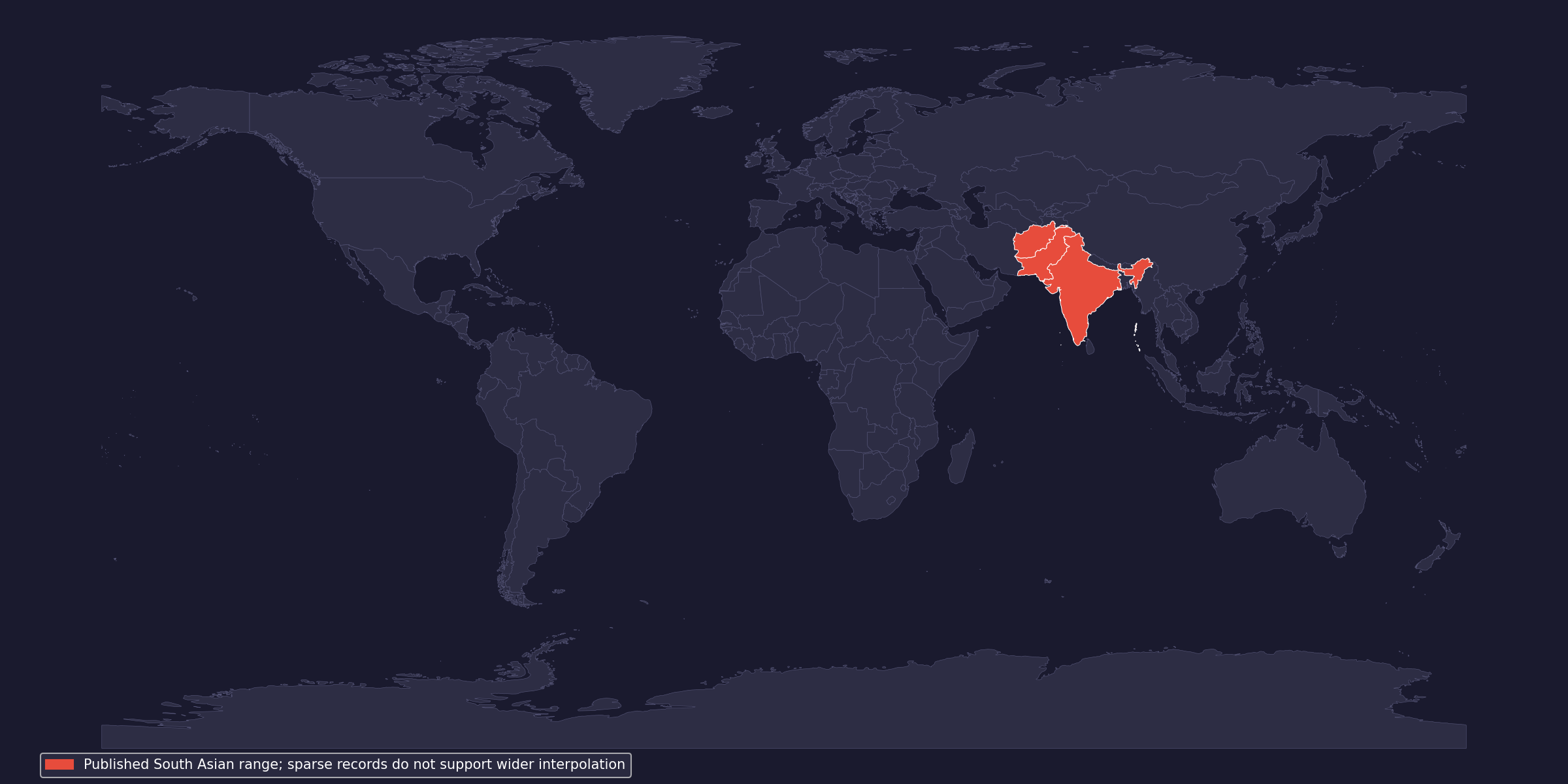
Published records place the species in northern and peninsular India, Afghanistan and Pakistan. The type locality is “North India,” while modern study stock with cave provenance came from Pakistan. Sparse records do not justify drawing a continuous range beyond these countries.
⚖️ Legal status
Checked on 2026-08-22: neither spelling of P. tenebrigera appears in the CITES Appendices valid from 5 March 2026, Annexes A-D of Commission Regulation (EU) 2026/1383, or the Bern Convention appendices. No entry was found on the current EU list of invasive alien species of Union concern.
National biosecurity, plant-health, import and live-insect transport rules can still apply. Retain the invoice and spelling note with the colony, confirm requirements before international shipment, and never release animals or substrate.
🤌 Husbandry
A 30 x 20 x 20 cm sealed tub holds a small breeding colony. Use fine fixed vents and enough floor area for a moisture gradient. The adults are not a useful handling species; search by lifting one feeding tile rather than repeatedly excavating the whole culture.
Quarantine additions for at least 60 days. Count adult males as well as females, because a female-heavy colony can age out without a replacement mating cohort. Never mix this species with other Pycnoscelus; female and nymph morphology is too similar for dependable sorting later.
💡 Lighting
UVB is unnecessary. Give a 10-12-hour day cycle and keep most of the substrate shaded with leaves and cork. Winged males may move toward lamps after disturbance, so do not open the lid beside an uncovered light source.
🌡 Heating and temperature
Maintain 22-27°C, with a small 26-28°C zone and an 18-23°C retreat. Nights may fall to 18-22°C. A laboratory colony bred successfully at 26.7°C, but the species also showed lower critical minima than the other tested congeners; that result supports offering a cool choice, not refrigerating the colony.
Heat one side or the room, never the full base. Temperatures used in rapid tolerance experiments are not safe long-term endpoints. Avoid prolonged exposure above 30°C.
💧 Humidity and water
Aim for about 55-75% RH with the lower substrate moist and the upper leaf layer partly dry. Cave association does not mean saturated mud: burrows need air spaces. Pour small amounts of water down one corner, then wait until the upper few centimeters begin to dry before watering again.
Vegetables provide much of the water. A very shallow textured dish may be used, but exposed deep water is unnecessary and hazardous to nymphs.
🌿 Enclosure and decoration
Build 8-12 cm of coir or pesticide-free soil with rotten leaves and soft decayed hardwood. Add a flat cork slab at the surface and a feeding tile. The lower layer should hold a tunnel when pressed without releasing water.
Do not design a bare egg-crate culture for this species. All life stages use the substrate to buffer temperature and humidity. Avoid aromatic wood, fertilized soil, calcareous sand, permanently wet moss and decor that blocks access to the only feeding point.
🪳 Feeding
Keep decomposed hardwood leaves available at all times. Offer carrot, squash, sweet potato, apple and leafy vegetables two or three times a week, plus a small amount of fish flake or balanced roach food weekly. Laboratory cultures have bred on dry dog or koi food, but a high-protein pellet alone is not a complete long-term substrate-feeding diet.
Place food above the soil and remove moist residues within 24-36 hours. Several tiny feeding points reduce competition among buried nymphs.
🥚 Breeding
Males and females mate, and the female retracts the ootheca into an internal brood sac before releasing nymphs. In a 2023 comparative study at 26.7°C, P. tenebrigera averaged 36.6 eggs and 24.7 live nymphs per brood, a 67.5% hatch rate. Those figures describe one captive stock, not a guaranteed colony target.
Keep several males and females, avoid synchronized single-age starts, and do not disturb swollen females. If births stop, first check whether adult males are still present, then review deep-substrate moisture and temperature.
🩺 Common problems
- Adults present but no young: verify both sexes, allow mating cover, and avoid repeatedly digging out pregnant females.
- Surface clustering: check waterlogging, heat at the base and lack of oxygen in compacted soil.
- Male losses: inspect lid gaps and reduce disturbance near lights; winged males are the dispersive sex.
- Mites or mold: reduce wet food, increase air exchange and keep a drier surface zone.
- Wrong identity: a sale label is not a diagnosis. Preserve provenance and use an experienced blattodean taxonomist when morphology or sex ratios conflict with this guide.
📌 Conclusion
P. tenebrigera is most valuable as a carefully labeled sexual culture. Its essential requirements are deep aerated substrate, a measured warm-to-cool gradient and enough males and females to prevent a quiet colony crash.
📚 Sources and further reading
- GBIF: Pycnoscelus tenebrigera
- Blattodea Species File: P. tenebriger spelling treatment
- Wang et al. 2025: taxonomic update of Pycnoscelus
- Jeon 2023: culture profile, thermal tolerance and brood data
- Zoological Survey of India: checklist of Indian Blattodea
- ReptiFiles — checked; no species care guide was found
- CITES Appendices, valid from 5 March 2026
- Commission Regulation (EU) 2026/1383
- EU list of invasive alien species of Union concern
- Bern Convention appendices