Share

Striped Cave Cockroach
🔤 Taxonomy
Pycnoscelus striatus (Kirby, 1903) is the spelling used by the current Blattodea Species File, ITIS and the 2025 genus revision. Some GBIF Backbone output incorrectly agrees the adjective as P. striata; the taxonomy tree therefore links the GBIF specialist-dataset record that preserves striatus. Older literature uses Leucophaea striata and the misspelled combination Pycnoscelis striata.
📌 Description
Adults vary with wing form. The 2025 revision measured short-winged males at 1.4-1.5 cm and a female at 1.5 cm, while a long-winged male reached 2.36 cm including its forewings. Both sexes burrow, and wild populations can occur at very high densities in bat or swiftlet guano. A captive enclosure should reproduce the loose, humid detritus layer, not the unhygienic chemistry of raw guano.
🌍 Distribution
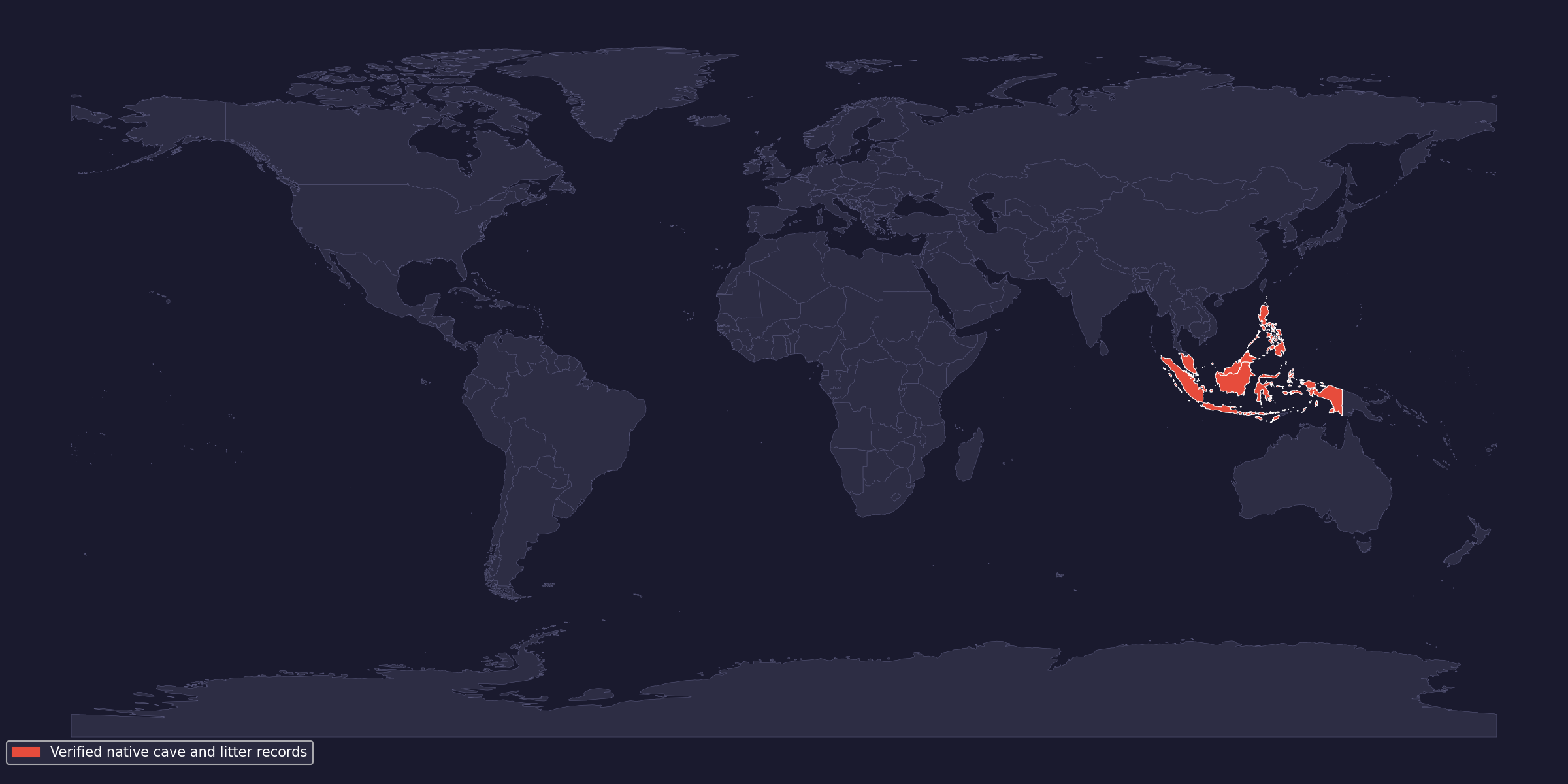
Verified native records cover Indonesia (including Sumatra and Borneo), Malaysia and the Philippines. The type came from Selangor, Peninsular Malaysia; modern material includes Sabah caves, and voucher work established the Philippines record. These are native cave and litter populations, not introduced P. surinamensis records from other tropical continents.
⚖️ Legal status
Checked on 2026-08-22: P. striatus was not found in CITES, EU wildlife-trade Annexes A-D, the EU Union list of invasive alien species or the Bern Convention appendices. National import, cave-collection, transport and live-insect rules may still apply.
Choose captive-bred stock, keep invoice and locality details, and do not buy cave-collected animals without lawful provenance. Never release roaches or living substrate; freeze waste before disposal where local rules permit.
🤌 Husbandry
Use at least 35 × 25 × 25 cm for a starter colony. Fit a clipped lid and fine metal mesh. The enclosure needs more ventilation than a sealed humid box, but less exposed surface than a dry feeder tub.
| Parameter | Practical target |
|---|---|
| Adult size | 1.4-2.4 cm depending on sex and wing form |
| Main temperature | 23-27 °C |
| Limited warm side | 27-29 °C |
| Night | 19-22 °C |
| Moisture | 70-85% RH, moist lower litter |
| Substrate | 10-15 cm loose decayed organic mix |
Quarantine new stock for 60 days and keep separate tools. Preserve cave or locality labels. Do not mix the colony with similar Pycnoscelus, because confident identification may require adult male characters.
💡 Lighting
UVB is unnecessary. Use a dim 10-12-hour cycle and deep shade. A cave-associated species does not need continuous darkness, but bright exposed feeding stations reduce activity and accelerate drying.
🌡 Heating and temperature
Maintain most of the enclosure at 23-27 °C, with only a small 27-29 °C side and a 20-23 °C retreat. Nights of 19-22 °C are acceptable for healthy stock. Heat the room or side through a thermostat; avoid hot bottom layers.
💧 Humidity and water
Keep the lower substrate consistently moist and the top leaves damp-to-nearly-dry, broadly 70-85% RH. The enclosure should smell like forest litter, not fermentation or ammonia. High humidity without cross-ventilation is a common cause of losses.
Offer a shallow textured water dish. Mist only enough to recharge the lower refuge; constant spraying of food and walls encourages fungi.
🌿 Enclosure and decoration
Provide 10-15 cm of pesticide-free soil/coir, decayed hardwood and crushed leaves. A small amount of well-rotted organic compost can enrich the mix only if it contains no fertilizer or pesticides. Do not use fresh manure or wild guano: both can carry pathogens, parasites, mites and excessive salts.
Top with whole hardwood leaves and light cork. Avoid perlite, cedar, pine shavings and heavy rocks that compact burrows.
🪳 Feeding
The natural association with guano indicates nutrient-rich detritus use, not a requirement for guano in captivity. Keep hardwood litter available, provide balanced dry roach food and rotate mushroom, carrot, squash, apple and greens. Offer small protein meals once or twice weekly to a growing colony.
Feed on a tile and remove moist remains within 48 hours. If dry food moulds, improve airflow and move it to the drier end rather than drying the whole substrate.
🥚 Breeding
Females form an ootheca, retract it and complete embryonic development internally before live nymphs are released. Published physiological work on P. striatus explicitly follows ootheca formation, embryogenesis and nymph birth. Both sexes occur; there is no basis for labelling this culture obligately parthenogenetic.
The species-level brood count and gestation range are not secure enough for structured hard limits. Maintain mature males and females, stable moisture and nutrient-rich detritus. Reproductive females depleted by starvation can form small oothecae that abort, so a colony should never be left with leaves alone for long periods.
🩺 Common problems
- Aborted reproduction: restore regular energy and protein foods and check that the lower substrate remains moist.
- Ammonia or sour odour: remove enriched wet patches and increase cross-ventilation; never add raw guano.
- Failed molts: provide a stable moist burrowing layer without compacting it.
- Misidentification: mature adult male characters and locality data matter; wing length alone varies.
- Allergy: cockroach debris and mouldy detritus can irritate airways; dampen waste and use protection if sensitive.
📌 Conclusion
The striped cave cockroach is for a keeper prepared to manage deep, nutrient-rich humidity without turning the enclosure anaerobic. Use decayed leaves and controlled protein instead of wild guano, and preserve the culture’s locality and adult identifications.
📚 Sources and further reading
- GBIF specialist-dataset record: Pycnoscelus striatus
- Wang et al. 2025: current spelling, diagnosis and measurements
- Lucañas and Lit: Philippine voucher record and cave ecology
- Nalina and Mohamed 1973: feeding, starvation and reproductive physiology
- ReptiFiles — checked; no species care guide was found
- CITES Appendices, valid from 5 March 2026
- EU wildlife-trade Annexes, Regulation (EU) 2026/1383
- EU Union list update, Regulation (EU) 2025/1422
- Bern Convention appendices