Share

Indian Burrowing Cockroach
🔤 Taxonomy
Pycnoscelus indicus (Fabricius, 1775) is the accepted name for the bisexual, sexually reproducing relative of P. surinamensis. The two were historically combined because adults look very similar. Modern revisionary work stresses reproductive mode: a mixed-sex line is P. indicus; an all-female obligately parthenogenetic line belongs to P. surinamensis. Appearance alone may not settle a poorly documented culture.
📌 Description
Adults are about 1.6-1.9 cm, dark brown with a pale band at the front and sides of the pronotum. Both sexes are winged, and males are slightly smaller. The roaches dig rapidly into loose soil and leaves. They are useful display detritivores but are also plausible greenhouse escapees, so a secure culture and a trustworthy sex history matter as much as temperature.
🌍 Distribution
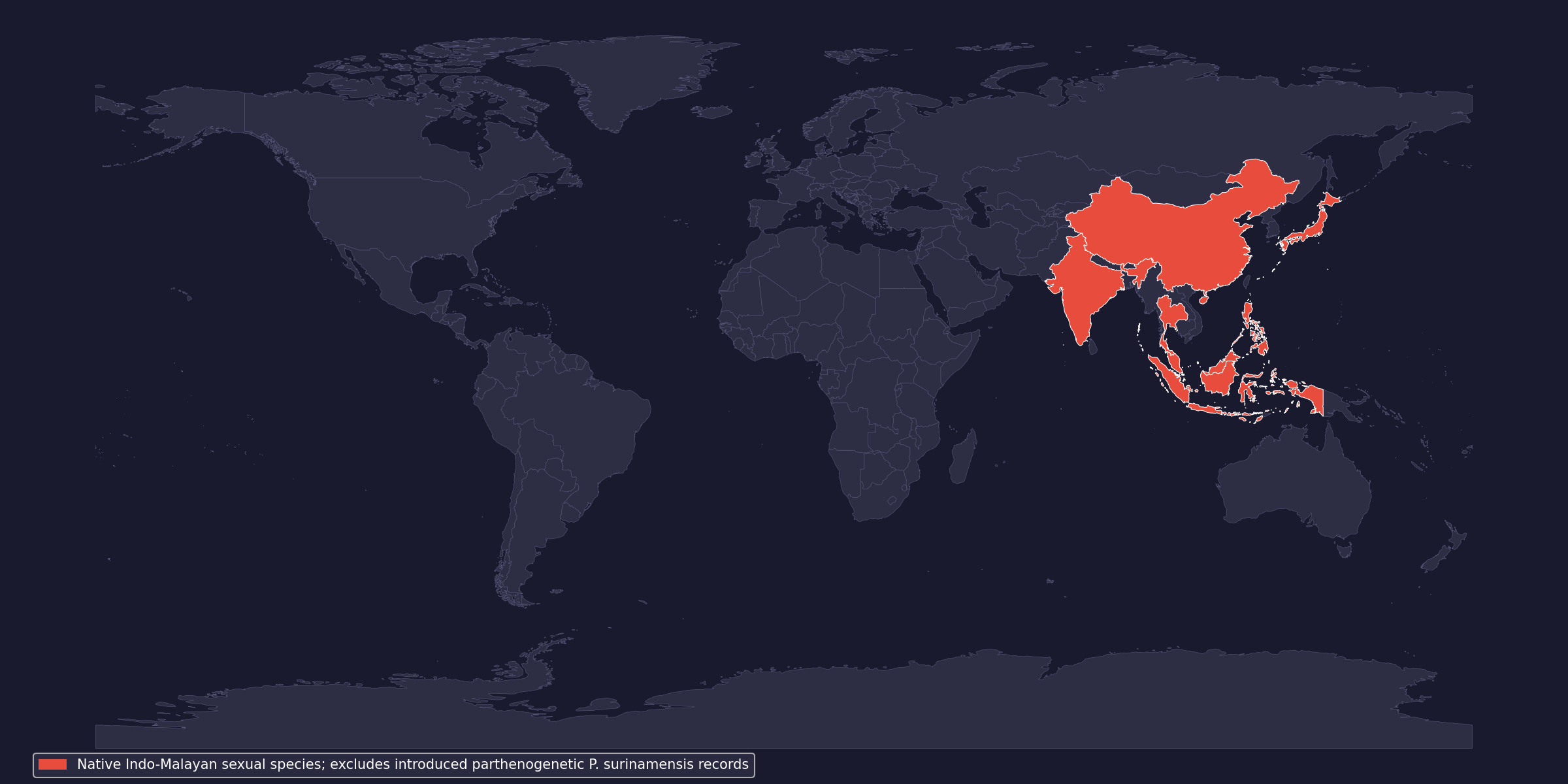
The sexual species is centred in the Indo-Malayan region. Voucher-backed modern material includes southern China and Okinawa, Japan, while classic studies and revisionary records support India, Thailand, Indonesia, Malaysia and the Philippines. Do not convert worldwide P. surinamensis reports into native P. indicus range: many older and introduced records were made before the reproductive forms were separated.
⚖️ Legal status
Checked on 2026-08-22: P. indicus was not found in CITES, EU wildlife-trade Annexes A-D, the EU Union list of invasive alien species or the Bern Convention appendices. Soil-associated live insects can nevertheless be restricted by national import, plant-health, transport or tenancy rules.
Retain invoice and line history. Never release animals or compost live substrate. Freeze surplus and used substrate in sealed bags before disposal where permitted.
🤌 Husbandry
Use at least 35 × 25 × 25 cm for 20-40 animals, with a clipped lid, fine metal mesh and a smooth barrier below the rim. Adults can climb and winged individuals may run or flutter when the substrate is disturbed.
| Parameter | Practical target |
|---|---|
| Adult size | 1.6-1.9 cm |
| Main temperature | 24-28 °C |
| Limited warm side | 28-30 °C |
| Night | 20-23 °C |
| Substrate | 10-15 cm loose litter soil |
| Reproduction | sexual; both males and females required |
Quarantine additions for 60 days. Keep this line separate from P. surinamensis and other Pycnoscelus. Record whether male and female offspring continue to appear; that observation is identification evidence, not just breeding trivia.
💡 Lighting
UVB is not required. Provide a dim 10-12-hour day and shaded leaf cover. Strong light makes adults remain buried and can dry the surface faster than the lower layer can buffer it.
🌡 Heating and temperature
Maintain 24-28 °C, a limited 28-30 °C side and a cooler 21-24 °C refuge. Use thermostat-controlled room or side heating. A bottom mat is poorly suited to a species whose normal response to exposure is to burrow deeper.
💧 Humidity and water
Keep the lower substrate lightly moist and the upper litter partly dry, broadly 55-75% RH. Males are reported to be more vulnerable to desiccation than females; a drying culture can lose its reproductive sex balance before the colony appears to fail.
Offer a shallow textured dish. Fresh vegetables add moisture, but fruit buried and forgotten in warm soil creates mites and fermentation.
🌿 Enclosure and decoration
Provide 10-15 cm of pesticide-free soil or coir mixed with crushed hardwood leaves and decayed wood. Top it with whole leaves and flat cork. The mix should hold a tunnel briefly without becoming compact mud.
Avoid fertilizer, perlite, cedar, pine shavings and large heavy slabs. Sift removed substrate over a catch box because nymphs disappear into a loose handful within seconds.
🪳 Feeding
Maintain a layer of safe hardwood leaves and offer a balanced dry cockroach food. Rotate carrot, squash, sweet potato, apple, pear, mushroom and greens. A small weekly protein portion supports reproduction; constant high protein is unnecessary.
Use a tile or dish, feed small portions every 2-4 days and remove wet leftovers within 48 hours. Renew leaves before they are completely reduced to veins.
🥚 Breeding
P. indicus reproduces sexually. Females internally incubate a retracted ootheca and later release mobile nymphs, so the structured metadata uses “viviparous.” Experimental studies established reproductive isolation from the obligately parthenogenetic P. surinamensis lines. Females of a sexual line are not expected to maintain the culture alone.
Exact brood and gestation values vary among study lines, and older literature often mixes the sibling species. This guide therefore avoids presenting P. surinamensis averages as hard P. indicus limits. Maintain several mature males, stable warmth and a moist lower refuge.
🩺 Common problems
- All-female offspring: question the line identity; it may be P. surinamensis.
- Loss of males: correct drying and retain several males before distributing surplus.
- Failed molts: preserve moist loose substrate, not a wet surface crust.
- Escapes: repair lid and mesh; do not rely solely on a barrier.
- Allergy and mites: dampen dusty frass, remove wet food and isolate any contaminated newcomer.
📌 Conclusion
The Indian burrowing cockroach is a worthwhile culture precisely when its bisexual identity is preserved. Buy from a keeper who can document males and mixed-sex offspring, then provide deep litter and containment suitable for a soil-dwelling insect with pest-like escape potential.
📚 Sources and further reading
- GBIF: Pycnoscelus indicus
- Wang et al. 2025: diagnosis, measurements and examined material
- Roth and Cohen 1968: chromosomes and Indo-Malayan range context
- Komatsu et al. 2014: sexual differentiation
- Roth 1974: reproductive comparison with P. surinamensis
- ReptiFiles — checked; no species care guide was found
- CITES Appendices, valid from 5 March 2026
- EU wildlife-trade Annexes, Regulation (EU) 2026/1383
- EU Union list update, Regulation (EU) 2025/1422
- Bern Convention appendices