Share

Wingless-female Burrowing Cockroach
🔤 Taxonomy
Pycnoscelus femapterus Roth, 1998 is the accepted spelling. The name combines the distinctive adult female condition with the genus: females lack both forewings and hind wings and continue to resemble large nymphs, while adult males are winged. This is not a spelling error for “femaptera,” and a wingless female should not automatically be labelled P. surinamensis.
📌 Description
Adults are small, commonly about 1.2-1.8 cm. Females are compact, dark and completely wingless; males are narrower with developed wings and may move quickly when exposed. Both sexes spend most of their time under the surface. The sexual dimorphism makes the colony interesting, but also makes it easy to mistake every female for an immature animal and conclude wrongly that no adult females are present.
🌍 Distribution
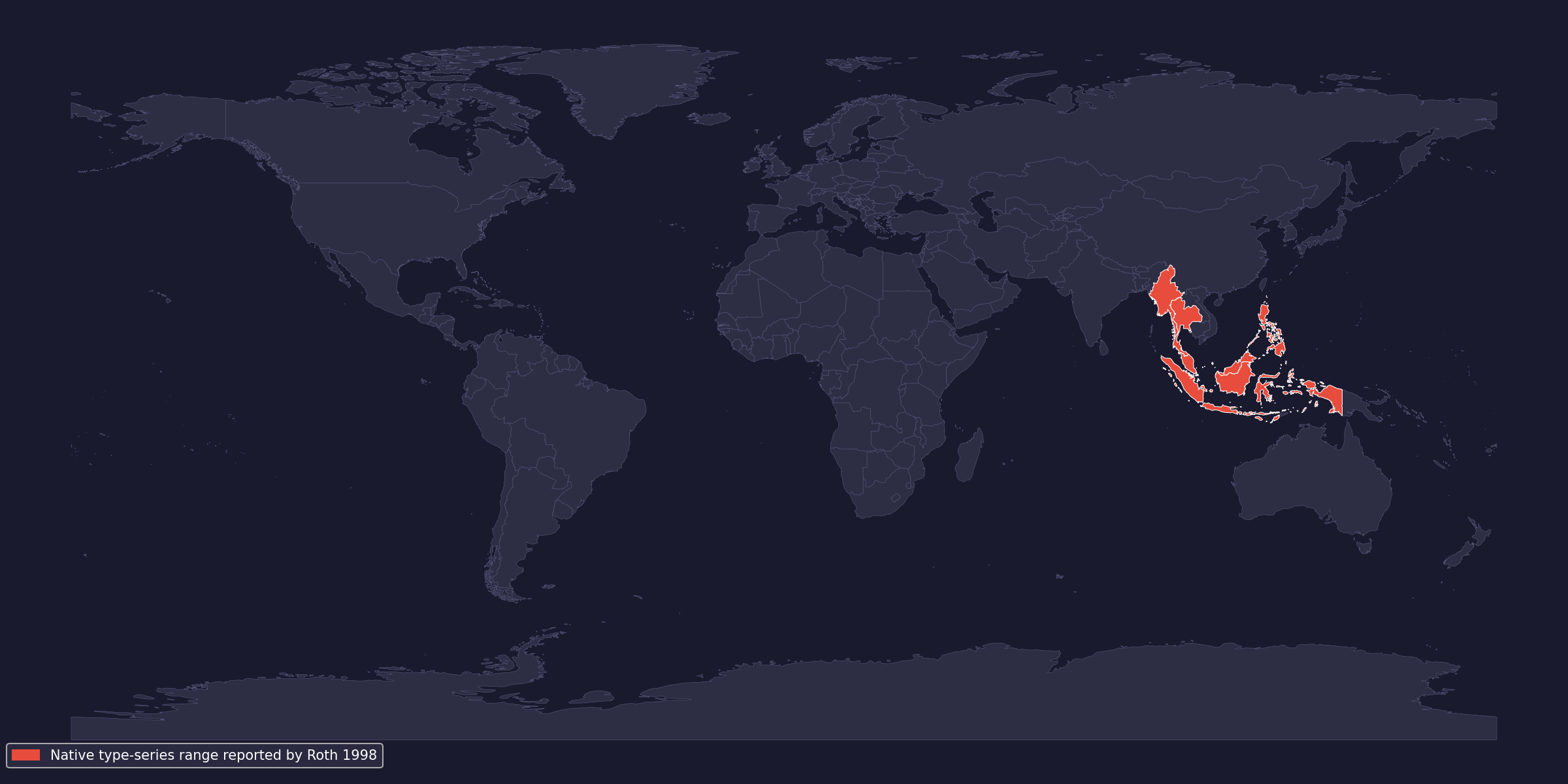
Roth described the species from material from Myanmar (then Burma), Java in Indonesia, Malaysia, the Philippines and Thailand. These are native collection records, not the worldwide introduced distribution of the parthenogenetic Surinam cockroach. The map highlights only those five documented countries.
⚖️ Legal status
Checked on 2026-08-22: P. femapterus was not found in CITES, EU wildlife-trade Annexes A-D, the EU Union list of invasive alien species or the Bern Convention appendices. Import and plant-health rules can still restrict live soil-associated insects.
Buy a named captive line, retain its locality and invoice, and never release animals or used substrate. Freeze surplus animals and substrate before disposal where local rules allow.
🤌 Husbandry
A starter group fits a 30 × 20 × 20 cm box with a clipped lid and fine mesh. Floor depth matters more than height. Work in a catch tub because winged males can run from disturbed substrate even though the colony normally stays buried.
| Parameter | Practical target |
|---|---|
| Adult size | about 1.2-1.8 cm |
| Main temperature | 24-28 °C |
| Limited warm side | 28-30 °C |
| Night | 20-23 °C |
| Substrate | 8-12 cm, moist below and drier above |
| Feeding | leaf litter plus food every 2-4 days |
Quarantine additions for about 60 days. Keep Pycnoscelus lines in separate boxes and use labelled tools; nymphs of related species can look much more alike than adults.
💡 Lighting
UVB is unnecessary. Use a dim 10-12-hour day-night cycle and keep most of the substrate shaded. Direct sunlight and strong lamps heat a shallow culture quickly and dry the exact layer used by nymphs.
🌡 Heating and temperature
Maintain 24-28 °C through most of the box, with a small side zone at 28-30 °C and a cool retreat at 21-24 °C. A thermostat-controlled side heater preserves the vertical moisture gradient; bottom heat can trap burrowing insects in increasingly hot, dry substrate.
💧 Humidity and water
Keep the lower third lightly moist and let the upper centimetre and feeding area dry between waterings. A working range of 55-75% RH is less important than this physical gradient. Condensation and a fermented smell mean too much water or too little air exchange.
Provide a shallow textured water source. Do not rely only on fruit, because a colony may consume dry leaves for days between fresh feeds.
🌿 Enclosure and decoration
Mix pesticide-free soil or coir with crushed hardwood leaves and well-decayed hardwood to a depth of 8-12 cm. Top with whole leaves and one flat cork piece. Avoid fertilizer, perlite, sharp sand, resinous wood and heavy decorations that can compress the burrowing layer.
When cleaning, replace only fouled sections. Sift carefully over a second box: adult females, nymphs and pieces of dark substrate are easy to confuse.
🪳 Feeding
Hardwood leaf litter is the permanent base diet. Add a dry roach food and rotate carrot, pumpkin, apple, pear, mushroom and leafy vegetables. Give a small protein portion weekly, not a constant heap of high-protein pet food.
Feed on a shallow tile and remove moist remains after 24-48 hours. Buried fruit is the common source of mites, flies and anaerobic pockets.
🥚 Breeding
This is a sexual, live-bearing species. Females retract the ootheca for internal development and release nymphs; captive accounts document already-mated wild females giving birth. Do not transfer the obligate parthenogenesis of P. surinamensis to this species. Both sexes must be retained for a continuing colony.
Published species-level brood and gestation ranges are insufficient for hard metadata. Stable warmth, old substrate and a reasonable adult sex ratio are more defensible targets than an invented count. A wingless adult female can be confirmed by size and mature terminal abdominal structure, not by waiting for wings that will never form.
🩺 Common problems
- No offspring: confirm that winged adult males are present; females alone are not a parthenogenetic culture.
- Failed molts: deepen the moist refuge while leaving the surface ventilated.
- Animals vanish during maintenance: sift removed substrate slowly; females closely resemble large nymphs.
- Mites or gnats: remove buried wet food and exchange only the fouled patch.
- Allergy: handle frass and shed skins as potential respiratory allergens.
📌 Conclusion
P. femapterus is best for a keeper who enjoys hidden burrowing behaviour and careful culture-line management. Its defining wingless females and sexual reproduction must be understood before purchase; otherwise adults are easily miscounted and the colony can be left without males.
📚 Sources and further reading
- GBIF: Pycnoscelus femapterus
- Roth 1998: original description, diagnosis and range
- Wang et al. 2025: current Pycnoscelus revision
- ReptiFiles — checked; no species care guide was found
- CITES Appendices, valid from 5 March 2026
- EU wildlife-trade Annexes, Regulation (EU) 2026/1383
- EU Union list update, Regulation (EU) 2025/1422
- Bern Convention appendices