Share

Pale-bordered Field Cockroach
🔤 Taxonomy
Pseudomops septentrionalis Hebard, 1917 is the accepted name. “Pale-bordered field cockroach” describes the cream border around the dark wings; “firefly cockroach” is a hobby name, not evidence of bioluminescence. It is an ectobiid field species and should not be confused with similarly patterned Pseudomops from Central and South America.
📌 Description
Adults are about 1.4-1.7 cm long. An orange pronotum edged in cream and a pale line around the dark forewings make the species conspicuous. Both sexes are fast, climb smooth surfaces and use low vegetation as well as leaf litter. Their four-month adult-scale life expectancy is short for a display cockroach, so a culture must keep producing oothecae rather than relying on a long-lived founder group.
🌍 Distribution
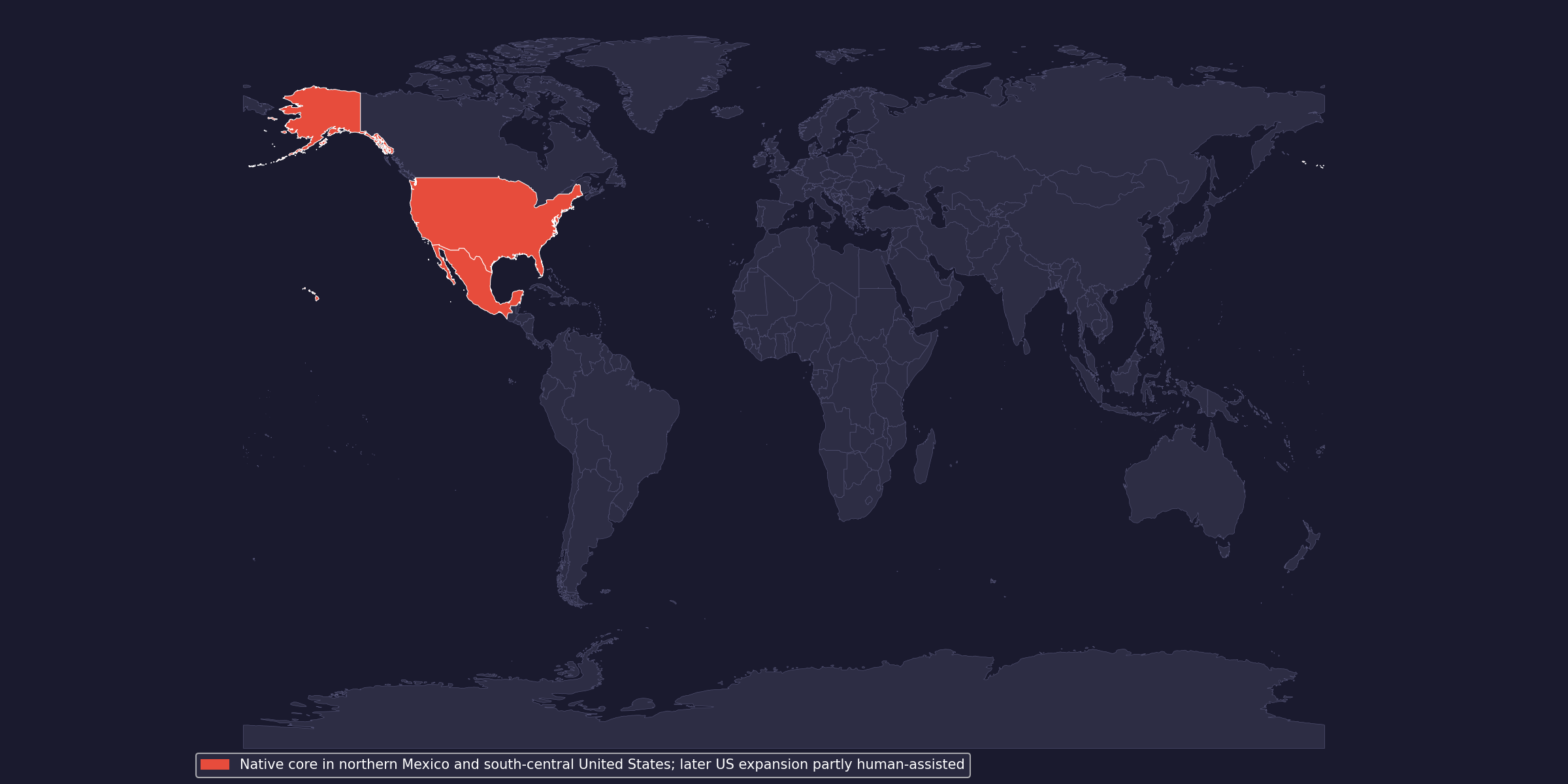
The historically documented native core covers northern Mexico and the U.S. states of Texas, Oklahoma and Louisiana. Records then appeared disjunctly in Mississippi, Alabama and farther across the southern United States; published authors considered human-assisted spread a plausible explanation. The country-scale map highlights the United States and Mexico, while this distinction between native core and later expansion remains essential.
⚖️ Legal status
Checked on 2026-08-22: the species was not found in CITES, EU wildlife-trade Annexes A-D, the EU Union list of invasive alien species or the Bern Convention appendices. Its absence from those lists is not permission to move live insects across borders; plant-health, import and local non-native-species rules may apply.
Retain proof of captive origin and never release surplus. Freeze animals, oothecae and used substrate before disposal where local rules permit. The species’ documented expansion makes escape prevention a biosecurity requirement, not merely a way to preserve the culture.
🤌 Husbandry
House 15-30 animals in at least 30 × 20 × 25 cm with a gasketed lid and fine metal mesh over every opening. Work over a catch tub. A broad smooth-wall barrier below the rim is useful backup, but it does not compensate for lid gaps.
| Parameter | Practical target |
|---|---|
| Adult size | 1.4-1.7 cm |
| Main temperature | 23-27 °C |
| Moisture | 65-85% RH with wet lower refuges |
| Substrate | 5-7 cm leaf-rich soil |
| Vertical structure | fine twigs, live plants, cork |
| Ootheca | about 18-24 young; roughly 40-55 days |
Quarantine newcomers for 60 days and keep separate tools. A sparse culture can disappear quickly because adult life is brief; retain several ootheca-bearing females and do not sell every new generation at once.
💡 Lighting
UVB is unnecessary. Give a shaded 10-12-hour day. Low-intensity planted lighting is acceptable if cork, litter and dense foliage remain available and the lamp does not dry the top of the enclosure.
🌡 Heating and temperature
Maintain 23-27 °C with a limited 27-29 °C side and a retreat around 21-24 °C. Warmth speeds the short generation cycle, but an all-hot box dehydrates this moisture-sensitive species. Heat one side through a thermostat rather than the whole floor.
💧 Humidity and water
This field cockroach desiccates readily. Keep the lower substrate and one sponge-like moss-free laying zone moist while allowing leaves at the opposite surface to approach dry. University laboratory work found that oothecae required a moist substrate; a dry incubator can lose a generation before adults show obvious stress.
Offer a very shallow textured dish or water gel made for invertebrates. Persistent wall condensation still means the enclosure needs more airflow.
🌿 Enclosure and decoration
Use 5-7 cm of pesticide-free soil/coir with rotten hardwood and leaves. Add thin cork, twig bundles and sturdy plants because adults occur on vegetation above the litter. Secure everything so maintenance does not crush animals or oothecae.
Cover cable holes and ventilation seams with mesh finer than the smallest nymph. Avoid resinous wood, fertilizer, perlite and open-top plant terrariums.
🪳 Feeding
Keep hardwood leaves available and feed a finely milled cockroach staple. Rotate carrot, squash, apple, berries and leafy greens; provide a modest protein food once weekly. Place food in two shallow dishes because a small species can be excluded by crowding.
Remove fruit within 24 hours. Drying fresh food under bright lamps is not a safe humidity strategy; correct the substrate instead.
🥚 Breeding
Females deposit oothecae on moist soil, beneath objects or against a moist porous surface. University of Tennessee guidance reports up to four oothecae per female, slightly more than 20 nymphs from an ootheca and hatching near 45 days under favourable laboratory conditions. The metadata uses a conservative 18-24 eggs and 40-55 days at 24-27 °C.
Leave oothecae in the stable colony or move the supporting object to an identically moist ventilated nursery. Do not peel a cemented case from bark. Dry incubation kills embryos; saturated stagnant incubation encourages fungi.
🩺 Common problems
- Ootheca failure: restore continuous local moisture and check that heat is not drying the laying surface.
- Sudden culture crash: short-lived adults may age out together; preserve overlapping generations.
- Escapes: replace warped lids and coarse mesh immediately.
- Mould and flies: remove fruit daily and ventilate the feeding surface while leaving the ootheca zone moist.
- Allergy: cockroach debris can sensitise airways; dampen dusty waste and use suitable protection if sensitive.
📌 Conclusion
The pale-bordered field cockroach rewards a keeper who can combine strong containment with an unusually dependable moist refuge. Build the ootheca zone and nymph-proof lid before purchase; a dry culture may look tidy while its next generation is already lost.
📚 Sources and further reading
- GBIF: Pseudomops septentrionalis
- Blattodea Species File
- University of Tennessee 2025 species and life-history note
- USDA Forest Service: expansion records and native-core context
- ReptiFiles — checked; no species care guide was found
- CITES Appendices, valid from 5 March 2026
- EU wildlife-trade Annexes, Regulation (EU) 2026/1383
- EU Union list update, Regulation (EU) 2025/1422
- Bern Convention appendices