Share

Six-Banded Woodlouse
🔤 Taxonomy
Porcellionides sexfasciatus (Budde-Lund, 1885) is the accepted species. It was originally named Metoponorthus sexfasciatus. Older sources divided it into several subspecies, but the 2024 Ibero-Balearic revision restored P. hispanus, P. lucasioides and P. lusitanus to species rank and treated P. glaber as distinct.
Trade identification from bands or colour alone is unreliable. Keep locality and voucher-quality adult photographs, and use male characters when a precise identification matters.
📌 Description
This is an elongated, fast Porcellionides, generally about 1.0-1.6 cm in culture. Fine dorsal granulation and transverse ridges on pereonites II-VII help diagnose true P. sexfasciatus. It cannot close into a complete ball.
It favours relatively dry stony or sandy ground compared with P. pruinosus, but still needs a permanent damp refuge for respiration, moulting and mancae.
| Care point | Practical target |
|---|---|
| Adult size | about 1.0-1.6 cm |
| Starter colony | 25 x 18 x 15 cm or larger |
| Temperature | 18-26°C |
| Substrate | 6-8 cm with leaves, rotten wood and mineral structure |
| Moisture | damp quarter; strongly ventilated remainder |
| Main failure | uniform wetness or an escaped, mislabelled culture |
🌍 Distribution
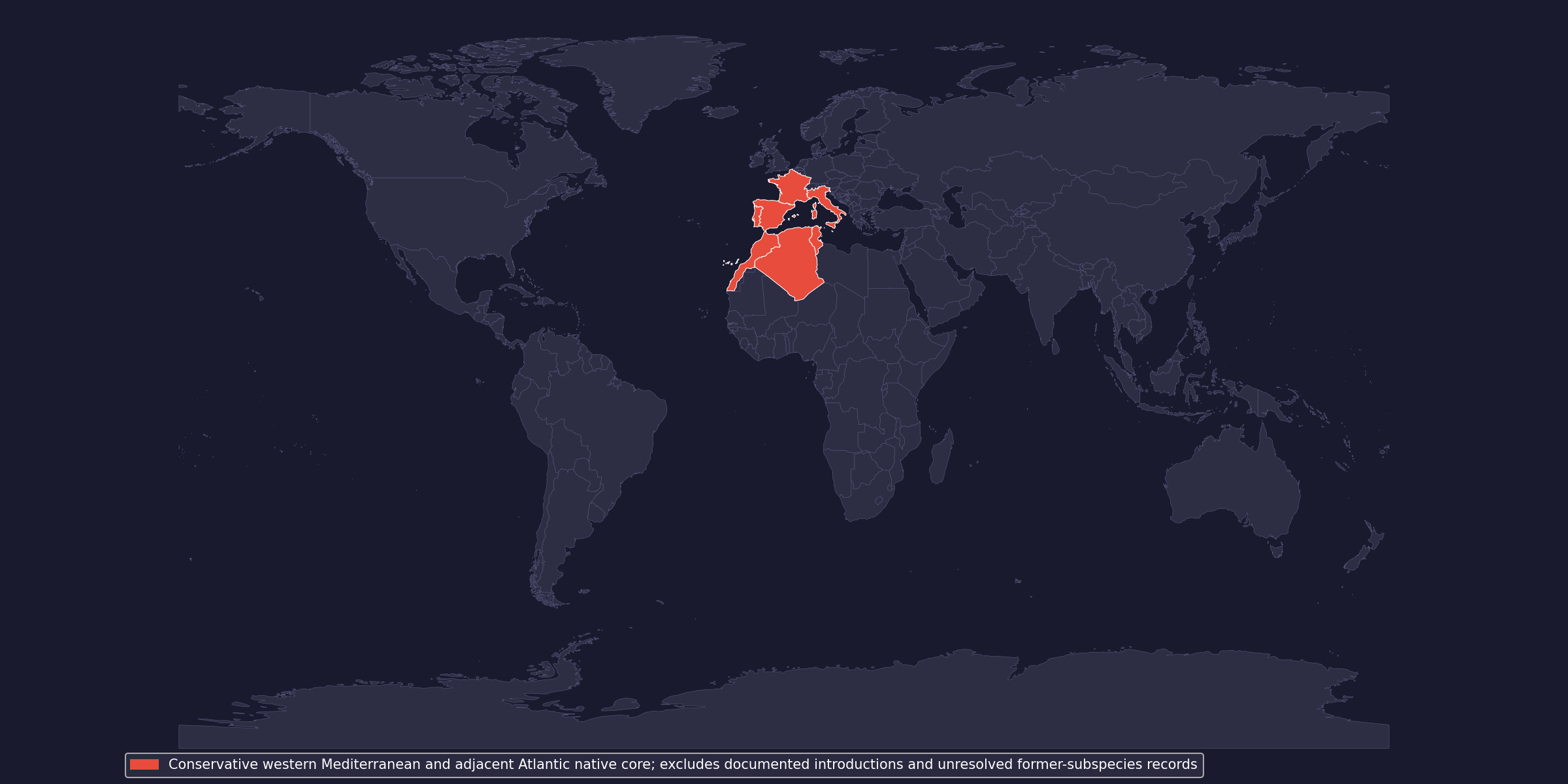
The native core is western Mediterranean and adjacent Atlantic: Portugal, Spain, coastal France, Italy and Malta, plus Morocco, Algeria and Tunisia. Human transport has established it elsewhere, including Atlantic islands and heated sites far outside that core. Introductions are not mapped as native range.
The 2024 revision verified extensive Portuguese, Spanish and Balearic records while also narrowing several former “subspecies” into separate species. Country shading remains coarser than the actual coastal and synanthropic distribution.
⚖️ Legal status
Checked on 2026-08-29: P. sexfasciatus is not listed in the CITES Appendices, EU wildlife-trade Annexes A-D under Regulation (EU) 2026/1383, or Bern Convention Appendices II-III. National collection, live-invertebrate import and invasive-organism rules may still apply.
Retain invoices, locality and line history. Secure all vents, freeze or heat-treat discarded substrate, and never release animals, especially outside the western Mediterranean core.
🤌 Husbandry
House 10-20 starter animals in a tight 25 x 18 x 15 cm tub. Use fine cross-ventilation, a secure lid and more vent area over the drier three-quarters. Low cork and stones should bridge the moisture boundary without trapping stagnant wet pockets.
Quarantine for 45-60 days with separate tools. Watch for P. pruinosus and other similar Porcellionides, and do not distribute an uncertain culture under a subspecies name discarded by current revisionary work.
💡 Lighting
UVB is unnecessary. Provide 10-14 hours of diffuse room light, shaded retreats and no direct sun. Bright plant lights are acceptable only if substrate temperatures stay within range.
🌡 Heating and temperature
Maintain 18-26°C, with a 16-21°C retreat and nights around 15-21°C. Avoid prolonged temperatures above 28°C. If heating is needed, warm one outer wall with a thermostat and preserve a cooler damp corner.
No planned winter rest is required. New arrivals, juveniles and weak cultures should not be deliberately cooled.
💧 Humidity and water
Keep about one-quarter damp through its depth and the rest mostly dry at the surface. Approximate 40-70% RH is workable because the animals choose the lower microclimate. Add water directly to the refuge rather than misting the whole box.
No water dish is needed. Widespread condensation, wall climbing and sour substrate suggest waterlogging; incomplete moults and loss of mancae suggest the refuge dried out.
🌿 Enclosure and decoration
Use 6-8 cm of pesticide-free soil, leaf mould, rotten hardwood and a little limestone grit. Cover most of the surface with dry hardwood leaves and provide low cork flats. Keep moss only in the damp corner and supply cuttlebone or limestone continuously.
Avoid fertilized compost, aromatic wood and sterile coir-only substrate. Fine mesh is essential because juveniles are small and adults are quick climbers.
🪳 Feeding
Decayed leaves and wood remain available continuously. Offer small firm vegetable pieces two or three times weekly and a very small protein portion about weekly. Use several feeding points once the colony grows.
Remove wet food within 24 hours. This dry-biased species is easily overwhelmed by spoiling food and mites in humid pockets.
🥚 Breeding
The repository uses “viviparous” for marsupial brooding. Females retain eggs and embryos in a ventral pouch and release mancae; there are no exposed eggs to incubate.
Breeding is usually steady when the damp refuge never fails. Place fine leaves and calcium near that refuge and avoid isolating brooding females. Divide cultures with substrate and several age classes.
🩺 Common problems
- Misidentification: compare adult morphology and preserve locality, not colour bands alone.
- Escapes: use very fine mesh, clean climbing films and secure the lid.
- Failed moults: restore deep refuge moisture and calcium.
- Mites or fungus: reduce fresh food and strengthen dry-side airflow.
- Line contamination: isolate fast, pruinosus-like animals until identified.
📌 Conclusion
The six-banded woodlouse suits a keeper who can maintain a mostly dry, escape-proof culture without losing its moist refuge. Current taxonomy makes careful identification more important than preserving obsolete subspecies labels.
📚 Sources and further reading
- GBIF: Porcellionides sexfasciatus
- Cifuentes & Da Silva 2024: Ibero-Balearic Porcellionides revision
- Gregory et al. 2021: identification, habitat and western Mediterranean range
- Taiti & Rossano 2015: Moroccan records and subspecies context
- ReptiFiles clean-up-crew overview
- CITES Appendices, valid from 5 March 2026
- Commission Regulation (EU) 2026/1383
- Bern Convention appendices