Share

Powder Isopod
🔤 Taxonomy
Porcellionides pruinosus (Brandt, 1833) is accepted by GBIF and the World List of Isopoda. Powder blue, powder orange, and powder isopod are common hobby names. Geographic and genetic studies indicate that animals historically assigned to this cosmopolitan-looking taxon include subtly different populations and close species, so a supplier label is not a substitute for a diagnostic identification.
Orange, Orange Dalmatian, Oreo, and Lemon-white are captive colour or pattern lines, not taxa. Keep them in this article and maintain separate labelled cultures when preserving their appearance matters.
📌 Description
Adults are slim, fast woodlice about 0.9-1.5 cm long. Wild-type animals have a grey bloom that resembles the powder on a grape; the pale coating can be rubbed away and should not be mistaken for mould. They do not roll into a ball and can move abruptly when disturbed.
This is one of the fastest establishing culture isopods and a useful cleanup-crew candidate where local law permits it. That same speed makes containment important and allows the colony to outcompete slower display species.
🌍 Distribution
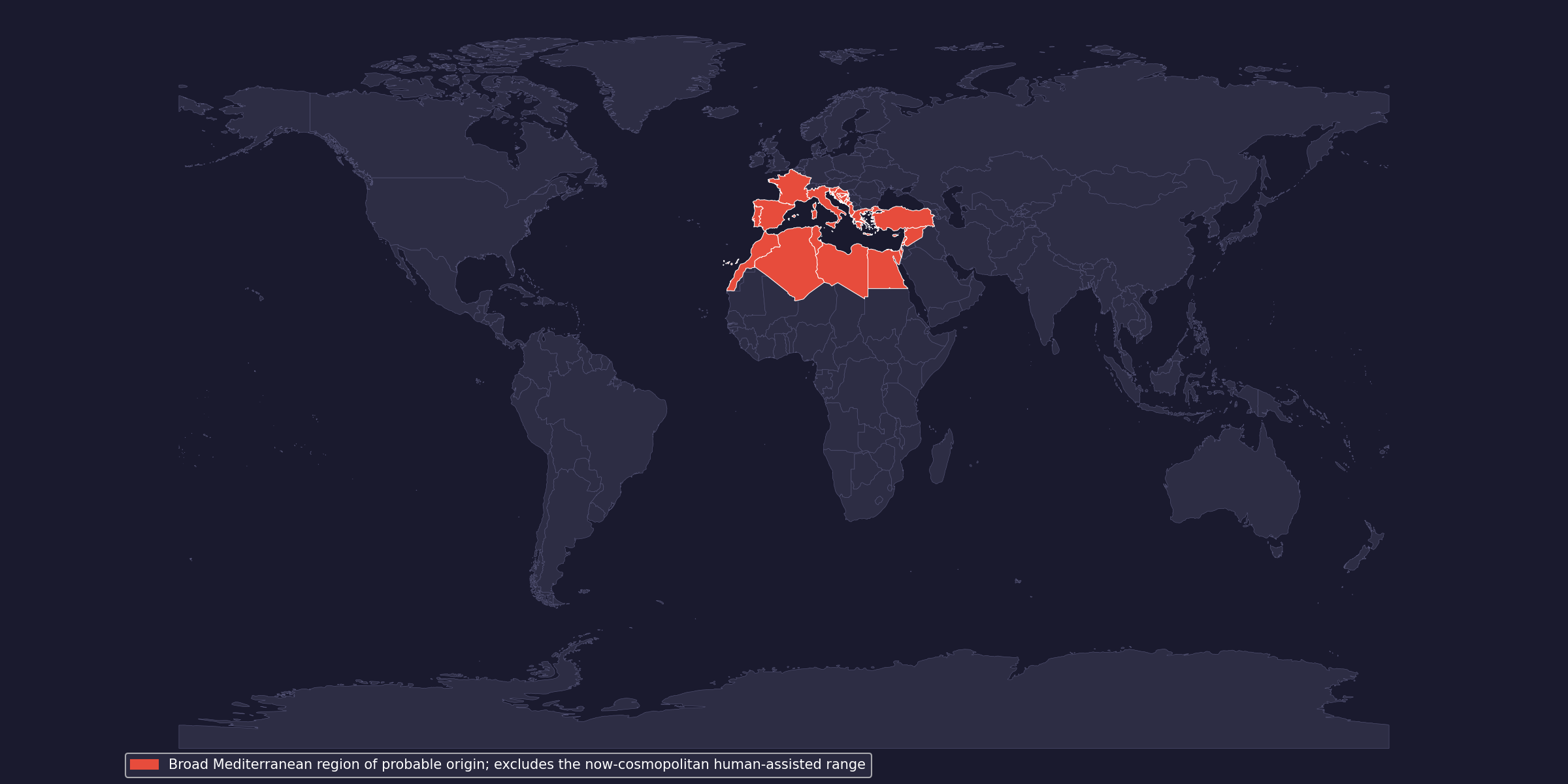
The species is generally considered native to the Mediterranean region and has been carried by people around the world, particularly in compost, manure, soil, nursery plants, and other disturbed habitats. Published work describes it as synanthropically cosmopolitan, while also warning that the traditional broad concept may hide a complex of species.
The map shows the broad probable region of origin, not the much larger introduced distribution and not a claim that every country contains one uniform lineage.
⚖️ Legal status
Checked on 2026-08-23: Porcellionides pruinosus is not CITES-listed and was not found in EU wildlife-trade Annexes A-D under Regulation (EU) 2026/1383 or Bern Convention Appendices II-III. This does not override national biosecurity, invasive-species, import, or live-feed rules.
Keep purchase records and confirm destination rules before shipping. Never release powder isopods or dispose of live substrate outdoors; their established history of human-assisted spread makes containment a practical legal and ecological concern.
🤌 Husbandry
A tightly closing 25 × 18 × 15 cm box suits a starter colony, but rapid growth soon requires more floor area or regular splitting. Use fine side ventilation and inspect lid rims, cable holes, and mesh. Service the colony inside a larger catch tub because adults sprint and mancae pass through surprisingly small gaps.
Quarantine each new morph for 30-60 days using separate tools. This helps reveal mites, fungus, mixed species, or loss of the stated pattern. Never add powder isopods to a rare isopod culture as a cleanup crew; they commonly become the dominant colony.
💡 Lighting
UVB is unnecessary. Provide 10-14 hours of ordinary diffuse light and cover under bark and leaves. Direct sunlight is dangerous, and strong plant lights should be positioned so they do not heat the lid.
🌡 Heating and temperature
Maintain 20-27 °C, with an 18-22 °C refuge and nights around 18-23 °C. Warmth speeds feeding and reproduction, but laboratory work shows that temperature increases change energy use and prolonged heat narrows the safe moisture margin.
Avoid maintaining the colony above 29-30 °C. When heating is required, warm only one outer side under thermostat control. A cooler refuge allows the animals to regulate rather than being forced into one temperature.
💧 Humidity and water
Maintain a connected damp zone over about one-third to one-half of the substrate and a ventilated, less-wet side. An approximate 60-80% air humidity suits most cultures, but substrate choices matter more than one hygrometer value. Add water to the damp end when its deeper layer begins to lighten.
Do not flood the box. Experimental work found this species acclimated to lower moisture, while mortality rose sharply above its optimal soil-moisture range. Clustering exclusively in moss and failed moults indicate excessive dryness; animals climbing walls, condensation, and sour litter indicate saturation.
🌿 Enclosure and decoration
Use 5-7 cm of leaf mould, pesticide-free topsoil, and crumbled rotten hardwood. Cover most of the surface with hardwood leaves and add cork slabs plus a moss pocket. Cuttlebone, limestone, or calcium carbonate should remain available.
The substrate must be edible and breathable. Avoid fertilizer, fresh manure, chemically treated leaves, resinous wood, and coir as the only ingredient. Powder isopods burrow into soil and can exploit deeper organic material, so replace exhausted portions before the colony crashes.
🪳 Feeding
Keep decayed leaves and white-rotted wood available continuously. Add small amounts of carrot, squash, sweet potato, mushroom, courgette, dried nettle, or similar plant food every one to three days according to colony size. Offer dried shrimp, gammarus, fish food, or a balanced invertebrate diet once or twice weekly in amounts consumed promptly.
Use several feeding points for dense colonies and remove wet remains within 24-48 hours. Permanent calcium supports moulting and reproduction. A rapidly growing colony can exhaust leaf litter invisibly beneath the surface, so replenish decomposed material rather than responding only with more protein.
🥚 Breeding
Females retain eggs and embryos inside a ventral, fluid-filled marsupium and release mancae. The site records this as “viviparous”; no external egg incubation applies. Young are extremely small and stay among fine leaf particles and pore spaces.
At warm stable temperatures, reproduction can be rapid. Keep the damp zone continuous, supply fine food and calcium, and split colonies before crowding causes crashes. Do not isolate gravid females. House Orange, Orange Dalmatian, Oreo, and Lemon-white separately when line consistency matters.
🩺 Common problems
- Culture crash after rapid growth: expand space and renew depleted leaf-and-wood substrate before numbers peak.
- Failed moults or missing mancae: deepen and reconnect the damp refuge and inspect ventilation holes.
- Mites and fungus: reduce surplus protein and wet vegetables; increase air exchange without drying the moist end.
- Escapees: seal the lid rim and service inside a catch bin; never rinse live material down a drain.
- Morph drift or mixed identity: maintain labelled lines separately and do not sell colour labels as formal taxonomy.
📌 Conclusion
Powder isopods are productive and adaptable, but they are not disposable cleanup organisms. Their best culture combines warm conditions, a real damp refuge, abundant decomposed leaves, and escape-proof handling; neglecting containment is the most consequential mistake.
📚 Sources and further reading
- GBIF: Porcellionides pruinosus
- World List of Isopoda: Porcellionides pruinosus
- Morphological and reproductive complexity in P. pruinosus populations
- Abiotic-factor study: temperature, soil moisture, and UV
- Study of moisture reduction, survival, and litter consumption
- Review of exotic Oniscidea documenting Mediterranean origin and spread
- ReptiFiles bioactive clean-up-crew overview mentioning powder blue
- CITES Appendices
- Current EU wildlife-trade Annexes: Regulation (EU) 2026/1383
- Bern Convention appendices