Share

Porcellionides myrmecophilus
🔤 Taxonomy
Porcellionides myrmecophilus (Stein, 1859) is the accepted combination. Older literature uses Porcellio myrmecophilus and Metoponorthus myrmecophilus. The world catalog also brings several older named forms into synonymy, so a historical subspecies or regional label should be checked against current taxonomy.
The name means ant-loving. This is a biological association, not a recommendation to add unidentified ants to a domestic culture.
📌 Description
This is a small, pale grey, finely textured woodlouse, about 5-8 mm long. It is uncommon in general surface collecting because it lives chiefly in and around ant nests, especially those of harvester ants in the genus Messor. Maltese observations found it feeding on decaying organic material and perhaps stored seed residues inside nests.
There is no established, replicated species-specific hobby protocol. The metadata and targets below are conservative starting points inferred from published nest ecology and general Porcellionides biology. They should be recorded and adjusted gradually by an expert keeper, not presented as settled experimental limits.
🌍 Distribution
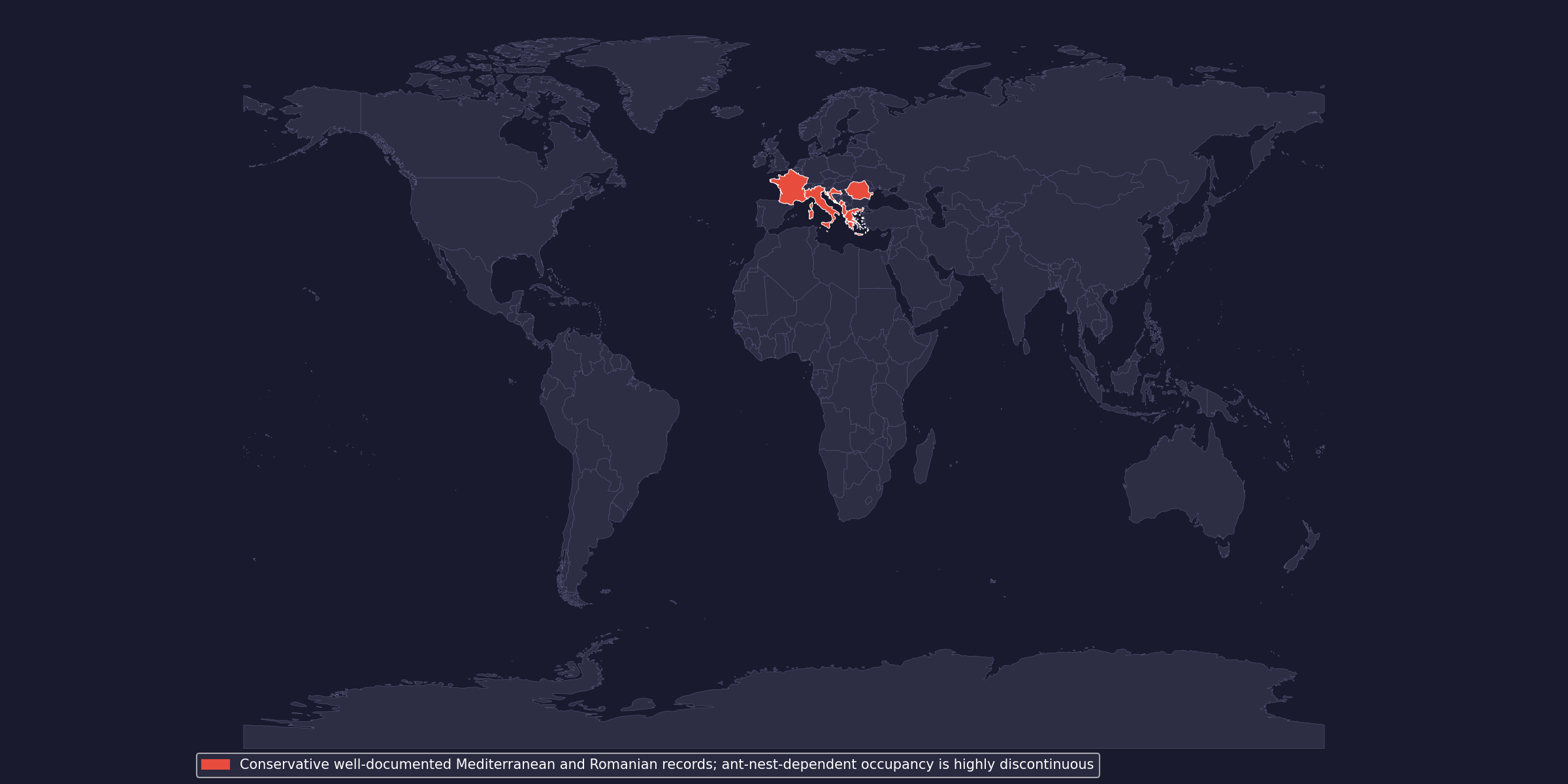
The world catalog summarizes the range as Mediterranean plus Romania. Documented records include France, Italy, Malta, the western Balkans, Albania, Greece and its islands, and Romania. The type material came from ant nests in Dalmatia near present-day Kotor and Zadar. Records extend elsewhere around the Mediterranean, but identification within this difficult genus deserves caution.
The map uses conservative well-documented countries and cannot show the species’ patchy dependence on suitable ant nests.
⚖️ Legal status
Checked on 2026-08-29: P. myrmecophilus was not found in CITES, EU wildlife-trade Annexes A-D under Regulation (EU) 2026/1383, or Bern Appendices II-III. National collection, protected-site, soil-movement, live-invertebrate, import, and biosecurity rules may still apply across its many range states.
Use only traceable captive stock. Keep the invoice, breeder and locality information, and import documents. Never excavate wild ant nests for the pet trade, move associated ants without species identification and permits, or release culture substrate.
🤌 Husbandry
This is an expert culture. Begin with a securely closing 20 × 15 × 12 cm container for a small verified group, using very fine ventilation and a second catch box during maintenance. A larger footprint is preferable once breeding is confirmed.
| Parameter | Conservative starting point |
|---|---|
| Adult length | about 0.5-0.8 cm |
| Temperature | 18-24 °C |
| Moisture | damp lower retreat with a less-wet ventilated surface |
| Substrate | 6-8 cm sandy mineral soil with fine leaf and seed detritus |
| Evidence quality | sparse; keep detailed records and change slowly |
Quarantine for at least 60 days with separate tools and no ants. Confirm that the stock is not P. pruinosus or another similar species. Photograph animals, molts, and brood events; retain voucher-quality dead specimens where lawful and useful for expert identification.
💡 Lighting
UVB is unnecessary. Provide a simple 10-12 hour room-light cycle and keep almost all usable retreats dark. Avoid direct sunlight and bright heat-producing lamps.
🌡 Heating and temperature
Start at 18-24 °C with a 16-20 °C retreat and similar night temperatures. This range is intentionally moderate because the species spans several Mediterranean climates and nest interiors buffer outdoor extremes.
Do not expose the colony to summer heat or forced winter cooling in an attempt to copy regional weather. If heat is required, warm one side wall under thermostat control and leave a cooler damp layer.
💧 Humidity and water
Create a damp, not saturated, lower zone beneath roughly one-third to one-half of the enclosure. Let the upper surface remain less wet with gentle ventilation. About 55-75% ambient RH is a starting reference, not a published optimum; nest-like moisture stability matters more than the display.
Add water by pipette into one deep corner and observe where animals settle. No water dish is needed. Failed molts, tight clustering, or disappearance from all but the wettest layer suggests dryness. Condensation, sour odour, and surface flight suggest waterlogging or inadequate airflow.
🌿 Enclosure and decoration
Use 6-8 cm of pesticide-free sandy loam or mineral topsoil mixed with fine deciduous leaf mould, crumbled rotten hardwood, and a small amount of crushed grass seed or similar plant detritus. Add thin cork or flat stone over several depths, plus one small moss pocket.
Calcium carbonate or fine limestone should remain available. Do not construct a live ant colony inside the isopod box: unknown host requirements, predation, stings, escapes, and legal movement of ants make that an unsafe experiment. Avoid fertilizer, insecticide-contaminated soil, coir alone, and wet sugary foods.
🪳 Feeding
Maintain fine leaf particles, decomposed hardwood, and microbial substrate continuously. Offer tiny portions of crushed grass or millet seed, dried nettle, mushroom, carrot, and balanced isopod food two or three times weekly. Supply a very small amount of fish food or dried invertebrate protein about weekly and keep fine calcium present.
Remove fresh remains within 24 hours. Because the species is small and poorly studied, start below the apparent appetite and increase only when food disappears without mites or mould.
🥚 Breeding
As in other terrestrial isopods, females brood embryos in a ventral marsupium and release mancae; metadata records this as viviparous. Species-specific brood size, season, and captive maturity data are not well established.
Do not isolate gravid females or introduce ants to stimulate breeding. Preserve stable deep moisture, fine food, calcium, and undisturbed pore spaces. Treat the first juveniles as evidence to maintain conditions, not a reason to enlarge or split the colony immediately.
🩺 Common problems
- No animals visible: inspect only one shelter at a time; a subterranean ant associate may remain hidden without being lost.
- Failed molts or juvenile loss: reconnect the damp lower layer and check fine ventilation holes.
- Mites or mould: sharply reduce supplemental food while retaining leaf substrate and airflow.
- Deaths after adding ants: separate the organisms safely; ant cohabitation is not part of this care protocol.
- Uncertain identification: isolate the culture and obtain specialist review rather than selling it under a confident name.
📌 Conclusion
Porcellionides myrmecophilus is appropriate only as a documented specialist culture. The useful goal is a stable, ant-free, nest-like moisture structure with careful records; improvising a mixed ant enclosure creates more risks than husbandry value.
📚 Sources and further reading
- GBIF: Porcellionides myrmecophilus
- World List of Isopoda: Porcellionides myrmecophilus
- Schmalfuss world catalog: synonyms and Mediterranean distribution
- Cassar et al. (2023): Maltese distribution, Messor associations, and nest ecology
- ReptiFiles site search completed; no species-specific guide found
- CITES Appendices
- EU wildlife-trade Annexes: Regulation (EU) 2026/1383
- Bern Convention appendices