Share

Flowery Blue Isopod
🔤 Taxonomy
Porcellionides floria Garthwaite & Sassaman, 1985 is currently accepted by GBIF and the World List of Isopoda. It was separated from the P. pruinosus complex using morphology and reproductive evidence, although the world catalog noted that synonymy remained possible. Flowery blue is a hobby name.
This species is exceptionally similar to powder isopods. Antennal banding, colour, or a seller label may not identify every specimen; maintain a source-labelled culture and do not represent an uncertain powder-type isopod as confirmed P. floria.
📌 Description
Adults are fast, slim woodlice about 0.9-1.2 cm long. They do not conglobate and may show a grey-blue bloom with variable pale patterning. Care and colony behaviour broadly resemble P. pruinosus: warm conditions, edible litter, a substantial moist zone, strong population growth, and careful containment.
Its speed and fecundity make it manageable for a first dedicated isopod colony, but not automatically suitable in every bioactive vivarium. Dense colonies can compete with other detritivores and vulnerable enclosure inhabitants may eat them or be disturbed by hungry isopods.
🌍 Distribution
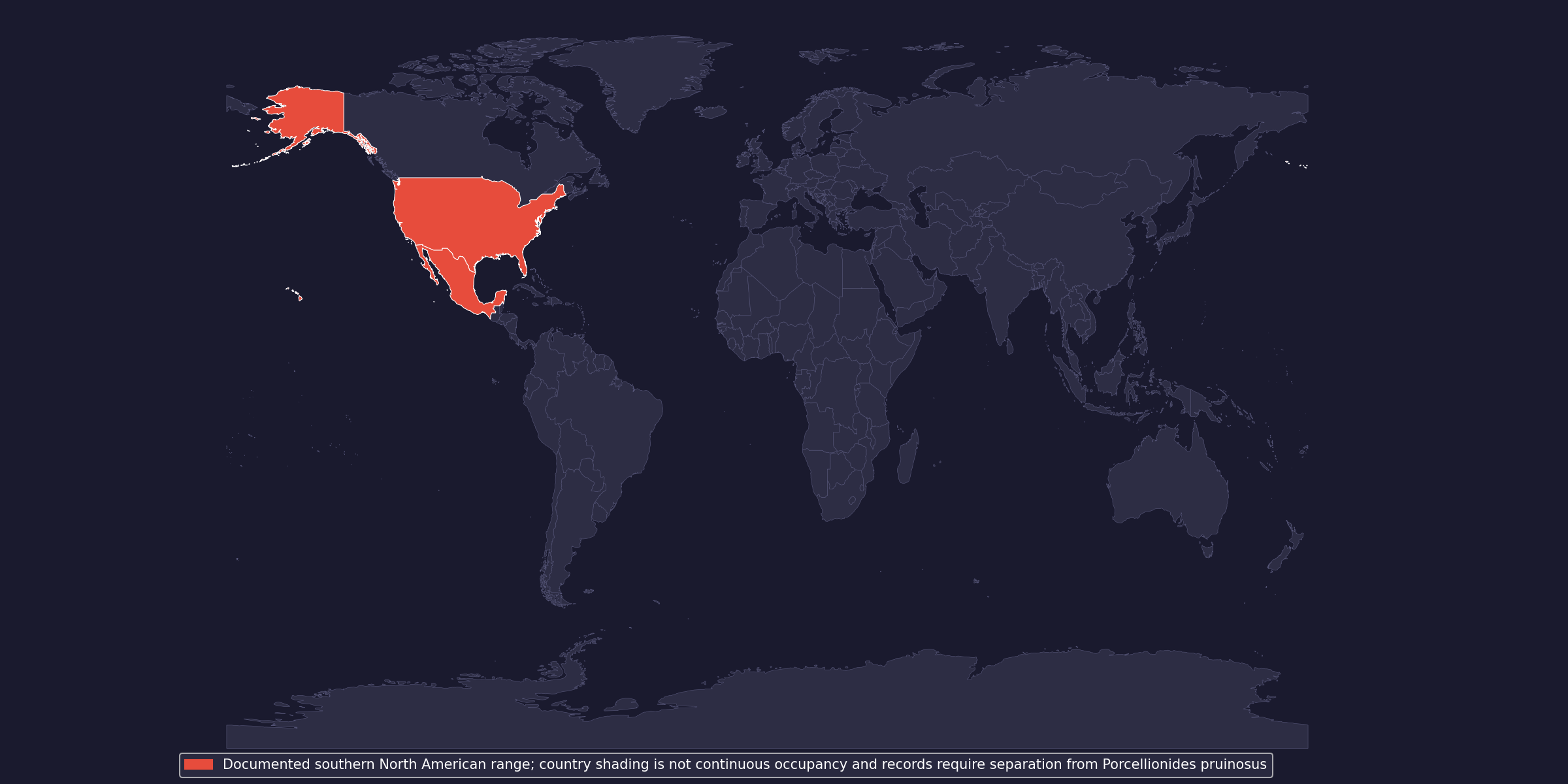
The original North American work and the world catalog place P. floria in the southern United States and Mexico. Verified records extend across parts of the southeastern and southern United States, southern California, and Mexico; records far outside that area require care because of confusion with P. pruinosus.
The country map is intentionally broad and does not imply uniform occupancy.
⚖️ Legal status
Checked on 2026-08-29: P. floria was not found in CITES, EU wildlife-trade Annexes A-D under Regulation (EU) 2026/1383, or Bern Appendices II-III. National plant-pest, soil, live-feed, import, and interstate movement rules can still restrict a culture.
Keep purchase and origin records, verify rules before shipping, and use an escape-proof container. Freeze unwanted substrate securely before disposal where local guidance permits; never release live animals or rinse them into drains.
🤌 Husbandry
A tightly closing 25 × 18 × 15 cm box suits a starter group. Add fine side ventilation and inspect lid rims and mesh because mancae are minute and adults move abruptly. Service the box inside a larger catch tub.
| Parameter | Practical target |
|---|---|
| Adult length | 0.9-1.2 cm |
| Temperature | 20-27 °C |
| Moisture | one-third to one-half damp, with a ventilated drier side |
| Substrate | 5-7 cm edible leaf-and-wood mix |
| Breeding | fast when warm and well fed |
Quarantine new stock for 30-60 days with separate tools. Look for mites, fungus, mixed powder isopods, and morph or label drift. Do not combine it with P. pruinosus.
💡 Lighting
UVB is unnecessary. Supply 10-14 hours of diffuse light and deep cover beneath bark and leaves. Keep the culture away from direct sun and hot plant lights.
🌡 Heating and temperature
Maintain 20-27 °C with an 18-22 °C refuge and nights around 18-23 °C. Warmth accelerates feeding and breeding, so it also increases the need for food, ventilation, and population checks.
Avoid sustained temperatures above 29 °C. If heating is required, warm only one outer side with a thermostat and preserve a cooler moist retreat.
💧 Humidity and water
Keep one-third to one-half of the substrate damp and connected from surface moss into the lower layer. Let the other side become less wet and well aerated. Approximately 60-80% ambient RH is useful only when the box still offers that gradient.
Add water to the damp end as it lightens; do not flood the enclosure. A dish is unnecessary. Failed molts and tight clustering indicate dryness, while condensation, wall climbing, or sour litter indicate saturation.
🌿 Enclosure and decoration
Use 5-7 cm of pesticide-free topsoil, leaf mould, and crumbled white-rotted hardwood. Cover most of the surface with safe deciduous leaves and add cork flats, a moss pocket, and permanent cuttlebone or limestone.
The colony consumes substrate from below. Renew exhausted leaf-and-wood material before numbers crash. Avoid fertilizer, treated leaves, fresh manure, resinous wood, and coir as the only substrate.
🪳 Feeding
Maintain decomposed leaves and soft hardwood continuously. Offer carrot, squash, sweet potato, mushroom, courgette, or dried nettle every one to three days according to colony size. Add dried shrimp, gammarus, fish food, or balanced invertebrate feed once or twice weekly.
Feed at several points and remove wet leftovers within 24-48 hours. A booming colony can consume leaf litter invisibly; more protein is not a substitute for replenishing decomposed fibre and calcium.
🥚 Breeding
Females brood embryos in a fluid-filled marsupium and release mancae, recorded as viviparous in metadata. Reproduction can be rapid under warm stable conditions. Tiny young remain in fine litter and substrate pores.
Keep the damp zone continuous, supply fine foods, and split the culture before crowding exhausts the substrate. Do not isolate gravid females. Preserve a backup culture because identification and containment problems are easier to resolve with separated labelled stock.
🩺 Common problems
- Crash after rapid growth: expand floor area and replace depleted leaf-rich substrate.
- Missing mancae: inspect ventilation openings and reconnect the damp lower layer.
- Mites and fungus: reduce surplus protein and wet produce while maintaining airflow.
- Escapees: seal rims and service the colony inside a catch container.
- Confusion with powder isopods: do not merge cultures; seek diagnostic or molecular confirmation when identity matters.
📌 Conclusion
Flowery blues are productive display detritivores for a keeper willing to contain and label them properly. Their main management issue is not delicacy but speed: food, substrate, space, and escape control must keep pace with the colony.
📚 Sources and further reading
- GBIF: Porcellionides floria
- World List of Isopoda: Porcellionides floria
- Garthwaite and Sassaman (1985): original description and separation from the P. pruinosus complex
- Canadian review discussing identification limits and North American range
- Schmalfuss world catalog: range and taxonomic caution
- ReptiFiles clean-up-crew overview; no species-specific guide found
- CITES Appendices
- EU wildlife-trade Annexes: Regulation (EU) 2026/1383
- Bern Convention appendices