Share

Greek Shield Isopod
🔤 Taxonomy
Porcellio werneri Strouhal, 1929 is accepted by GBIF and the World List of Isopoda. Older work sometimes treated it near or beneath P. flavomarginatus, but the current catalogs retain it as a species. Greek shield, pancake, and space pod are hobby names; Silver Back or Creamy labels describe captive lines, not subspecies.
📌 Description
Adults are roughly 1.5-2.2 cm long but appear larger because the body is exceptionally broad and flat. The expanded side plates form a shield-like outline, and the animal presses into very narrow gaps instead of rolling into a ball.
It is a slow, attractive display species with little tolerance for uniformly wet, stagnant substrate. At the same time, “dry species” must not be interpreted as “no damp refuge”: successful care preserves both ventilation and a hydrated molting zone.
🌍 Distribution
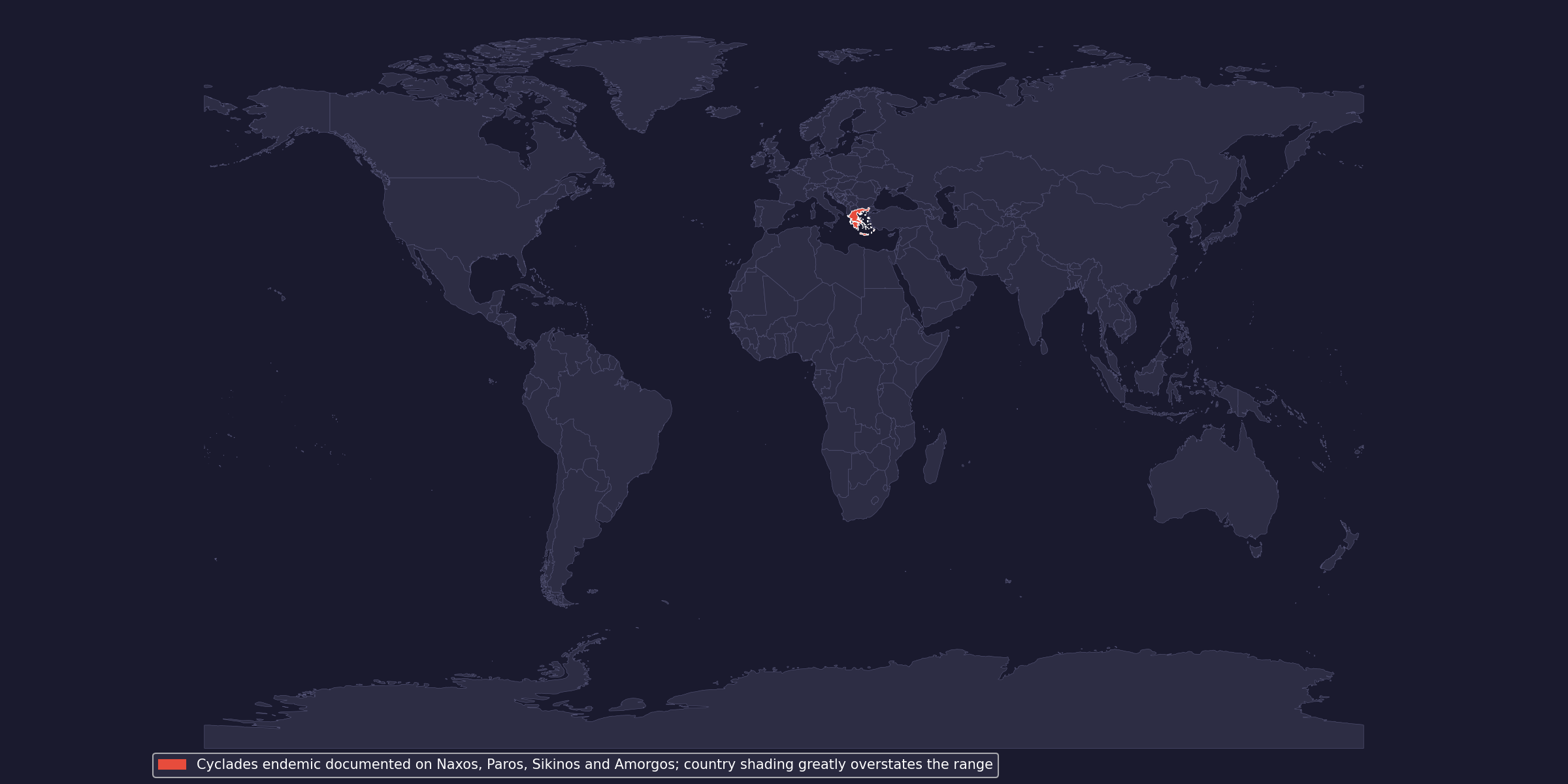
The species is endemic to the Greek Cyclades. The world catalog names Naxos, Paros, and Amorgos; the modern Greek checklist also includes Sikinos. Recorded habitats are rocky ground, maquis, and phrygana. The map shades all Greece because the generator works by country, not because the species occurs nationwide.
⚖️ Legal status
Local and national rules may still apply.
Checked on 2026-08-29: no listing was found for P. werneri in CITES, EU wildlife-trade Annexes A-D under Regulation (EU) 2026/1383, or Bern Appendices II-III. Greek protected-area, island collection, export, and transport rules still apply independently.
Buy established captive-bred animals and retain the invoice, breeder information, culture label, and import papers. Do not collect wild island endemics, combine named lines without records, or release animals and substrate.
🤌 Husbandry
For 10-15 animals use a 30 × 25 × 15 cm box or larger. Supply fine cross-ventilation and several wide, almost flat cork retreats. Keep about one-quarter to one-third of the substrate damp and the remaining surface much drier.
| Parameter | Practical target |
|---|---|
| Adult length | 1.5-2.2 cm; unusually broad body |
| Temperature | 17-26 °C |
| Moisture | one-quarter to one-third damp, remainder airy |
| Substrate | 5-7 cm mineral, leaf-rich mix |
| Social housing | roomy colony; several separated hides |
Quarantine for 60 days. Use separate forceps, record losses and molts, and check for mites or mixed stock. Do not house it with faster isopods or use it as a cleanup crew with predators.
💡 Lighting
UVB is unnecessary. Provide 10-14 hours of diffuse light and dense shaded cracks. Avoid direct sun and strong lamps near a low plastic lid.
🌡 Heating and temperature
Maintain 17-26 °C, preferably 20-24 °C for routine culture, with a cooler 16-21 °C retreat and nights of 16-22 °C. Breeding can slow during a naturally cooler room season without deliberate chilling.
Prolonged heat above 27-28 °C narrows the moisture margin. If heat is essential, warm only one side wall with a thermostat and leave the moist refuge cool.
💧 Humidity and water
Keep one-quarter to one-third damp under moss and cork. Let the open surface remain much drier, with approximately 50-65% ambient RH as a secondary reference. The damp lower layer must stay connected so broad adults and mancae can molt safely.
Pour water into the damp end and inspect it by touch. Do not use an open dish. Crowding only in moss and incomplete molts mean too little usable moisture; condensation, spoiled litter, wall climbing, or losses after watering indicate excess moisture or weak airflow.
🌿 Enclosure and decoration
Use 5-7 cm of pesticide-free topsoil, leaf mould, decomposed hardwood, and a mineral component such as limestone grit. Add thick leaf litter, several flat cork slabs, stable porous limestone, and a moss pocket at one end.
Keep cuttlebone or plain calcium carbonate available. Do not balance stone on loose substrate, and avoid coir-only beds, wet compost, fertilizer, resinous wood, and a permanently soaked bottom layer.
🪳 Feeding
Deciduous leaves and soft rotten hardwood form the permanent diet. Offer squash, sweet potato, carrot, mushroom, courgette, or dried greens two or three times a week in small amounts. Provide dried shrimp, gammarus, fish food, or insect-based feed once or twice weekly.
Use several small feeding sites. Remove wet remnants within 24-48 hours and renew leaf litter before it is reduced to veins. Calcium should never run out.
🥚 Breeding
Females carry embryos in a ventral marsupium and release mancae; the metadata records this as viviparous. Breeding is moderate to slow, and the young are vulnerable to both dry mesh and waterlogged substrate.
Space, quiet flat hides, steady moisture access, calcium, and modest protein are more useful than warming the whole colony. Do not isolate gravid females. Split only after captive-born young have matured, and retain line labels.
🩺 Common problems
- Deaths in a “desert” box: restore a deep damp refuge; the species is dry-leaning, not drought-proof.
- Losses after misting: stop wetting the entire surface and improve cross-ventilation.
- Damaged margins or appendages: add broad hides and reduce crowding.
- No mancae: minimize disturbance, confirm mature sexes, and check that fine food and moisture reach the young.
- Mixed culture labels: isolate lines and document origin before exchanging animals.
📌 Conclusion
The Greek shield isopod rewards a patient intermediate keeper with an unusual body shape and quiet surface activity. Its enclosure must offer wide cracks and a real moisture gradient; making every part either wet or bone-dry is the recurring failure.
📚 Sources and further reading
- GBIF: Porcellio werneri
- World List of Isopoda: Porcellio werneri
- Schmalfuss world catalog: taxonomic note and island distribution
- Sfenthourakis et al.: terrestrial isopods of Greece
- Specialist captive profile used conservatively for size and care comparison
- ReptiFiles site search completed; no species-specific guide found
- CITES Appendices
- EU wildlife-trade Annexes: Regulation (EU) 2026/1383
- Bern Convention appendices