Share

Porcellio succinctus
🔤 Taxonomy
Porcellio succinctus Budde-Lund, 1885 is the accepted name. Old Catalan records under this name were later assigned to P. violaceus, so an old label outside Murcia is not evidence of this species. It belongs to the informal Iberian “monticola” assemblage and can be confused with P. expansus, P. bolivari, and other large contrasting Porcellio.
📌 Description
This is a large, high-contrast Spanish woodlouse. The 2017 redescription measured males to 25 mm without the uropods and 35 mm with them; females reached 21 mm body length and 25 mm with uropods. Dark tergites carry four prominent pale marks, and the body edge is pale.
Its documented wild range is extremely small and its captive breeding is slow. It is therefore an advanced conservation-sensitive display culture, not a disposable cleanup crew. Exact species-level lifespan and reproductive-temperature trials have not been published; the ranges here are deliberately conservative.
🌍 Distribution
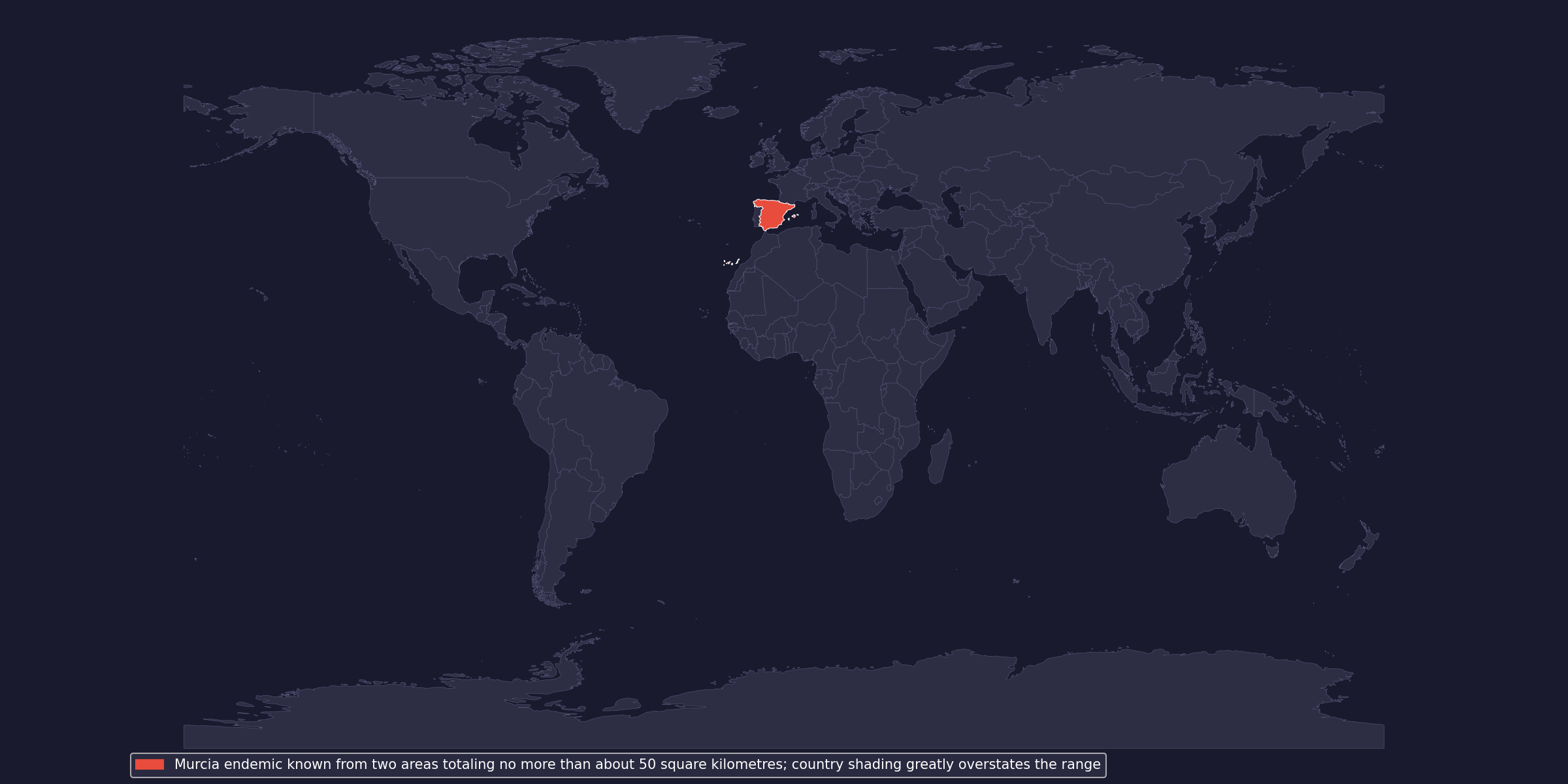
The species is known only from two small areas totaling no more than about 50 km² in Murcia, southeastern Spain: around Cartagena and farther north around Cresta del Gallo. The redescription reports semi-arid thermomediterranean slopes, about 300 mm annual rain, strong summer drought, fractured dolomitic rock, open pine, and scrub.
The country map greatly overstates this narrow endemic range.
⚖️ Legal status
Local and national rules may still apply.
Checked on 2026-08-29: P. succinctus was not found in CITES, EU wildlife-trade Annexes A-D under Regulation (EU) 2026/1383, or Bern Appendices II-III. Absence from those trade lists is not permission to collect it.
A 2025 peer-reviewed trade assessment reports that all known populations occur in protected areas and notes Spanish laws restricting collection and sale of wild organisms without a justified legal basis. Accept only traceable captive-bred stock. Keep the invoice, breeder lineage, transfer history, photographs, and import papers; never buy animals represented as newly field-collected.
🤌 Husbandry
Use at least 40 × 30 × 20 cm for 10-15 animals. Large males need floor space and separated flat shelters. Place fine cross-ventilation mainly over the dry three-quarters, but retain a lower, connected moisture route beneath the damp quarter.
| Parameter | Practical target |
|---|---|
| Adult size | 2.1-2.5 cm body; large males to 3.5 cm with uropods |
| Temperature | 17-25 °C |
| Moisture | one-quarter damp; strong gradient to a dry surface |
| Substrate | 7-10 cm leaf-rich soil with limestone |
| Breeding | slow; avoid repeated disturbance |
Quarantine 60-90 days with separate tools. Photograph the pattern and male uropods where possible, record every death and manca, and never merge colonies merely because both were sold under the same name.
💡 Lighting
UVB is not needed. Give 10-14 hours of diffuse light and deep shade beneath rock-like slabs and bark. Direct sun is dangerous. A clear box with little substrate can heat far above room temperature in minutes.
🌡 Heating and temperature
Maintain 17-25 °C, with a 15-20 °C retreat and similar night temperatures. The wild annual mean reported from the known area is 17.7 °C with occasional light winter frost, but captive animals must not be exposed to frost.
Avoid prolonged heat above 27 °C and sudden swings. Heat one outer side only when necessary, always with a thermostat, and never place heat beneath the moist refuge. Do not force seasonal cooling on juveniles, thin animals, or new arrivals.
💧 Humidity and water
Keep roughly one-quarter of the substrate damp beneath moss and a shelter. Let the rest of the surface dry well with 40-60% ambient RH as a rough guide, while deeper material remains barely moist. Pour small amounts into the refuge rather than misting every surface.
Do not use an open water dish. Large adults gathered in the damp corner need a larger or wetter refuge; failed molts indicate the same problem. Persistent condensation, wall climbing, a sour smell, or deaths shortly after watering indicate excess moisture and inadequate ventilation.
🌿 Enclosure and decoration
Provide 7-10 cm of pesticide-free mineral topsoil mixed with leaf mould, decomposed hardwood, and limestone grit. Heap dry deciduous leaves over most of the surface. Use broad flat cork and stable limestone slabs that create narrow retreats; set heavy stones on the container floor before adding substrate.
Keep plain calcium available continuously. Avoid coir-only beds, damp compost, fresh pine, fertilizer, and fine sand as the entire substrate. The enclosure should suggest fractured semi-arid ground through safe microclimates, not reproduce outdoor drought.
🪳 Feeding
Decayed hardwood leaves and white-rotted wood remain available at all times. Offer small pieces of squash, sweet potato, carrot, mushroom, or dried herbs once or twice weekly. Give dried shrimp, gammarus, or quality fish food about weekly, divided among several locations.
Remove fresh remains within 24-48 hours. Too much protein encourages mites and aggression; too little edible litter quietly starves a colony even when vegetables are present.
🥚 Breeding
Females brood embryos in a marsupium and release mancae, represented as viviparous in site metadata. Do not isolate gravid females or attempt external egg incubation.
Expect slow breeding. Preserve a continuous damp lower layer, calcium, protein, fine litter, and several undisturbed shelters. Do not sell or split the founder group until captive-born animals have matured and reproduced. Maintain separate records for every lineage because conservation value depends on traceable origin.
🩺 Common problems
- Gradual adult losses: check hidden substrate heat, loss of the damp refuge, and crowding under one slab.
- Failed molts: restore deeper moisture and permanent calcium without saturating the surface.
- Damaged appendages: increase floor area, hides, and feeding points.
- No offspring: minimize disturbance and verify mature males and females; the species is not a fast breeder.
- Dubious identification: compare with the redescription and keep the culture isolated rather than guessing from colour alone.
📌 Conclusion
Porcellio succinctus belongs with an experienced keeper committed to traceable captive breeding. Legal origin, a large dry-leaning enclosure, and a protected moist refuge must all be ready before acquisition; wild collection is unacceptable.
📚 Sources and further reading
- GBIF: Porcellio succinctus
- World List of Isopoda: Porcellio succinctus
- Garcia, Robledo and Villar Zabal (2017): rediscovery, measurements, habitat, and range
- Cifuentes (2021): reviewed Murcia records
- Robla et al. (2025): unregulated trade and protected-area populations
- ReptiFiles site search completed; no species-specific guide found
- CITES Appendices
- EU wildlife-trade Annexes: Regulation (EU) 2026/1383
- Bern Convention appendices