Share

Painted Woodlouse
🔤 Taxonomy
Porcellio spinicornis Say, 1818 is accepted. P. pictus, P. germanicus and P. melanocephalus occur as older synonyms. The dark head, two antennal flagellum segments and two pairs of pleopodal lungs help separate it from similar mottled woodlice.
📌 Description
The painted woodlouse reaches about 8–12 mm. A dark central band bordered by contrasting yellow mottling is typical, although pattern and ground colour vary. It runs rather than conglobates and is most active on walls and stone after dark.
| Care point | Practical target |
|---|---|
| Adult length | about 0.8–1.2 cm |
| Starter colony | 30 × 20 × 15 cm or larger |
| Temperature | 15–23 °C |
| Moisture | one damp refuge, most surface merely moist to dry |
| Structure | stable limestone, bark and mortar-like crevices |
| Evidence limit | strong habitat records; sparse species-level captive trials |
🌍 Distribution
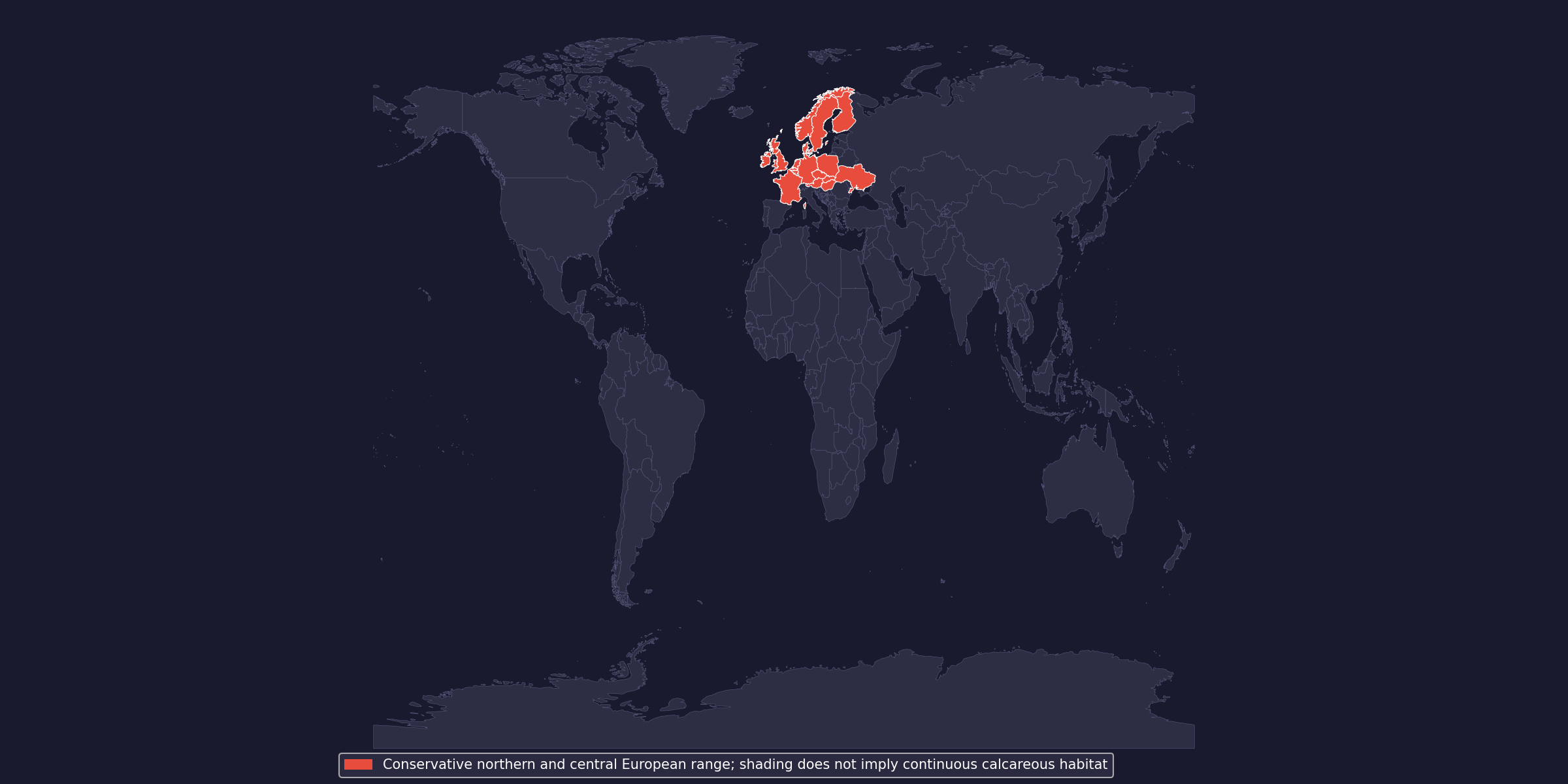
The species is native across northern and central Europe and has been introduced to North America. Its European distribution is associated especially with limestone districts, walls, quarries and other calcareous structures. The map shows a conservative documented European range and excludes introduced records.
The broad synanthropic range makes a single climate station uninformative. Captive care should reproduce secure cool crevices and a moisture choice, not outdoor monthly weather.
⚖️ Legal status
Checked on 2026-08-29: P. spinicornis was not found in CITES, EU wildlife-trade Annexes A–D under Regulation (EU) 2026/1383, or Bern Appendices II–III.
Local and national rules may regulate collection from walls, quarries, protected sites or private property, as well as soil transport, sale and import. Keep purchase and locality records, use captive stock, sterilize waste substrate and never release a culture.
🤌 Husbandry
A 30 × 20 × 15 cm ventilated box suits a starter group of 20–30 animals. Provide 6–8 cm of soil and leaf mould, with a damp moss-and-wood refuge occupying roughly one quarter to one third of the floor. The rest should remain only lightly moist, with dry upper stone surfaces and continuous shade beneath them.
Quarantine additions for 45–60 days with separate tools. Confirm adults rather than relying on trade colour. ReptiFiles has no species guide, and hard captive limits are not published; these targets combine its documented calcareous habitat with conservative isopod culture practice.
💡 Lighting
UVB is unnecessary. Diffuse room light for 9–14 hours is sufficient. Provide permanent dark crevices and keep the container away from sunlight, which rapidly heats stone.
🌡 Heating and temperature
Maintain 15–23 °C, with a 12–18 °C cool retreat and nights around 10–18 °C. Avoid prolonged temperatures above 25 °C. No basking lamp is required; the warmer metadata range is simply the upper usable enclosure zone.
Seasonal room cooling is acceptable. Do not deliberately chill weak, new or poorly fed colonies.
💧 Humidity and water
Approximate enclosure RH may range from 60–85%, but the gradient is more important than the average. Keep moss and lower substrate continuously damp at one end, while allowing exposed stone and upper leaves elsewhere to dry between waterings.
Never let the whole enclosure become bone-dry, and do not keep all of it saturated. No open dish is necessary. Failed moults and permanent crowding at the wet end indicate too little contact moisture.
🌿 Enclosure and decoration
Use pesticide-free topsoil, leaf mould, soft rotten hardwood and deciduous leaves. Add firmly supported limestone pieces, weathered mortar-like mineral fragments or cork to create narrow retreats. Stones must sit on the enclosure floor so burrowing cannot collapse them.
Keep cuttlebone or crushed oyster shell available. Avoid sharp construction waste, chemically treated masonry, cement dust, fertilizer and resinous wood.
🪳 Feeding
Leaves and rotten wood are continuous staples. Offer mushroom, squash, carrot, dried nettle or balanced isopod food every three to five days. A small protein portion once weekly is sufficient for most colonies.
Remove wet food after 24–36 hours. Feed lightly enough that crevices remain clean and airy; a pile of rich food in the damp retreat encourages mites.
🥚 Breeding
Females brood embryos in a marsupium and release mancae, recorded as viviparous in structured metadata. Species-specific captive maturation and brood figures are poorly documented, so sellers’ production claims should not be treated as biological limits.
Maintain the moisture gradient rather than making the entire box wet for young. Do not isolate gravid females. Split only a mixed-age colony, transferring mature substrate and several hides.
🩺 Common problems
- Whole enclosure too wet: preserve dry stone surfaces and increase cross-ventilation.
- Failed moults: restore the damp refuge and check calcium availability.
- Overheating: cool the room; stones can retain heat after lights switch off.
- No juveniles: verify adults, food quality and hidden dry-outs.
- Mites or mould: reduce fresh and protein foods and remove residue.
- Collapsed hides: support every heavy stone from the enclosure floor.
📌 Conclusion
Porcellio spinicornis is manageable when its calcareous-crevice ecology is taken seriously. A stable cool enclosure with one dependable damp refuge works better than a uniformly humid tropical isopod box.
📚 Sources and further reading
- GBIF: Porcellio spinicornis
- World List of Isopoda
- British Myriapod and Isopod Group
- Schmalfuss world catalog
- ReptiFiles clean-up-crew overview; no species guide found
- CITES Appendices, valid from 5 March 2026
- Commission Regulation (EU) 2026/1383
- Bern Convention appendices