Share

Porcellio spatulatus
🔤 Taxonomy
Porcellio spatulatus Costa, 1882 is the accepted name in GBIF and the World List of Isopoda. Porcellio latissimus appears as a synonym in the world catalog. “Coros” is a locality or culture label used in the hobby, not a subspecies, and should remain attached only to stock of documented origin.
📌 Description
This is a broad, unusually flattened Porcellio that normally reaches about 1.5-2 cm in body length. It cannot roll into a ball. Its low profile lets it press beneath bark and stone-like shelters, so usable horizontal crevices matter more than enclosure height.
Published husbandry trials are not available. The practical values below combine its western Mediterranean distribution with established captive experience for this species and related dry-leaning Porcellio. The central task is to keep most of the surface airy without allowing the protected moist refuge to disappear.
🌍 Distribution
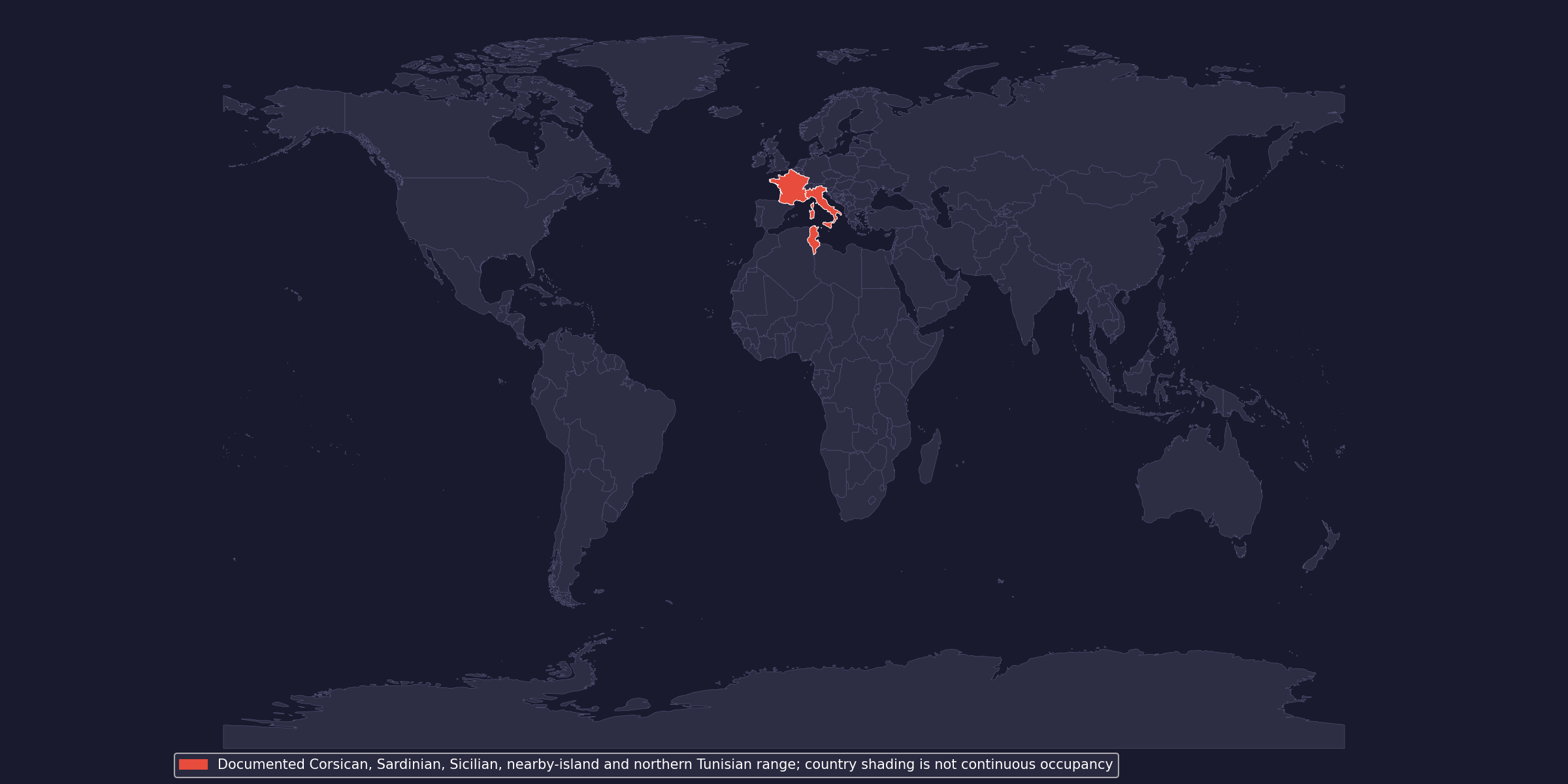
The world catalog records P. spatulatus from Corsica, Sardinia, Sicily and nearby islands, plus northern Tunisia. Country shading therefore represents parts of France, Italy, and Tunisia rather than continuous occupancy across those countries.
⚖️ Legal status
Checked on 2026-08-29: P. spatulatus was not found in the CITES Appendices, EU wildlife-trade Annexes A-D under Regulation (EU) 2026/1383, or Bern Convention Appendices II-III. This trade status does not authorize collection in reserves or the removal and export of native animals from France, Italy, or Tunisia.
Choose captive-bred stock and keep the invoice, breeder details, culture label, and any import documents. Local rules may separately regulate possession, breeding, transport, sale, import, or disposal. Never release animals or used substrate.
🤌 Husbandry
A 30 × 20 × 15 cm box is a practical minimum for a starter group of 10-15. Provide fine cross-ventilation above the drier three-quarters and a secure lid. Broad adults need several shelters rather than one crowded cork slab.
| Parameter | Practical target |
|---|---|
| Adult body length | 1.5-2 cm |
| Temperature | 18-25 °C |
| Moisture | damp refuge over about one-quarter; mostly dry surface |
| Substrate | 5-7 cm, rich in leaves and rotten hardwood |
| Food | decomposed leaves and wood; modest vegetables and protein |
Quarantine new animals for 30-60 days with separate tools. Confirm deaths, molts, mites, and the culture label before combining stock. Do not mix this slower display colony with prolific cleanup species.
💡 Lighting
UVB is unnecessary. Give 10-14 hours of diffuse room or plant light with complete shade beneath cork. Keep clear tubs out of direct sun; they overheat quickly even when the room feels mild.
🌡 Heating and temperature
Maintain 18-25 °C, with a cooler refuge around 16-21 °C and nights of 16-21 °C. Moderate seasonal cooling can slow breeding, but deliberate winter chilling is not needed for routine care.
Avoid prolonged temperatures above 27 °C. If the room needs heat, warm one outer side under thermostat control and leave the moist end unheated. Measure both ends at substrate level.
💧 Humidity and water
Keep moss and the deeper substrate damp over roughly one-quarter of the floor. The remaining surface should dry between waterings while retaining faint moisture lower down. An air-humidity range around 45-65% is only a secondary guide; the animals must be able to choose a moist underside and a genuinely airy shelter.
Add water directly to the refuge rather than misting the whole lid. No water bowl is required. Failed molts or permanent crowding in the wet corner suggest insufficient moisture; condensation, sour substrate, or constant wall climbing suggests saturation and weak airflow.
🌿 Enclosure and decoration
Use 5-7 cm of pesticide-free topsoil or leaf soil mixed with deciduous leaf mould and crumbled white-rotted hardwood. Cover the surface with oak, beech, or other safe hardwood leaves. Add flat cork, stable limestone pieces, and one moss pocket.
Keep cuttlebone, limestone, oyster shell, or plain calcium carbonate available. Avoid coir as the sole substrate, fine sand alone, fertilizer, fresh resinous wood, and stones resting loosely above burrows.
🪳 Feeding
Leaves and rotten hardwood are the permanent staple. Two or three times weekly, offer a small amount of squash, carrot, sweet potato, courgette, mushroom, or dried nettle. Add dried shrimp, gammarus, or quality fish food about once weekly.
Place food at several points and remove damp leftovers within 24-48 hours. Excess protein encourages mites and crowding; vegetables and pellets do not replace decomposed fibre.
🥚 Breeding
Females brood eggs and embryos in a ventral fluid-filled marsupium and release mancae. The site records this mode as viviparous; there is no external egg incubation. Breeding appears moderate under stable care rather than explosively fast.
Maintain a connected damp lower layer, fine leaf fragments, calcium, and quiet shelter. Do not isolate gravid females. Protect ventilation openings against tiny mancae and wait for a full second generation before dividing a valuable locality culture.
🩺 Common problems
- Deaths after a dry spell: enlarge and reconnect the damp refuge; juveniles dehydrate first.
- Losses after frequent spraying: stop wetting the whole surface and increase cross-flow.
- Damaged antennae or uropods: add flat retreats and feeding stations, then reduce density.
- Mites and fungus: remove surplus supplements while preserving edible leaf litter.
- Uncertain identity: keep source-labelled cultures separate; body width alone is not a reliable diagnosis.
📌 Conclusion
Porcellio spatulatus suits an intermediate keeper who can read the substrate rather than chase one humidity number. Prepare broad crevices, a mostly dry ventilated surface, and one dependable damp refuge before the colony arrives.
📚 Sources and further reading
- World List of Isopoda: Porcellio spatulatus
- GBIF: Porcellio spatulatus
- Schmalfuss world catalog: synonymy and distribution
- Taiti and Argano: Oniscidea of Sardinia, including the species range map
- ReptiFiles clean-up-crew overview; species-specific search returned no guide
- CITES Appendices
- EU wildlife-trade Annexes: Regulation (EU) 2026/1383
- Bern Convention appendices