Share

Silvestri's Woodlouse
🔤 Taxonomy
Porcellio silvestrii Arcangeli, 1924 is the accepted name. Older combinations and synonyms useful for literature searches are Porcellio monticola silvestrii, P. curvisetosus, and P. perplexus. Trade labels such as Dalmatian or Black Senia refer to captive lines or morphs, not formal subspecies or verified localities.
📌 Description
Adults are elongated, non-conglobating isopods about 1.5-2.5 cm long. Mature males are often brighter orange, while females tend to be grey or dull orange; this useful colony-level sexual dimorphism is not a substitute for examining the ventral reproductive structures. Long uropods and active surface behaviour make the species conspicuous when settled.
It prefers cooler conditions than many Mediterranean cultures and breeds more slowly than powder isopods. The principal failure points are warmth, stagnant wet substrate, and drying the only moulting refuge.
🌍 Distribution
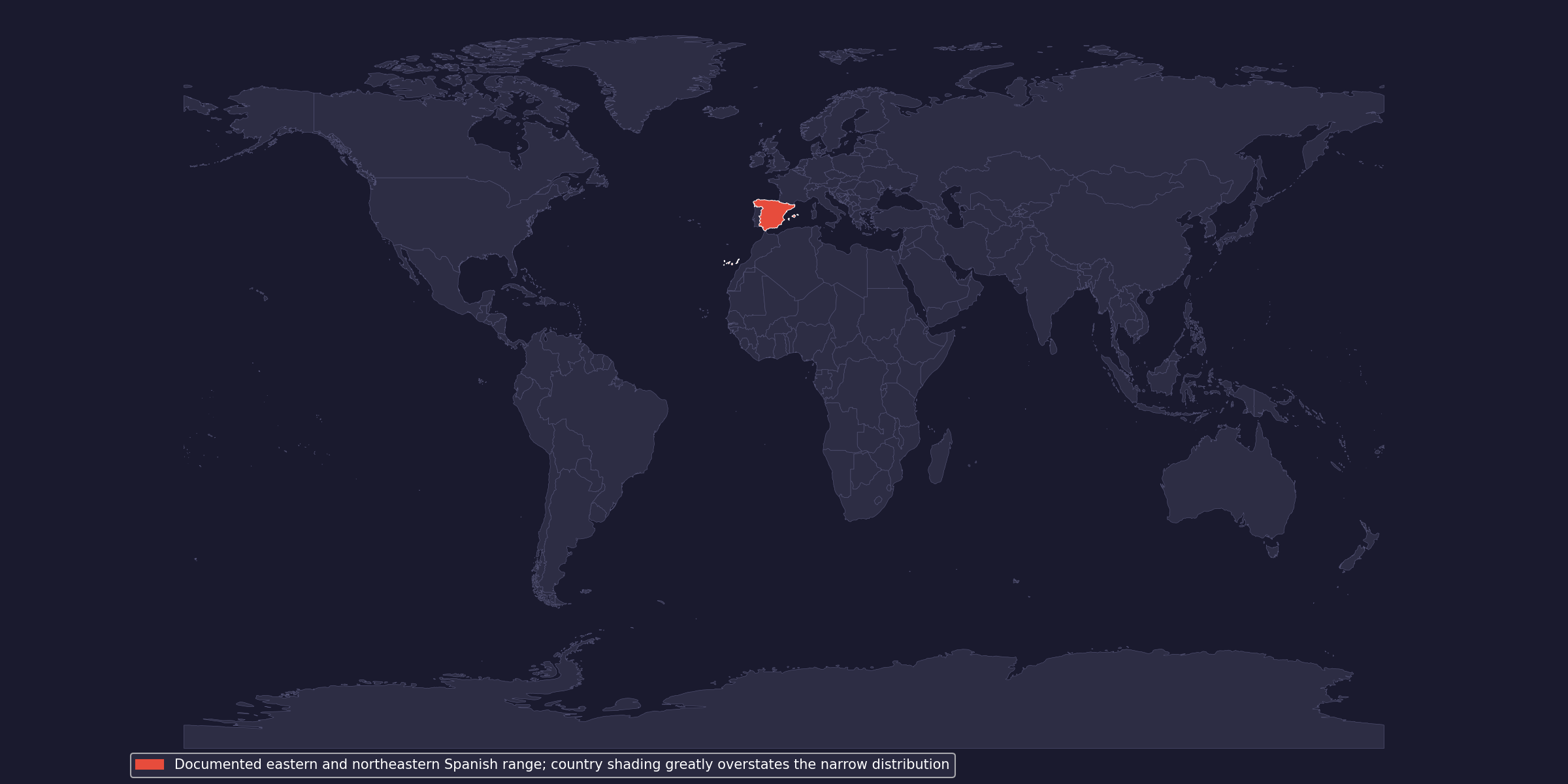
Catalogues treat P. silvestrii as an eastern and northeastern Spanish species. Faunal records are concentrated in Catalonia and the Valencian region, with additional eastern Spanish records. Older reports outside that core require careful identification, so the country-level map is intentionally conservative.
⚖️ Legal status
Checked on 2026-08-29: P. silvestrii was not found in the CITES Appendices, EU wildlife-trade Annexes A-D under Regulation (EU) 2026/1383, or Bern Convention Appendices II-III. Spanish and autonomous-community rules may still restrict collection, protected-site access, transport, sale, and export of native invertebrates.
Choose captive-bred stock and keep invoices and the exact morph or lineage record. Do not collect wild animals, invent a locality from a morph name, release colonies, or discard viable substrate outdoors.
🤌 Husbandry
A 30 × 20 × 15 cm container suits 10-20 starters; increase floor area as the colony grows. Use fine cross-ventilation and keep roughly one-third of the substrate damp, grading to a dry surface. Provide several flat shelters over different moisture levels.
| Parameter | Practical target |
|---|---|
| Adult length | 1.5-2.5 cm |
| Temperature | 14-25 °C; cooler room conditions preferred |
| Moisture | one-third damp with a dry ventilated end |
| Substrate | 6-8 cm, leaf-rich and edible |
| Staples | leaves and rotten hardwood; regular calcium |
| Reproduction | moderate to slow; avoid early splitting |
Quarantine new stock for 60 days with separate tools. Record the seller’s sex ratio and line name, and do not merge morphs or cultures with different provenance.
💡 Lighting
UVB is not required. Use diffuse room light for 10-12 hours and retain deep shade under bark. Avoid direct sun and strong display lighting.
🌡 Heating and temperature
Keep the culture between 14 and 25 °C, with a 12-19 °C cool refuge and nights around 12-20 °C. Ordinary cool seasonal room temperatures are suitable for healthy established stock; deliberate cold dormancy is unnecessary.
Avoid sustained temperatures above 26-27 °C. If the room is unusually cold, warm only one wall under thermostat control, leaving the moist end cooler.
💧 Humidity and water
An overall 50-65% RH trend works when one end contains damp moss and lower substrate and the opposite surface can dry. Pour water into the moist corner and wait for it to spread below the surface instead of spraying the entire enclosure.
No water dish is needed. Persistent condensation, fungal leaf litter, or climbing indicates too much water or too little airflow. Moulting failure and juvenile loss require checking moisture beneath—not just on top of—the moss.
🌿 Enclosure and decoration
Use 6-8 cm of pesticide-free topsoil or leaf soil mixed with leaf mould, soft rotten hardwood, and a mineral component such as crushed limestone. Add abundant deciduous leaves, several cork flats, and a compact moss pocket.
Keep cuttlebone or plain calcium carbonate available. Avoid pure coconut fibre, aromatic conifer bark despite reports from pine landscapes, fertilizer, treated timber, and heavy unsecured stones.
🪳 Feeding
Hardwood leaves and decomposed wood are permanent staples. Every three to five days offer a small amount of squash, carrot, mushroom, dried greens, or complete isopod diet. Supply a modest protein food, such as dried shrimp or fish food, once or twice weekly only when it is consumed promptly.
Remove wet remains within 24-48 hours and spread food across two points. Increase leaves and rotten wood before increasing concentrated supplements.
🥚 Breeding
Females retain eggs and embryos in a ventral marsupium and release mancae, so reproduction is recorded as viviparous with no external incubation. Specialist keepers report maturity around six months and moderate to slow colony growth, but these figures should not be treated as a guarantee for every line.
Stable cool temperatures, deep moisture, calcium, and a mature mixed-sex group matter more than heavy feeding. Leave gravid females in the colony and wait for several age classes before making a split.
🩺 Common problems
- Warm-weather decline: move the enclosure to a cooler stable room before adding more water.
- Failed moults: verify damp lower substrate and a permanent calcium source.
- Mold and mites: reduce protein and wet produce and increase cross-ventilation.
- Slow reproduction: check maturity, sex ratio, and stability before changing conditions.
- Morph or sex confusion: retain line records and confirm sex ventrally; colour alone is not definitive.
📌 Conclusion
P. silvestrii suits an intermediate keeper with a naturally cool room and patience for moderate colony growth. Test summer temperatures and the moisture refuge before buying; extra heat is more likely to harm this species than to speed it up safely.
📚 Sources and further reading
- World List of Isopoda: Porcellio silvestrii
- GBIF species record: Porcellio silvestrii
- Cifuentes (2021), eastern Spanish records
- Schmalfuss (2003), taxonomy and northeastern Spanish range
- Specialist captive reference: Exuvium Isopods
- ReptiFiles site check; general clean-up-crew reference
- Warburg (2012), marsupial development in terrestrial isopods
- CITES Appendices
- EU wildlife-trade Annexes: Regulation (EU) 2026/1383
- Bern Convention appendices