Share

Porcellio pumicatus
🔤 Taxonomy
Porcellio pumicatus Budde-Lund, 1885 is accepted by the World List of Isopoda and GBIF. Older synonyms include Porcellio verhoeffi, P. strandi, and P. orarum verhoeffi. Because this uncommon species has little presence in the hobby, preserve the original identification and source rather than assigning a trade morph name.
📌 Description
Adults reach about 1.2-1.5 cm. Published faunal summaries describe a ground-dwelling species encountered beneath stones; it cannot roll into a ball. Reliable species-specific captive trials are scarce, so the parameters below are conservative starting ranges based on its central Italian and Sardinian ecology and standard Porcellio biology.
This uncertainty makes it an intermediate species even though the physical setup is simple. Change one variable at a time and keep written observations rather than treating an unverified care post as a fixed prescription.
🌍 Distribution
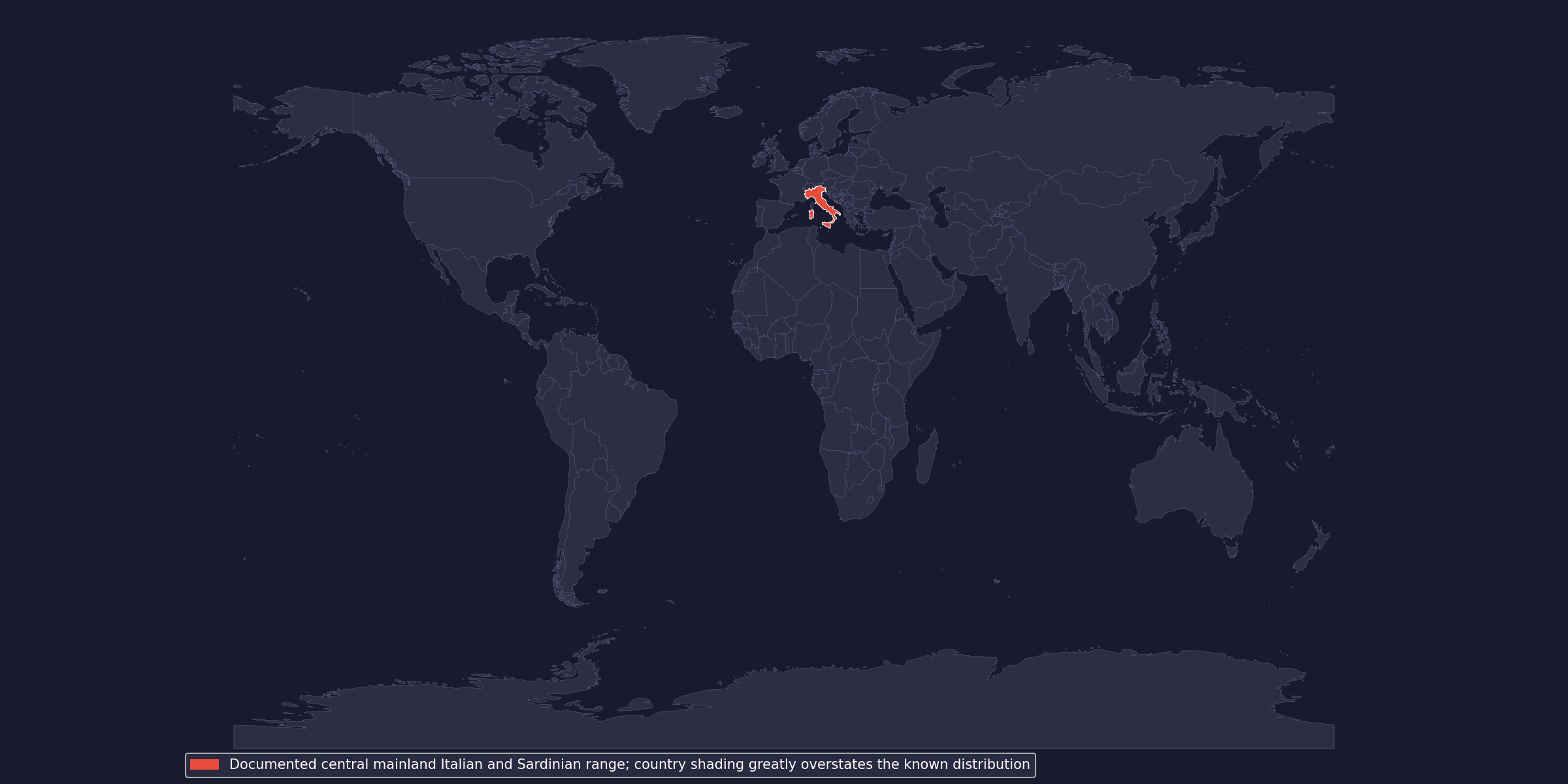
The documented range is central mainland Italy and Sardinia. The country-level map cannot show that separation and must not be read as evidence that the species occurs throughout Italy.
⚖️ Legal status
Checked on 2026-08-29: P. pumicatus was not found in the CITES Appendices, EU wildlife-trade Annexes A-D under Regulation (EU) 2026/1383, or Bern Convention Appendices II-III. Italian and Sardinian protected-area, collection, transport, sale, and export rules remain separate and may protect sites or native fauna without naming the species in those international lists.
Use documented captive-bred stock and retain invoices and breeder details. Do not collect under stones in the wild, release cultures, or discard live substrate outdoors.
🤌 Husbandry
Start a small colony in at least 25 × 20 × 15 cm, with fine cross-ventilation. Keep about one-third of the floor damp and allow the opposite surface to dry. Flat bark and securely placed stone-like cover should span the gradient.
| Parameter | Conservative starting target |
|---|---|
| Adult length | 1.2-1.5 cm |
| Temperature | 16-25 °C |
| Moisture | one-third damp, remainder ventilated and drier |
| Substrate | 5-7 cm, leaf-rich and mineral-bearing |
| Staples | leaves, rotten hardwood, calcium |
| Evidence level | limited species-specific captive data |
Quarantine for 60 days with separate tools and retain the source label. A culture sold only under a photograph should be treated as identification-uncertain.
💡 Lighting
UVB is not required. Provide 10-12 hours of diffuse light and shaded retreats. Prevent direct sunlight from striking the container.
🌡 Heating and temperature
Use 16-25 °C as a cautious range, with a 14-20 °C retreat and cool nights. Do not assume that Sardinian origin means constant high heat; under-stone microhabitats can remain much cooler than exposed air.
Heat one side wall with a thermostat only if necessary. Avoid base heating and sustained temperatures above 27 °C.
💧 Humidity and water
Maintain damp lower substrate and moss at one end, with a dry surface option and steady airflow. An overall 50-70% RH trend is less important than the condition beneath the refuge. Add water to the substrate rather than misting every surface.
A water dish is unnecessary. Condensation and sour odour indicate excessive water or inadequate ventilation; dry moss and moulting failures indicate an unstable hydration zone.
🌿 Enclosure and decoration
Use 5-7 cm of pesticide-free topsoil or leaf soil mixed with deciduous leaf mould, rotten hardwood, and crushed limestone. Add abundant leaves, thin cork, moss at the damp end, and securely seated flat stone or bark.
Offer cuttlebone or calcium carbonate continuously. Avoid pure coconut fibre, aromatic conifer material, fertilizers, treated wood, and unsupported heavy décor.
🪳 Feeding
Keep deciduous leaves and soft rotten hardwood available at all times. Every three to five days provide a small amount of squash, carrot, mushroom, dried greens, or complete isopod food. Offer a small protein portion once weekly and reduce it if consumption is slow.
Place food on bark or a dry leaf and remove wet remains within 24-48 hours. Sparse species-specific data argue for measured portions and records, not aggressive feeding.
🥚 Breeding
As in other terrestrial isopods, females retain eggs and embryos in a ventral marsupium and release mancae. The repository records this reproductive mode as viviparous; there are no exposed eggs to incubate.
Species-specific clutch and maturity data were not located. Maintain stable conditions, calcium, mature mixed-sex stock, and several juvenile size classes before splitting the culture.
🩺 Common problems
- Colony declines after a setup change: restore the prior moisture and temperature and stop disturbing hides.
- Failed moults: check deep moisture and continuous calcium.
- Mold or mites: reduce supplements and improve cross-ventilation.
- Crushing injuries: seat stones on the floor before adding substrate.
- Uncertain identity: preserve the seller label and seek adult taxonomic examination.
📌 Conclusion
P. pumicatus should be kept as a documented observation colony, not as an “easy” generic isopod. A cool gradient, secure cover, edible substrate, and careful records are more defensible than precise claims unsupported by species-level captive studies.
📚 Sources and further reading
- World List of Isopoda: Porcellio pumicatus
- GBIF species record: Porcellio pumicatus
- Schmalfuss (2003), taxonomy and central Italy–Sardinia range
- ReptiFiles site check; general clean-up-crew reference
- Warburg (2012), marsupial development in terrestrial isopods
- CITES Appendices
- EU wildlife-trade Annexes: Regulation (EU) 2026/1383
- Bern Convention appendices