Share

Yellow-dot Isopod
🔤 Taxonomy
Porcellio ornatus H. Milne Edwards, 1840 is an accepted species in Porcellionidae. It is close enough in appearance to regional relatives that locality-free trade identifications deserve caution; a 2015 revision illustrated Spanish P. ornatus while distinguishing the Moroccan P. pseudornatus.
Yellow is a captive colour line, not a subspecies. Preserve the label in breeding records without turning it into a wild geographic claim.
📌 Description
Adults reach roughly 1.8-2.5 cm and show a flattened Porcellio outline with pale yellow marks that become stronger in selected Yellow cultures. They are quick, visible, and capable climbers. Unlike pill isopods, they do not roll into a complete ball.
The species is more forgiving than P. bolivari, but it is not a wet-box cleanup isopod. Success depends on strong ventilation, dry leaf-covered ground, raised bark retreats, and a small damp zone for respiration and molting.
🌍 Distribution
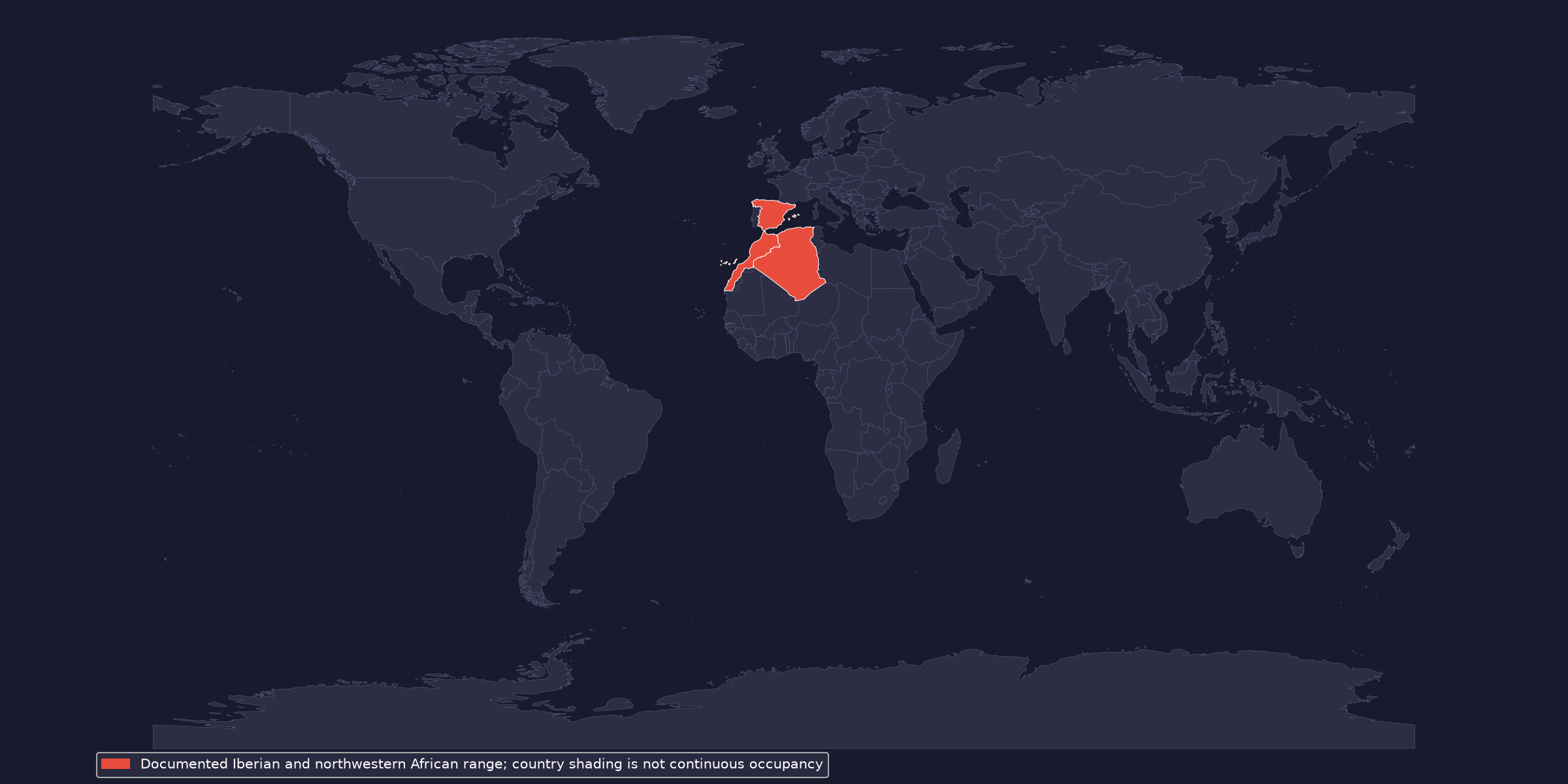
WoRMS records P. ornatus from Spain, Morocco, and Algeria. Spanish populations occur in the southeast, while North African records and the existence of similar species make reliable locality labels useful. The map shows the accepted country-level range, not uniform occupancy.
⚖️ Legal status
Checked on 2026-08-23: P. ornatus was not found in the current CITES Appendices, EU wildlife-trade Annexes A-D under Regulation (EU) 2026/1383, or Bern Convention Appendices II-III. National and protected-area rules may still restrict collecting or exporting native invertebrates in Spain, Morocco, and Algeria.
Prefer captive-bred stock and retain the invoice, breeder, colour line, and claimed locality. Never release cultures or discard live substrate outdoors.
🤌 Husbandry
A well-ventilated 30 × 20 × 15 cm box is the minimum practical starter enclosure. Fine mesh is essential because mancae are small and adults climb silicone, bark, and textured décor. Keep about one-quarter of the floor damp and leave the remaining surface dry beneath a deep layer of leaves.
| Parameter | Practical target |
|---|---|
| Adult size | 1.8-2.5 cm |
| Temperature | 18-26 °C |
| Moisture | damp quarter, mostly dry ventilated surface |
| Substrate | 7-9 cm, leaf-rich and mineral-bearing |
| Staple diet | hardwood leaves and decayed wood, regular protein |
| Social housing | colony with several elevated retreats |
Quarantine new animals for 60-90 days. Keep their tools and waste separate and record mortality, mites, color, and breeder label. Open the enclosure over a catch tub; this species can run out quickly when bark is lifted.
💡 Lighting
UVB is not required. A 10-12-hour ambient light cycle is sufficient, with shadow under bark and leaves. Avoid direct sun and hot display lighting.
🌡 Heating and temperature
Maintain 18-26 °C, with 20-24 °C a dependable everyday range. Cooler nights around 17-22 °C are acceptable and breeding can continue at normal indoor temperatures. Do not create a hot basking surface.
When heating is necessary, warm one side wall under thermostat control. Sustained heat above 28 °C can dry the refuge and accelerate a crash, particularly in a small, highly ventilated tub.
💧 Humidity and water
Keep a moss and deep-soil refuge damp while the open area remains around 45-65% relative humidity and dries at the surface. Add water to the refuge instead of spraying the entire enclosure. This produces access to moisture without stale air.
No water dish is necessary. Persistent condensation or mold on the dry-side leaves means the setup is too wet. Failed molts and animals never leaving the damp corner indicate that moisture has become too localized or inconsistent.
🌿 Enclosure and decoration
Use 7-9 cm of leaf soil or pesticide-free topsoil mixed with rotten hardwood, leaf fragments, and limestone grit. Add sphagnum only to the moist end and keep a permanent source of plain calcium.
Cover the dry end with oak, beech, or other safe hardwood leaves. Layer cork flats and lean one piece upward to create elevated, airy resting surfaces. Guard all ventilation gaps. Avoid coconut fibre alone, conifer bark, fertilizer, treated wood, and unstable stones.
🪳 Feeding
Leaves and decomposed hardwood remain the base diet. Supplement once or twice weekly with a small piece of squash, carrot, mushroom, sweet potato, dried herb, or a complete isopod food. Remove wet leftovers within 24-48 hours.
Offer dried shrimp, fish food, or another insect-based protein about weekly; active adults respond well, but uneaten protein rapidly attracts mites. Cuttlebone, limestone, oyster shell, or plain calcium carbonate should always be present.
🥚 Breeding
Females brood eggs and embryos in a fluid-filled marsupium and release mancae; there are no externally incubated eggs. The structured field therefore uses viviparous. Breeding is usually steady once adults settle, even at moderate room temperatures.
Protect the moist refuge from drying, feed protein modestly, and avoid lifting every hide to search for newborns. Split dense colonies before space under bark disappears. Maintain Yellow as a labelled line rather than mixing it casually with other P. ornatus cultures.
🩺 Common problems
- Escapes: cover vents with fine mesh and service the box over a larger tub.
- Whole-colony clustering in wet moss: check dry-side heat and make the refuge larger or more stable.
- Mold and grain mites: reduce fresh food and wet surface area while preserving deep moisture.
- Failed molts: verify damp substrate and permanent calcium.
- Weak colour or unexpected offspring: check the source label and keep selective lines separate; colour does not establish taxonomy.
📌 Conclusion
P. ornatus rewards an intermediate keeper with bold surface activity, provided the enclosure is airy and mostly dry. Install fine-mesh ventilation and a dependable damp refuge before the colony arrives; uniform wetness is the most avoidable failure.
📚 Sources and further reading
- WoRMS: Porcellio ornatus
- GBIF species record: Porcellio ornatus
- Taiti & Rossano (2015), Moroccan records and comparison with P. pseudornatus
- Specialist care notes for the Yellow line
- ReptiFiles cleanup-crew overview
- Warburg (2012), marsupial development in terrestrial isopods
- CITES Appendices
- EU wildlife-trade Annexes: Regulation (EU) 2026/1383
- Bern Convention appendices