Share

Porcellio obsoletus
🔤 Taxonomy
Porcellio obsoletus Budde-Lund, 1885 is an accepted species with an unusually long synonym list. Names still useful in older regional literature include P. anatolicus, P. contractus, P. fissifrons, P. griseus, P. hatayensis, P. napolitanus, and P. syriacus. A 2026 review questioned whether Lebanese P. obsoletus libanicus belongs to this species.
📌 Description
Adults are broad, dark brown to grey isopods about 1.6-2.3 cm long, with relatively weak dorsal granulation and broad flattened uropod exopodites. They do not conglobate. Superficial similarity to common Porcellio makes a source label or photograph alone unreliable for identification.
The species is more moisture-tolerant than the driest Spanish giants, but still requires airflow and a dry surface option. A generous gradient is safer than choosing one humidity reading for every culture bearing this name.
🌍 Distribution
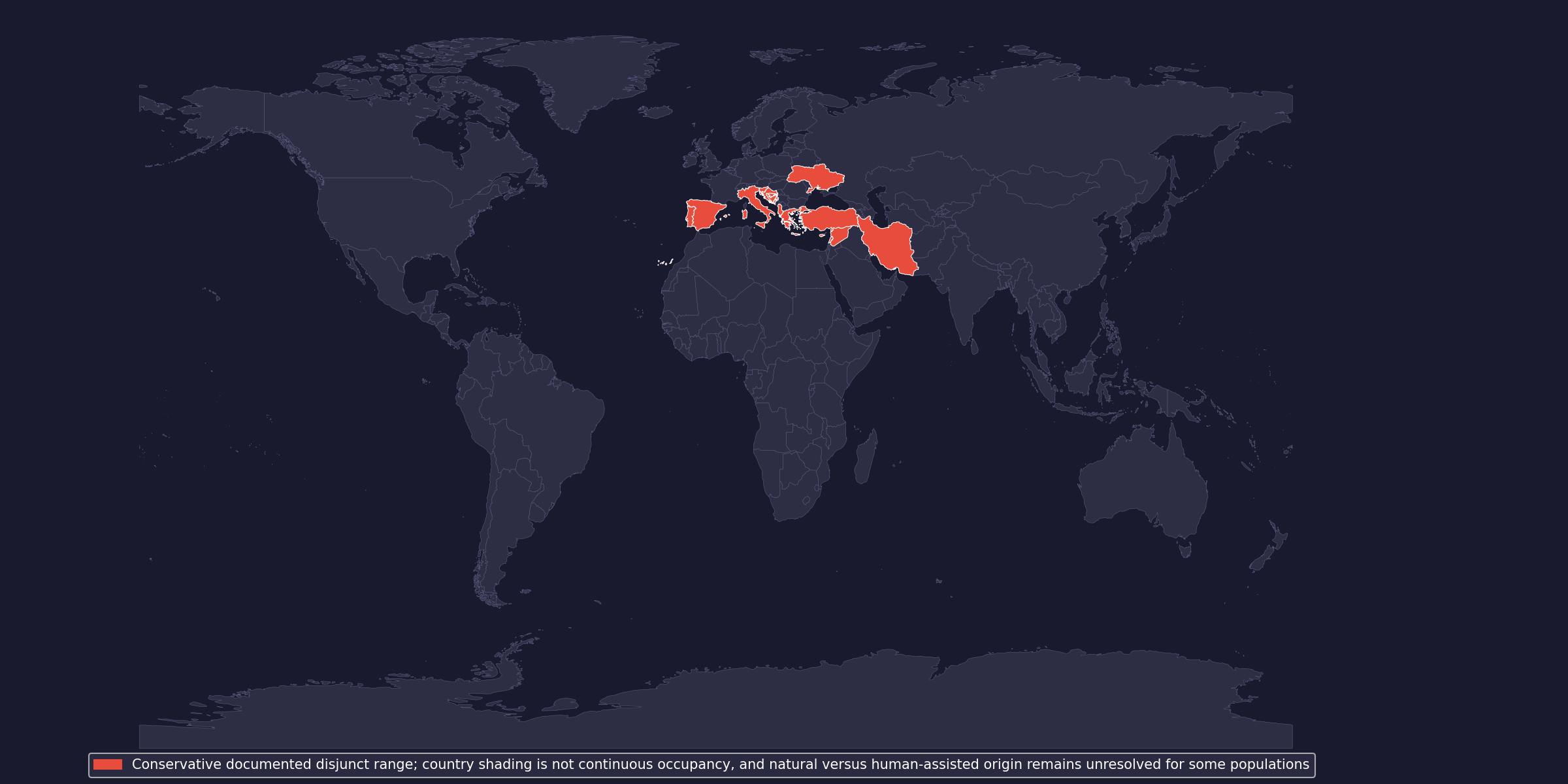
The documented range is fragmented. Older revisions place the species in Italy, the Adriatic and eastern Mediterranean, Turkey, Cyprus, Lebanon, northern Syria, Crimea, and northern Iran. Records are also documented from coastal Croatia and Bosnia and Herzegovina, Greece, Albania, and Slovenia. A 2026 revision added mainland Portugal and Spain and left open whether the separated western populations are ancient or human-assisted.
The map shows conservative country records, not continuous native occupancy and not certainty about how every disjunct population originated.
⚖️ Legal status
Checked on 2026-08-29: P. obsoletus was not found in the CITES Appendices, EU wildlife-trade Annexes A-D under Regulation (EU) 2026/1383, or Bern Convention Appendices II-III. Local protection, collection, import, transport, and sale rules can still apply throughout its broad range.
Buy captive-bred animals with an invoice and the exact culture locality, especially for Croatian, Greek, or other named lines. Never release a colony, collect in protected sites, or represent an unverified culture as a wild locality.
🤌 Husbandry
A 30 × 20 × 15 cm box suits a starter colony; use 40 × 30 cm or more as numbers rise. Provide fine cross-ventilation and keep roughly one-third of the substrate damp, grading to a dry surface at the opposite end. Several cork flats allow choice without crowding.
| Parameter | Practical target |
|---|---|
| Adult length | 1.6-2.3 cm |
| Temperature | 16-25 °C |
| Moisture | one-third damp, with a dry ventilated end |
| Substrate | 6-8 cm, leaf-rich and edible |
| Staples | leaves, rotten hardwood, calcium |
| Social housing | colony; expand before crowding develops |
Quarantine new stock for 30-60 days with separate tools. Retain locality and supplier records and avoid merging cultures from widely separated parts of the range.
💡 Lighting
UVB is unnecessary. Use diffuse light for 10-12 hours with complete shade under bark. Direct sun or strong lamps can overheat the upper substrate even when the room is cool.
🌡 Heating and temperature
Maintain 16-25 °C, with a 14-20 °C retreat and cooler nights. Cultures from different localities may not respond identically, so preserve the seller’s established room-temperature cycle rather than applying strong artificial seasonality.
If heat is needed, warm one side wall through a thermostat. Avoid temperatures above 27 °C and never heat the base.
💧 Humidity and water
Keep the moist end damp through its full depth and let the other end dry at the surface. General readings around 50-70% RH are a guide, not a replacement for inspecting substrate below the moss. Pour water into one corner rather than misting the whole box.
No water bowl is needed. Continuous condensation and sour substrate require less water and more airflow; dry, brittle moss and repeated moulting failures require a deeper or more stable refuge.
🌿 Enclosure and decoration
Use 6-8 cm of pesticide-free topsoil or leaf soil with leaf mould, rotten hardwood, and a modest mineral component. Add moss at one end, abundant deciduous leaves, cork flats, and securely seated limestone or bark pieces.
Keep cuttlebone or plain calcium carbonate available. Avoid pure coir, conifer bark, fertilizer, treated wood, and waterlogged compact soil.
🪳 Feeding
Deciduous leaf litter and soft rotten wood are permanent staples. Offer small vegetable, mushroom, dried green, or complete isopod-food portions every three to five days. Give dried shrimp, gammarus, or fish food once weekly, divided across the colony.
Remove wet leftovers after 24-48 hours. Increase the number of feeding points before increasing the protein portion.
🥚 Breeding
Females carry eggs and embryos in a ventral marsupium and later release mancae; reproduction is therefore recorded as viviparous, without external egg incubation. Established cultures can reproduce steadily, but locality, temperature, founder size, and identification all affect reports.
Leave gravid females with the colony, maintain calcium and stable deep moisture, and delay splitting until juveniles of several sizes are present. Preserve locality lines separately.
🩺 Common problems
- Whole-box dampness: reduce watering and open more cross-ventilation before substrate turns anaerobic.
- Failed moults: verify moisture at depth and continuous calcium.
- Mites and mold: reduce supplemental food and remove residues.
- Crowding damage: enlarge the enclosure and add hides and feeding points.
- Identity or locality drift: do not merge lines or rename stock from colour photographs.
📌 Conclusion
P. obsoletus is a useful intermediate display species when its moisture gradient and locality records are taken seriously. Its wide, disjunct range is a reason to document cultures carefully, not a reason to assume every population needs identical conditions.
📚 Sources and further reading
- World List of Isopoda: Porcellio obsoletus
- GBIF species record: Porcellio obsoletus
- Schmalfuss (1992), western Asian revision
- Jakob et al. (2024), first Slovenian record
- Cifuentes, Rando and da Silva (2026), Iberian records
- ReptiFiles site check; general clean-up-crew reference
- Warburg (2012), marsupial development in terrestrial isopods
- CITES Appendices
- EU wildlife-trade Annexes: Regulation (EU) 2026/1383
- Bern Convention appendices