Share

Nickles's Isopod
🔤 Taxonomy
Porcellio nicklesi Dollfus, 1892 is an accepted eastern Spanish species. It was originally associated with P. bolivari and the older combination Porcellio bolivari nicklesi remains useful for searching. Hobby stock is also sold as Orange, Orange Blaze, Rubivan, or simply “bolivari nicklesi”; none of those labels proves species identity or locality.
📌 Description
Adults have a body length near 2 cm, while the extended uropods of mature males can bring the visible total close to 3 cm. Wild-type animals are grey-brown; orange trade lines exist, but colour is not diagnostic. They cannot roll into a ball and use speed and tight crevices instead.
This large dry-climate Porcellio is best kept as a display colony. Its main challenges are crowding, excess moisture, and the temptation to disturb a slow or seasonal breeding group.
🌍 Distribution
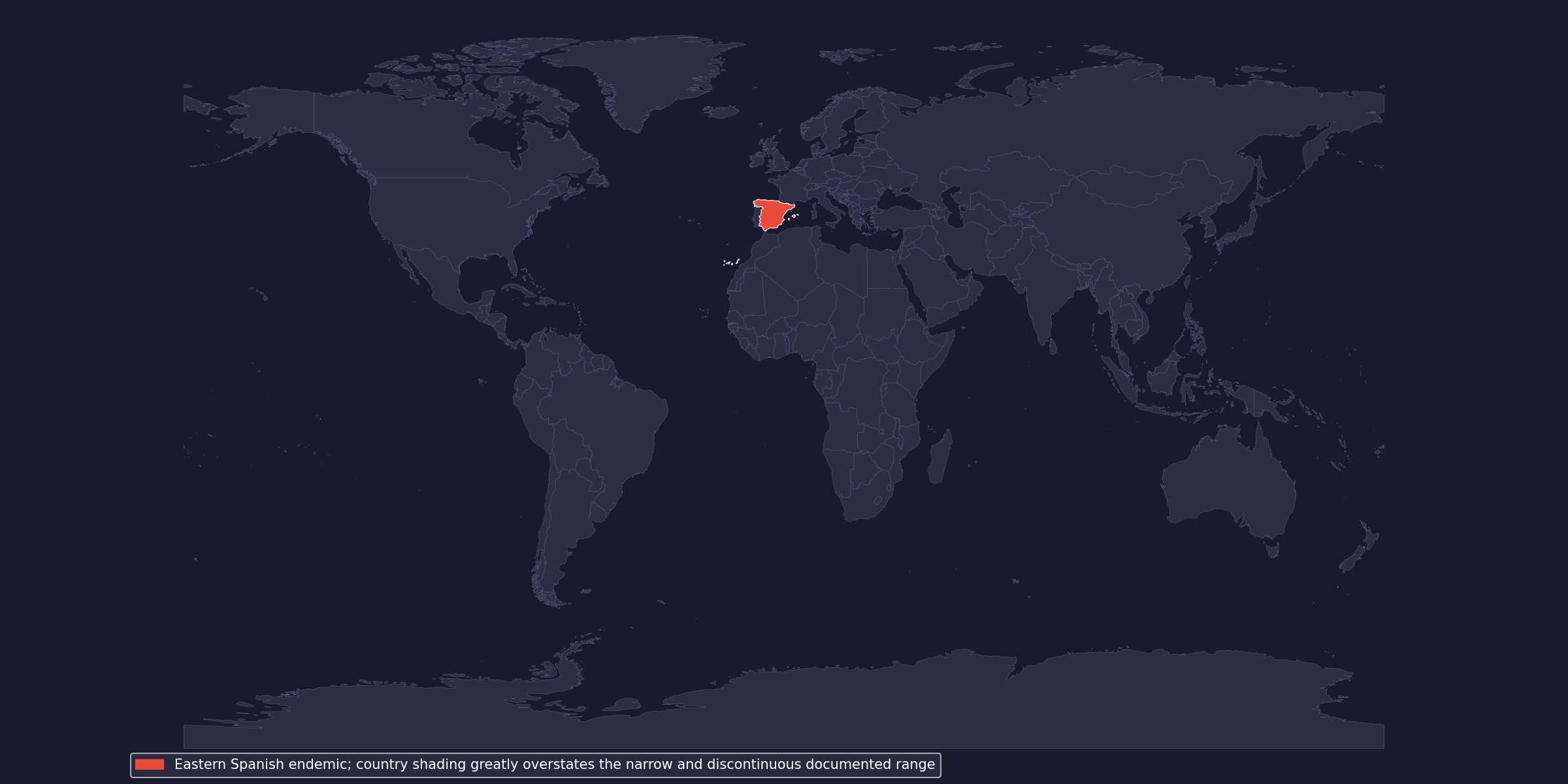
Faunal reviews record P. nicklesi across eastern mainland Spain, including Valencian and Murcian localities, Almería, and the Columbretes Islands. The single-country map deliberately overstates this narrow, discontinuous range and says nothing about the provenance of a captive morph.
⚖️ Legal status
Checked on 2026-08-29: P. nicklesi was not found in the CITES Appendices, EU wildlife-trade Annexes A-D under Regulation (EU) 2026/1383, or Bern Convention Appendices II-III. Spanish and regional rules can still restrict collection in protected sites and the removal, transport, sale, or export of native invertebrates.
Buy captive-bred stock, keep the invoice and the seller’s exact line name, and do not convert a colour name into a locality claim. Never collect from the wild or release animals and culture material.
🤌 Husbandry
Provide at least 40 × 30 × 20 cm for a starter group, with large fine-mesh vents on the lid and opposing walls. Keep about one-fifth of the floor reliably moist and the rest dry at the surface. Spread several bark flats across the enclosure so dominant adults cannot control the only useful shelter.
| Parameter | Practical target |
|---|---|
| Adult size | 2 cm body; males near 3 cm with uropods |
| Temperature | 18-25 °C |
| Moisture | narrow damp refuge; predominantly dry surface |
| Substrate | 8-10 cm, mineral-rich and edible |
| Staples | leaves and rotten hardwood; modest supplements |
| Social housing | roomy colony with several hides and feeding points |
Quarantine for 60-90 days with dedicated tools. Avoid digging through a new culture during the first two weeks, but record visible adults, deaths, mites, and the original label.
💡 Lighting
UVB is not required. A 10-12-hour diffuse light cycle is sufficient, with deep shade below bark. Direct sun and close lamps can make the dry side dangerously hot before the lower refuge appears dry.
🌡 Heating and temperature
Keep most of the enclosure at 18-25 °C, with a 16-21 °C retreat and cooler nights. Sustained heat above 27 °C is unnecessary and shortens the margin for error between ventilation and dehydration.
Use a thermostat-controlled heat source on one side wall only if the room falls below the target. Never heat from below or warm the whole box evenly.
💧 Humidity and water
Air readings around 40-60% RH suit the open side, but damp moss and lower substrate must remain available for respiration and moulting. Add water slowly to the refuge; do not spray every leaf and hide.
No dish is required. Broad condensation, wet food spoiling overnight, or animals climbing persistently suggests excess moisture or stagnant air. Moulting failures and juveniles packed into the final damp centimetres indicate that the refuge has dried too far.
🌿 Enclosure and decoration
Use 8-10 cm of pesticide-free topsoil or leaf soil with deciduous leaf mould, rotten hardwood, and crushed limestone. Concentrate moss at one end, then add a deep dry leaf layer and several thin cork flats. Secure rock before adding loose substrate.
Supply cuttlebone, limestone, or calcium carbonate continuously. Avoid pure coir, aromatic conifer bark, treated wood, fertilizer, and large unstable stones.
🪳 Feeding
Hardwood leaves and decomposed wood are permanent foods. Every four to seven days offer small amounts of squash, carrot, mushroom, dried greens, or complete isopod food. Add a modest protein item such as dried shrimp or fish food weekly.
Feed at two or more points and remove wet residues within 24-48 hours. A slow colony needs smaller portions, not a richer pile; overfeeding favours mites and fungal growth.
🥚 Breeding
Females brood eggs and embryos in a ventral marsupium before releasing mancae, so reproduction is recorded as viviparous and there are no external eggs to incubate. Keepers report seasonal pauses and moderate reproduction rather than constant output.
Do not isolate gravid females or repeatedly lift their hide. Preserve a cool stable cycle, calcium, a narrow damp refuge, and several age classes before dividing the colony. Keep named colour lines separately documented.
🩺 Common problems
- Adult losses in crowded groups: increase floor area, hides, and feeding points.
- Failed moults: restore deep damp substrate and verify continuous calcium.
- Mold and mites: reduce supplemental portions and increase cross-ventilation.
- Broken uropods: use flatter retreats and reduce competition and handling.
- No juveniles for months: confirm maturity and mixed sexes before changing a stable seasonal culture.
- Name confusion: retain the original label and avoid mixing “true form,” Rubivan, Orange, and unverified stock.
📌 Conclusion
P. nicklesi rewards a keeper who can give a large Spanish Porcellio space, airflow, and restraint. Prepare the full adult enclosure first; crowding and repeated checking are harder to correct after a small colony begins to decline.
📚 Sources and further reading
- World List of Isopoda: Porcellio nicklesi
- GBIF species record: Porcellio nicklesi
- Cifuentes (2021), Valencian and Murcian records
- Cifuentes (2021), Andalusian records
- Schmalfuss (2003), world catalogue of terrestrial isopods
- ReptiFiles site check; general clean-up-crew reference
- Warburg (2012), marsupial development in terrestrial isopods
- CITES Appendices
- EU wildlife-trade Annexes: Regulation (EU) 2026/1383
- Bern Convention appendices