Share

Porcellio magnificus
🔤 Taxonomy
Porcellio magnificus Dollfus, 1892 is accepted by the World List of Isopoda and GBIF. It is a large, non-conglobating member of Porcellionidae. Similar trade cultures and colour variants should not be assigned this name solely from photographs; preserve the breeder’s identification and locality information.
📌 Description
Adults are commonly about 2.5-3.5 cm long, with a broad granular body, long uropods, and striking orange-red lateral colour against a grey or dark centre. They cannot roll into a ball. Move them in a cup and avoid lifting them by legs, antennae, or uropods.
The species is best treated as advanced because large-bodied Porcellio require a precise moisture gradient, ample floor area, and clean ventilation. The practical values here combine the documented southeastern Spanish origin with experienced-keeper guidance; they are starting points, not results from a controlled captive study.
🌍 Distribution
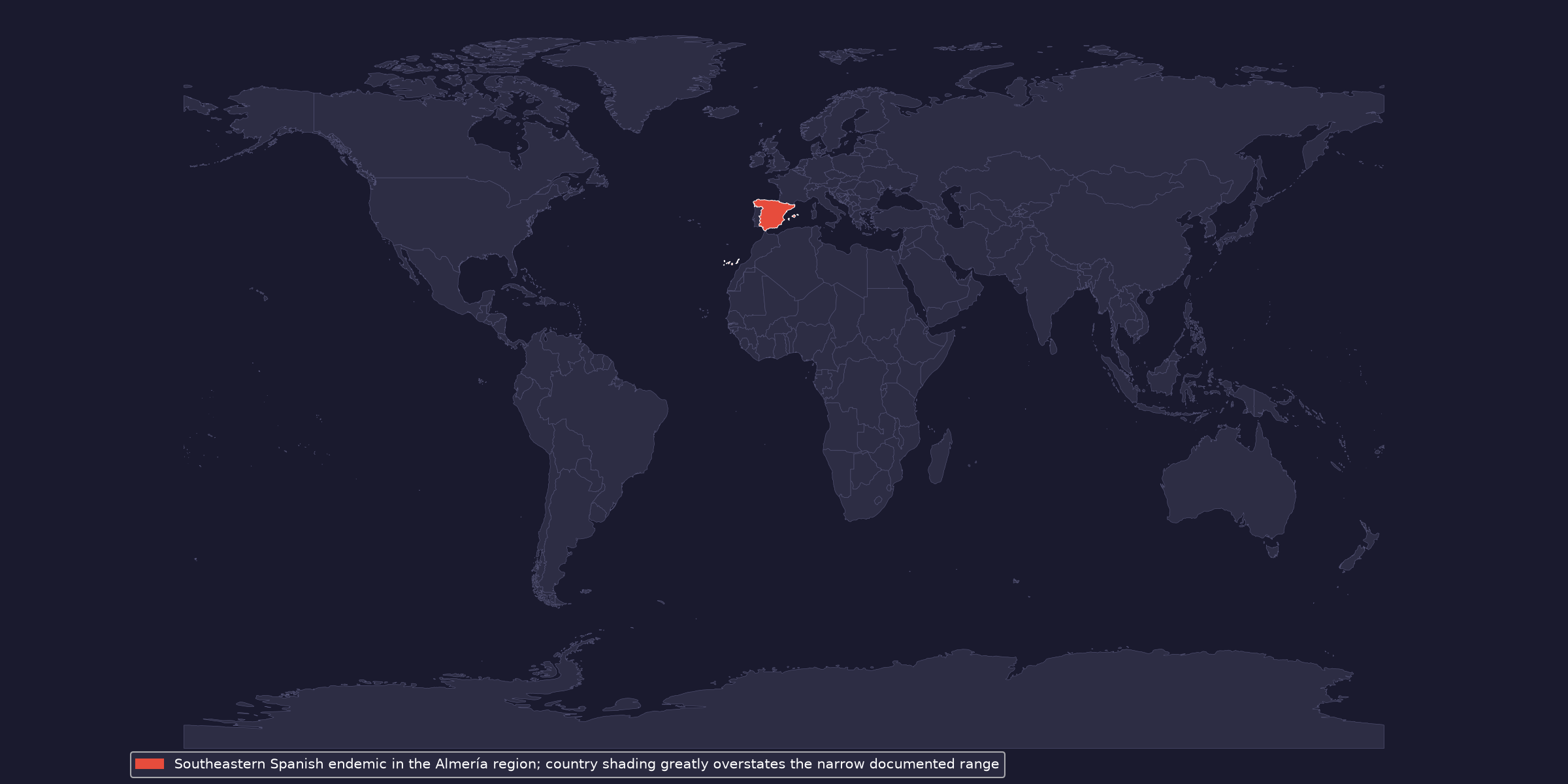
Schmalfuss’s world catalogue records P. magnificus from southeastern Spain in the Almería region, and WoRMS resolves its distribution to Spain. The country map necessarily overstates this highly localized endemic range.
⚖️ Legal status
Checked on 2026-08-29: P. magnificus was not found in the CITES Appendices, EU wildlife-trade Annexes A-D under Regulation (EU) 2026/1383, or Bern Convention Appendices II-III. Local and national rules may nevertheless regulate collecting, protected sites, export, import, transport, keeping, and sales.
Choose documented captive-bred stock and retain invoices, breeder records, and any locality label. Do not take animals from Spanish habitat without permission, mix unverified lines, release surplus, or discard living culture material outdoors.
🤌 Husbandry
Use at least 40 × 25 × 18 cm for a starter group, with broad fine-mesh vents high and low on opposing sides. Keep about one-quarter of the footprint moist and most of the leaf surface dry. Spread flat bark retreats and food across the enclosure so large adults are not forced into one contact point.
| Parameter | Practical starting point |
|---|---|
| Adult length | 2.5-3.5 cm |
| Temperature | 18-26 °C |
| Moisture | stable damp quarter; predominantly dry surface |
| Substrate | 6-8 cm, edible and free draining |
| Staples | hardwood leaves and decomposed deciduous wood |
| Social housing | roomy colony with several hides and feeding sites |
Quarantine new stock for 60-90 days with dedicated tools. Monitor mites, flies, deaths, and labeling before any merger. Separate cultures with different claimed localities or uncertain identification.
💡 Lighting
UVB is not required. A 10-12-hour diffuse photoperiod supports a normal day-night rhythm and plants if used, but every retreat must remain shaded. Keep the box away from direct sunlight and hot lamps.
🌡 Heating and temperature
Maintain 18-26 °C with a 16-21 °C cool retreat and similar nights. Moderate seasonal cooling is acceptable. Prolonged heat above about 27 °C increases dehydration risk, especially when ventilation is strong.
If the room falls below the range, heat one side wall gently under thermostat control. Measure the substrate as well as the air; never use bottom heat or make the sole damp zone the warmest point.
💧 Humidity and water
Treat 45-65% average RH as a trend, not the primary control. The useful gradient is physical: moist lower substrate and a moss pocket at one end, dry leaves and bark over most of the surface, and unrestricted cross-flow above. Pour water into the damp end and adjust frequency after inspecting it below the surface.
Do not add a water dish. Constant condensation, wet leaves, sour odor, or quick mold growth signal excessive water or weak airflow. Bad moults and all animals crowding at the damp edge indicate that the refuge is unstable.
🌿 Enclosure and decoration
Provide 6-8 cm of pesticide-free topsoil or leaf soil blended with leaf mould, mineral grit, and crumbled soft hardwood. Add a deep hardwood leaf layer, several cork or hardwood slabs, and one compact moss patch. Seat stones firmly before adding substrate so burrowing cannot undermine them.
Leave cuttlebone, limestone, or plain calcium carbonate available. Avoid conifer wood, treated timber, fertilizer, pure coconut fibre, and decorative sterile substrates that offer no decomposed food.
🪳 Feeding
Deciduous leaves and soft decomposed hardwood should never run out. Every four to seven days provide a small quantity of squash, carrot, mushroom, dried nettle, or a balanced isopod feed. Add dried shrimp, gammarus, or quality fish food roughly once weekly in modest portions.
Use more than one feeding spot. Remove moist leftovers within 24-48 hours and reduce portions if mites or mold rise. Protein supports a large colony but cannot replace leaf litter, wood, and calcium.
🥚 Breeding
Females retain developing young in a ventral marsupium and release mancae. This is viviparous development, with no external egg-incubation stage. Species-specific reproductive measurements are sparse. Keeper sources report viable cultures when the moisture boundary is stable, but a new group can establish slowly.
Begin with enough unrelated, correctly identified animals to include both sexes. Keep handling and enclosure rebuilding minimal, offer multiple retreats, and wait for several juvenile sizes before dividing a culture.
🩺 Common problems
- Losses after misting: reduce the wet footprint and improve opposing ventilation.
- Failed moults: restore deep moisture at one refuge and verify continuous calcium.
- Damaged appendages: increase floor area, hides, and feeding locations.
- Mites, mold, or odor: feed less, remove leftovers sooner, and inspect drainage.
- Stalled colony: correct heat and moisture first; repeated disturbance rarely helps.
- Label doubt: retain provenance and obtain adult morphological identification rather than relying on colour.
📌 Conclusion
P. magnificus rewards an experienced keeper with size and colour, but needs space and a sharply managed gradient. Prepare strong airflow, dry leaf-covered ground, one dependable damp end, calcium, and several retreats before the colony arrives.
📚 Sources and further reading
- World List of Isopoda: Porcellio magnificus
- GBIF species record: Porcellio magnificus
- Schmalfuss (2003), world catalogue of terrestrial isopods
- Scuttle & Squeak, P. magnificus care guide
- Exuvium, ventilation and moisture guidance for low-humidity isopods
- ReptiFiles site check; general clean-up-crew reference
- EAZA invertebrate live-food husbandry manual
- Warburg (2012), marsupial development in terrestrial isopods
- CITES Appendices
- EU wildlife-trade Annexes: Regulation (EU) 2026/1383
- Bern Convention appendices