Share

Smooth Woodlouse
🔤 Taxonomy
Porcellio laevis Latreille, 1804 is an accepted species in Porcellionidae. Dairy Cow, Milk Back, Orange, Oropesa, Sicily Mix, and White are trade labels for captive cultures, not formal taxa.
Those labels need a qualification: the identity of every culture sold as P. laevis is not settled. Keepers report that some Dairy Cow and Milk Back stocks do not cross with other “laevis” lines, and a 2026 research project is testing whether the trade contains cryptic species. Until peer-reviewed results resolve the question, record the supplier and lineage, keep cultures separate, and use “Porcellio cf. laevis” when identity is uncertain. This guide groups the submitted names for practical care; it does not certify that all are the same biological species.
📌 Description
The smooth woodlouse is a broad, fast Porcellio reaching about 1.5-2 cm. Compared with P. scaber, its dorsal surface is smoother and adults look heavier. Captive lines range from grey-brown to orange, white, mottled, or black-and-white.
Healthy colonies are conspicuous at food and reproduce quickly. Their main risks are crowding, protein shortage, a depleted non-edible substrate, and a sealed wet container. They cannot roll into a complete ball and should be moved on bark or with a soft spoon, not pinched.
🌍 Distribution
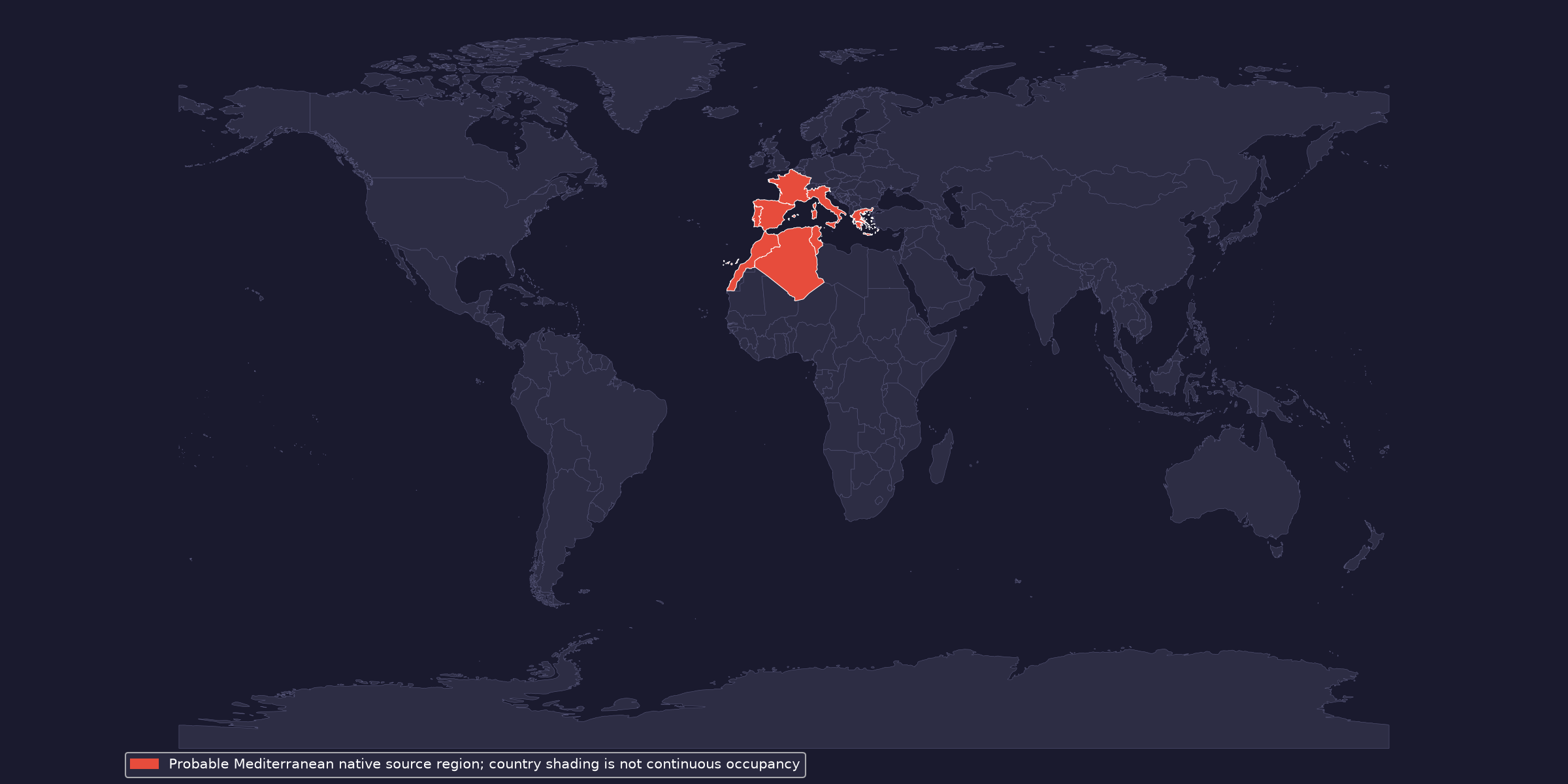
WoRMS records P. laevis from southern Europe and North Africa and from introduced populations on several continents. Recent faunal work describes it as originally Mediterranean and now synanthropically cosmopolitan. The map therefore shows the probable Mediterranean source region, not every introduced record and not the origin of any particular captive morph.
⚖️ Legal status
Checked on 2026-08-23: Porcellio laevis was not found in the current CITES Appendices, EU wildlife-trade Annexes A-D under Regulation (EU) 2026/1383, or Bern Convention Appendices II-III. These list checks do not override national controls on live invertebrate import, transport, breeding, sale, or agricultural biosecurity.
Buy traceable captive stock and retain the invoice, seller, culture name, and date. Never release animals or substrate outdoors; freeze unwanted culture material before disposal when local rules permit.
🤌 Husbandry
A 30 × 20 × 15 cm ventilated box suits a starter colony of roughly 20-30 animals. Maintain a damp refuge across about one-third of the floor and a lightly damp to almost dry surface at the other end. P. laevis tolerates more moisture than the giant Spanish Porcellio species, but it still needs air exchange and a real choice of microclimates.
| Parameter | Practical target |
|---|---|
| Adult size | 1.5-2 cm |
| Temperature | 18-26 °C |
| Moisture | damp third, ventilated drier side |
| Substrate | at least 6 cm, rich in leaves and rotten hardwood |
| Staple diet | hardwood leaves and decayed wood |
| Social housing | colony; split before crowding |
Quarantine new stock for 60-90 days with separate tools. Watch for mixed species, fungus gnats, pest mites, iridovirus-like blue or purple animals, unexplained deaths, and incorrect labels before moving leaves, wood, or animals near other colonies.
💡 Lighting
UVB is unnecessary. Provide a normal 10-12-hour room-light cycle and shaded cover. Direct sun or a display lamp can dangerously heat a small tub even when the room is cool.
🌡 Heating and temperature
Maintain 18-26 °C; ordinary room temperature around 20-24 °C works well. Reproduction slows toward the cool end without requiring artificial winter rest. If heating is needed, warm one side under thermostat control and keep the opposite end cooler.
Avoid bottom heat, which dries the refuge from below, and sustained temperatures above 28 °C. A warm, crowded culture consumes oxygen quickly, so heat must always be paired with generous cross-ventilation.
💧 Humidity and water
Use 55-75% relative humidity only as a supporting measurement. The substrate is the better guide: moss at the moist end should feel damp but should not release water when squeezed. The far end may dry at the surface, while deeper layers retain slight moisture.
No water dish is needed. Add water directly to the moist end. Constant condensation, sour odour, and substrate that smears like mud indicate excess water or insufficient airflow; failed molts and juveniles clustering tightly in the damp corner suggest the refuge has become too dry.
🌿 Enclosure and decoration
Use at least 6 cm of pesticide-free leaf soil, crushed decayed hardwood, and a moisture-retaining component such as sphagnum. Coconut fibre can contribute structure but is not an adequate diet by itself. Cover most of the surface with verified safe oak, beech, maple, or other hardwood leaves.
Add cork flats, soft rotten hardwood, and a small moss refuge. Keep plain cuttlebone, limestone, oyster shell, or calcium carbonate available. Avoid coniferous aromatic wood, fertilizer, treated compost, street-collected leaves, and heavy stones resting on loose substrate.
🪳 Feeding
Leaf litter and decomposed hardwood are permanent staples. Once or twice weekly offer a portion of squash, carrot, sweet potato, mushroom, dried nettle, or a balanced isopod diet small enough to disappear within 24-48 hours.
This species is protein-responsive, especially in dense colonies. Offer a modest amount of dried shrimp, fish food, or insect-based feed once or twice weekly and increase only when it is consumed cleanly. Protein does not replace leaves, wood, or calcium. Shortages can lead to nibbling on molts, newborns, or vulnerable terrarium inhabitants.
🥚 Breeding
Females brood eggs and embryos in a fluid-filled ventral marsupium and release mancae, not externally laid eggs. The repository therefore records reproduction as viviparous and omits incubation fields. Do not dig up gravid females or try to isolate a brood.
Warm stable conditions, protein, calcium, and ample leaf biomass support rapid growth. Split a colony when most hides are crowded or all food disappears immediately. Preserve Dairy Cow, Milk Back, Orange, Oropesa, Sicily Mix, and White as separately labelled cultures; mixing destroys provenance and may conceal incompatible lineages.
🩺 Common problems
- Mites, mold, or sour smell: remove excess food, improve ventilation, and replace saturated patches.
- Failed molts: restore a moist refuge and permanent calcium without wetting the entire box.
- Cannibalism or damaged mancae: increase leaf biomass and modest protein, then reduce crowding.
- Sudden decline after combining cultures: separate them; identity, microbes, and care history may differ.
- Blue-purple individuals or unexplained deaths: isolate the box and its tools rather than transferring stock.
📌 Conclusion
This is a productive beginner colony only when its appetite and population growth are planned for. Set up edible substrate, ventilation, and a second labelled culture before numbers surge; do not assume a familiar trade name proves species identity.
📚 Sources and further reading
- WoRMS: Porcellio laevis
- GBIF species record: Porcellio laevis
- Gardini et al. (2026), Mediterranean origin and synanthropic distribution
- Current research project on cryptic diversity in trade cultures
- Specialist culture notes for P. laevis Milk Back
- ReptiFiles cleanup-crew overview
- Warburg (2012), marsupial development in terrestrial isopods
- CITES Appendices
- EU wildlife-trade Annexes: Regulation (EU) 2026/1383
- Bern Convention appendices