Share

Titan Isopod
🔤 Taxonomy
Porcellio hoffmannseggii Brandt, 1833 is the accepted spelling. Listings commonly drop the final “i” as P. hoffmannseggi; older literature also contains P. emarginatus and P. hispanicus, now treated as synonyms or former combinations in the species complex.
“Titan isopod” is a hobby name. Orange is a captive colour line, not a subspecies, and belongs in this guide while remaining separately labelled.
📌 Description
This is one of the largest terrestrial isopods in the European hobby. Large adults can approach 3-4 cm when the projecting uropods are included. The flattened body, long antennae, and long rear appendages make it a striking surface-active display species, but also one that needs more floor space than P. scaber.
Its key care combination is high ventilation with a small, dependable moist retreat. Keeping the entire box damp causes stale conditions; keeping every layer dry prevents normal respiration and molting.
🌍 Distribution
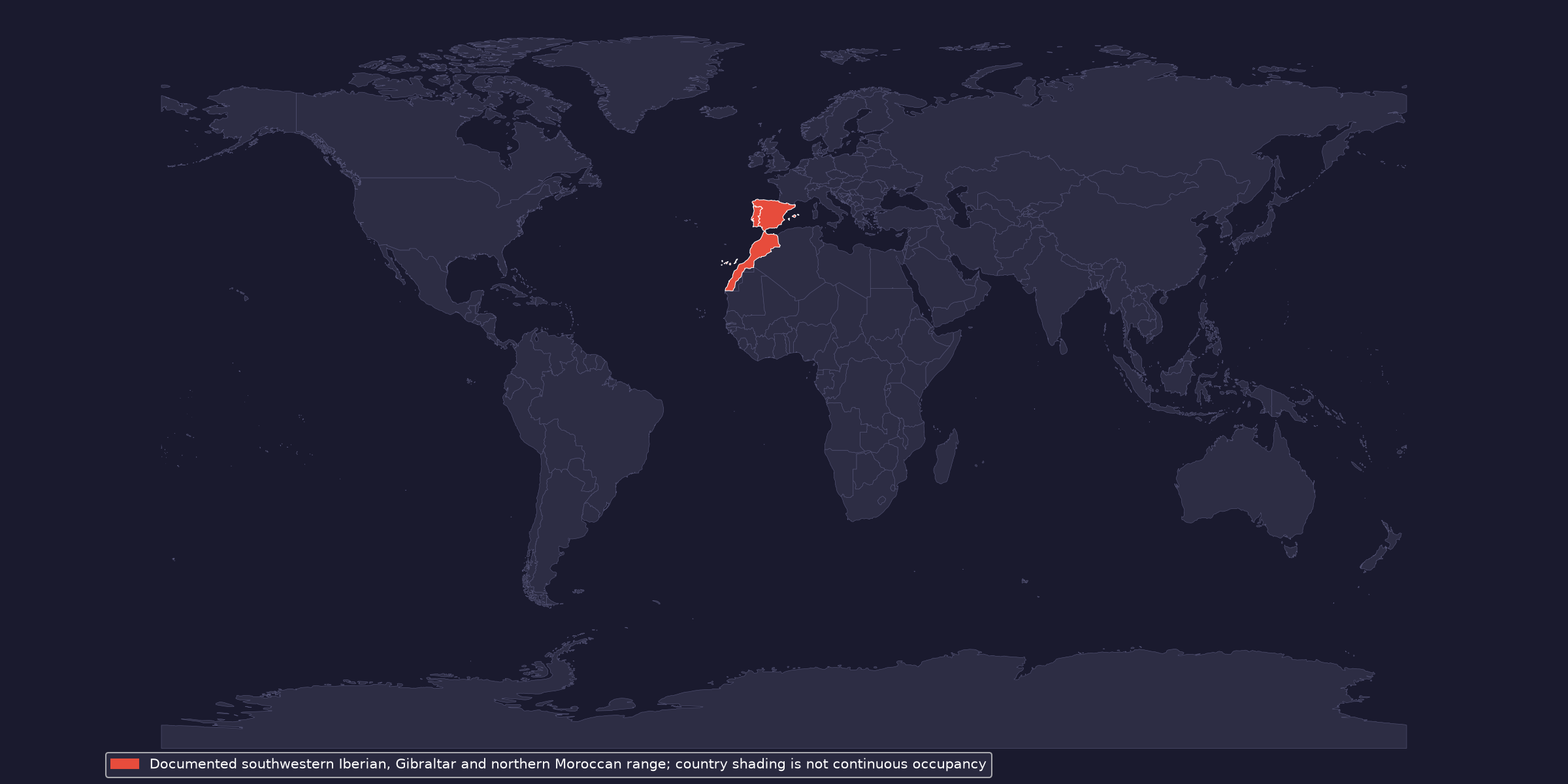
Taxonomic revisions and WoRMS records place the typical form across Portugal, southwestern Spain, and northern Morocco, with records around Gibraltar. Some island or named forms historically placed beneath P. hoffmannseggii require care when interpreting old labels.
⚖️ Legal status
Checked on 2026-08-23: no listing for P. hoffmannseggii was found in the current CITES Appendices, EU wildlife-trade Annexes A-D under Regulation (EU) 2026/1383, or Bern Convention Appendices II-III. Collection inside protected sites and export of native wildlife may nevertheless be regulated in Portugal, Spain, and Morocco.
Choose captive-bred animals and retain proof of origin, especially for an imported or locality-labelled culture. Never release the animals or their substrate.
🤌 Husbandry
Use at least a 40 × 30 × 20 cm box for a starter group, with cross-ventilation on two sides and a well-ventilated lid. Reserve roughly one-fifth to one-quarter of the floor as the moist refuge; the remainder should have a dry surface and only faint moisture deeper down.
| Parameter | Practical target |
|---|---|
| Adult size | 2.5-4 cm including projecting uropods |
| Temperature | 18-25 °C |
| Moisture | small moist refuge, mostly dry ventilated surface |
| Substrate | 7-10 cm, leaf-rich and mineral-bearing |
| Staple diet | leaves and decayed hardwood, with regular protein |
| Social housing | roomy colony with many separated hides |
Quarantine for 60-90 days. Imported stock can arrive dehydrated or with mites, mixed juveniles, and uncertain locality labels. Transfer the packing material into the prepared moist edge, then leave the animals largely undisturbed for the first week.
💡 Lighting
UVB is not required. Give 10-12 hours of diffuse room light and deep shaded shelters. Direct sun and heat lamps are inappropriate for a small ventilated box.
🌡 Heating and temperature
Maintain 18-25 °C, with 20-24 °C a useful working range. Cooler nights around 17-22 °C are acceptable. Breeding may slow in winter without deliberate chilling.
Avoid prolonged temperatures above 27 °C. If the room is cold, heat one side wall with a thermostatted source; never heat beneath the moist refuge. Large colonies need even more ventilation as temperature and feeding increase.
💧 Humidity and water
Relative humidity around 45-65% across the open area is compatible with this dry-leaning species, provided the moss refuge remains damp. Pour water only into that refuge and let the dry side breathe. A hygrometer cannot confirm that a hidden animal has access to moisture, so inspect the moss and deeper substrate by touch.
No water dish is needed. Constant lid condensation, animals spending days high on the walls, or a sour smell suggests saturation and inadequate airflow. Animals permanently packed into the last damp corner signal that the refuge is too small or dry.
🌿 Enclosure and decoration
Build 7-10 cm of pesticide-free topsoil or leaf soil mixed with crushed rotten hardwood, leaf fragments, and a mineral component such as limestone grit. Keep sphagnum only at the moist end. A coconut-fibre-only bed is nutritionally poor and tends to hide moisture errors.
Cover the dry zone with hardwood leaves and several cork flats placed separately so adults can spread out. Leaning bark creates ventilated elevated retreats. Keep plain calcium available at all times and secure heavy stones on the container floor before adding substrate.
🪳 Feeding
Leaves and soft rotten hardwood must remain available. Offer squash, carrot, sweet potato, mushroom, dried herbs, or formulated isopod food once or twice weekly in small portions.
Giant Porcellio use animal protein readily. Provide dried shrimp, quality fish food, or insect-based feed about once weekly, divided among several stations to reduce crowding. Remove fresh leftovers within 24-48 hours. Calcium from cuttlebone, limestone, oyster shell, or plain calcium carbonate should never run out.
🥚 Breeding
Females carry eggs and embryos in a ventral marsupium and release mancae; no eggs are laid for external incubation. The structured field therefore uses viviparous. Mature males usually have more strongly developed rear appendages and ventral reproductive structures, but sex should not be forced by handling valuable animals.
Breeding is moderate rather than explosive. Stable moisture access, space under multiple hides, protein, and calcium matter more than raising the whole enclosure humidity. Avoid moving gravid females, protect the first mancae from dry ventilation mesh, and keep Orange stock separately labelled.
🩺 Common problems
- Deaths after wetting the whole box: restore a small moist refuge and increase cross-flow.
- Failed molts: verify deep moisture and calcium; do not mist adults directly.
- Chewed antennae or missing limbs: add hides and feeding stations, then reduce density.
- Poor breeding: check maturity, sex balance, protein, and whether the refuge dries between inspections.
- Persistent wall climbing: check heat, saturated substrate, spoiled food, and ventilation.
📌 Conclusion
The titan isopod suits a keeper ready to manage airflow and moisture as separate variables. Prepare a spacious, mostly dry box with a protected damp corner before purchase; turning the enclosure into a uniformly humid tropical culture is the central avoidable error.
📚 Sources and further reading
- WoRMS: Porcellio hoffmannseggii
- GBIF species record: Porcellio hoffmannseggii
- Schmalfuss (1987), revision and range of P. hoffmannseggii
- Cifuentes (2021), records from Extremadura
- Specialist husbandry profile
- ReptiFiles cleanup-crew overview
- Warburg (2012), marsupial development in terrestrial isopods
- CITES Appendices
- EU wildlife-trade Annexes: Regulation (EU) 2026/1383
- Bern Convention appendices