Share

Porcellio haasi
🔤 Taxonomy
Porcellio haasi Arcangeli, 1925 is accepted by the World List of Isopoda and GBIF. The species is sold in several colour-selected cultures, including “High Yellow”; these are trade labels, not separate taxa. Keep any locality and line name with the scientific identification.
📌 Description
Published Catalan material places mature males around 25 mm; a practical adult range is therefore about 2.0-2.5 cm rather than the larger figures sometimes advertised. The animal is broad, granular, non-conglobating, and has extended uropods. Colour ranges from grey-brown to conspicuous yellow lateral patches.
This is an intermediate dry-climate Porcellio. It tolerates neither a sealed humid box nor complete desiccation. Species-specific laboratory husbandry has not been published; the numbers below are cautious starting points synthesized from its eastern Spanish ecology and established breeder practice.
🌍 Distribution
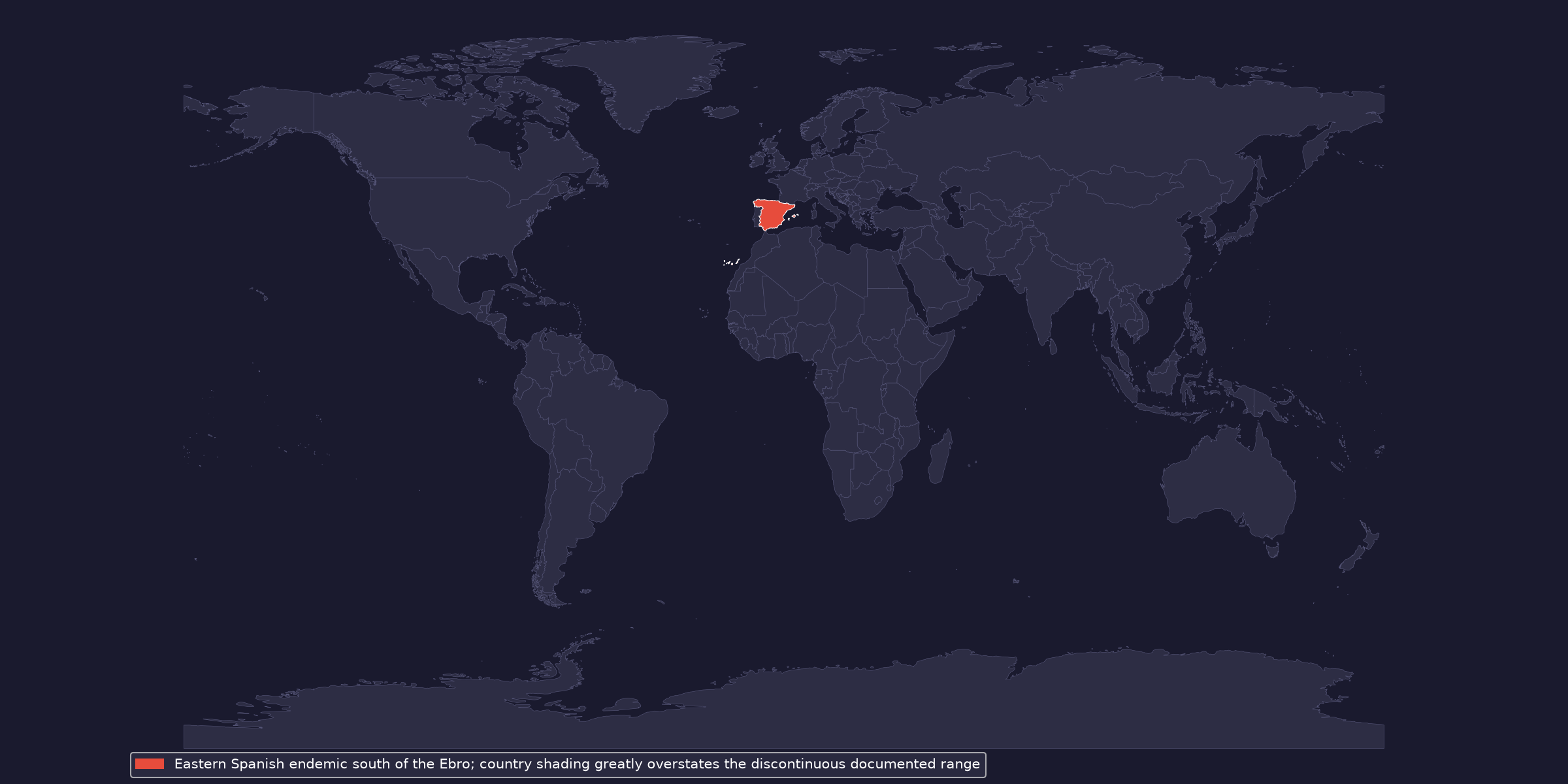
The world catalogue records P. haasi in eastern Spain south of the River Ebro. A Catalan faunistic treatment describes it as endemic to southern Catalonia. Shading all of Spain therefore greatly exaggerates a localized and discontinuous range.
⚖️ Legal status
Checked on 2026-08-29: P. haasi was not found in the CITES Appendices, EU wildlife-trade Annexes A-D under Regulation (EU) 2026/1383, or Bern Convention Appendices II-III. Local and national rules can still control collection, protected areas, export, import, transport, possession, and animal sales.
Obtain documented captive-bred stock, retain invoices and breeder/locality labels, and quarantine arrivals. Never collect from Spanish habitat without permission, release surplus, or dispose of living substrate outdoors.
🤌 Husbandry
House a starter group in at least 35 × 25 × 18 cm with generous fine-mesh cross-ventilation. Maintain a damp refuge over roughly one-fifth to one-quarter of the floor and keep most leaves dry on top. Several flat hides and two feeding points reduce crowding.
| Parameter | Practical starting point |
|---|---|
| Adult length | 2.0-2.5 cm |
| Temperature | 18-25 °C |
| Moisture | small stable damp end; mostly dry surface |
| Substrate | 6-8 cm, edible and well drained |
| Staples | deciduous leaves and soft rotten hardwood |
| Social housing | ventilated colony with several retreats |
Quarantine for 60-90 days with separate tools. Watch for flies, mites, unexplained deaths, and incorrect labels. Do not merge cultures with different localities, colour-line histories, or uncertain identities.
💡 Lighting
UVB is not needed. Give a 10-12-hour diffuse light cycle with deep shaded retreats. Keep the enclosure out of direct sunlight; transparent tubs can heat far beyond room temperature.
🌡 Heating and temperature
Maintain 18-25 °C with a 16-21 °C cool area and similar night temperatures. Seasonal room cooling is useful, but forced winter chilling has not been established as necessary. Avoid sustained temperatures above about 27 °C.
When heating is unavoidable, warm one side wall gently and control it with a thermostat. Verify deep-substrate temperature and never heat from below or remove the cooler moist option.
💧 Humidity and water
Average RH around 45-60% is a secondary guide. Keep lower substrate and a compact moss patch moist at one end while most bark and leaves remain dry at the surface. Add water into the substrate rather than fogging the whole enclosure, and change the interval according to actual drying.
No water dish is required. Persistent condensation, sour substrate, and fast mold suggest overwatering or inadequate airflow. Failed moults or total crowding at one edge suggest that the moist refuge has contracted too far.
🌿 Enclosure and decoration
Use 6-8 cm of pesticide-free topsoil or leaf soil mixed with hardwood leaf mould, soft decayed wood, and mineral grit. Add a thick layer of safe deciduous leaves, several pieces of cork or hardwood bark, and a compact moss refuge. Secure stones before filling around them.
Provide cuttlebone, limestone, or plain calcium carbonate continuously. Pure coconut fibre, aromatic conifer, treated wood, fertilizer, and sterile gravel do not provide a suitable edible base.
🪳 Feeding
Hardwood leaves and soft decomposed hardwood remain available at all times. Every four to seven days offer a little squash, carrot, mushroom, dried nettle, or balanced isopod food. Once weekly, add a small protein portion such as dried shrimp, gammarus, or quality fish food.
Split food between two locations and remove wet leftovers within 24-48 hours. Reduce the ration when mites or mold appear; supplemental protein is useful but should never dominate the diet.
🥚 Breeding
Females brood embryos in a ventral marsupium and release mancae. This is viviparous development, with no external egg-incubation stage. Controlled breeding data for P. haasi were not located. Trade cultures suggest moderate propagation once settled, but line vigor and starting group composition vary.
Provide mature mixed-sex stock, stable deep moisture, calcium, moderate protein, and low disturbance. Wait until the colony contains several juvenile size classes before dividing it, and preserve each locality or colour line separately.
🩺 Common problems
- Sudden deaths in a wet box: dry most of the surface and enlarge opposing vents.
- Failed moults: restore deep refuge moisture and continuous calcium.
- Mold or mites: reduce supplemental food and remove residues sooner.
- Damaged uropods: add floor space, bark cover, and another feeding site.
- Slow reproduction: stabilize conditions and verify mature mixed-sex stock before changing parameters.
- Inflated size or locality claim: retain the label but distinguish seller information from published evidence.
📌 Conclusion
P. haasi is manageable for a keeper already comfortable with moisture gradients. Its essentials are strong airflow, a mostly dry leaf surface, one reliable damp refuge, edible substrate, modest protein, calcium, and careful provenance.
📚 Sources and further reading
- World List of Isopoda: Porcellio haasi
- GBIF species record: Porcellio haasi
- Arcangeli (1925), original Spanish isopod treatment
- Catalan faunistic publication, endemic distribution and size
- Schmalfuss (2003), world catalogue of terrestrial isopods
- PostPods, P. haasi “Bardenas” keeper parameters
- Porcellio.nl, P. haasi culture and adult size
- ReptiFiles site check; general clean-up-crew reference
- EAZA invertebrate live-food husbandry manual
- Warburg (2012), marsupial development in terrestrial isopods
- CITES Appendices
- EU wildlife-trade Annexes: Regulation (EU) 2026/1383
- Bern Convention appendices