Share

Yellow-Margined Isopod
🔤 Taxonomy
Porcellio flavomarginatus Lucas, 1853 is the accepted name in GBIF and the World List of Isopoda. Older combinations that still appear in regional literature include Porcellio creticus, P. decorus, P. andrius, and P. rechingeri, now treated as synonyms.
“Crete” identifies the ancestry or locality claimed for a captive line; it is not a subspecies or colour morph taxon. Keep it on culture records without creating a separate species article or assuming that every similarly patterned animal comes from Crete.
📌 Description
Adults are broad, non-conglobating isopods about 1.5-2.3 cm long. Dark animals may carry pale cream to yellow lateral markings, with considerable variation across the natural range and within Crete. High-elevation Cretan specimens have been reported as darker and smoother than lowland animals, showing why colour alone is a poor basis for naming stock.
This is a dry-tolerant Mediterranean Porcellio, not a species for uniform tropical humidity. Successful cultures combine a predominantly dry, airy surface with one deep, dependable hydration refuge.
🌍 Distribution
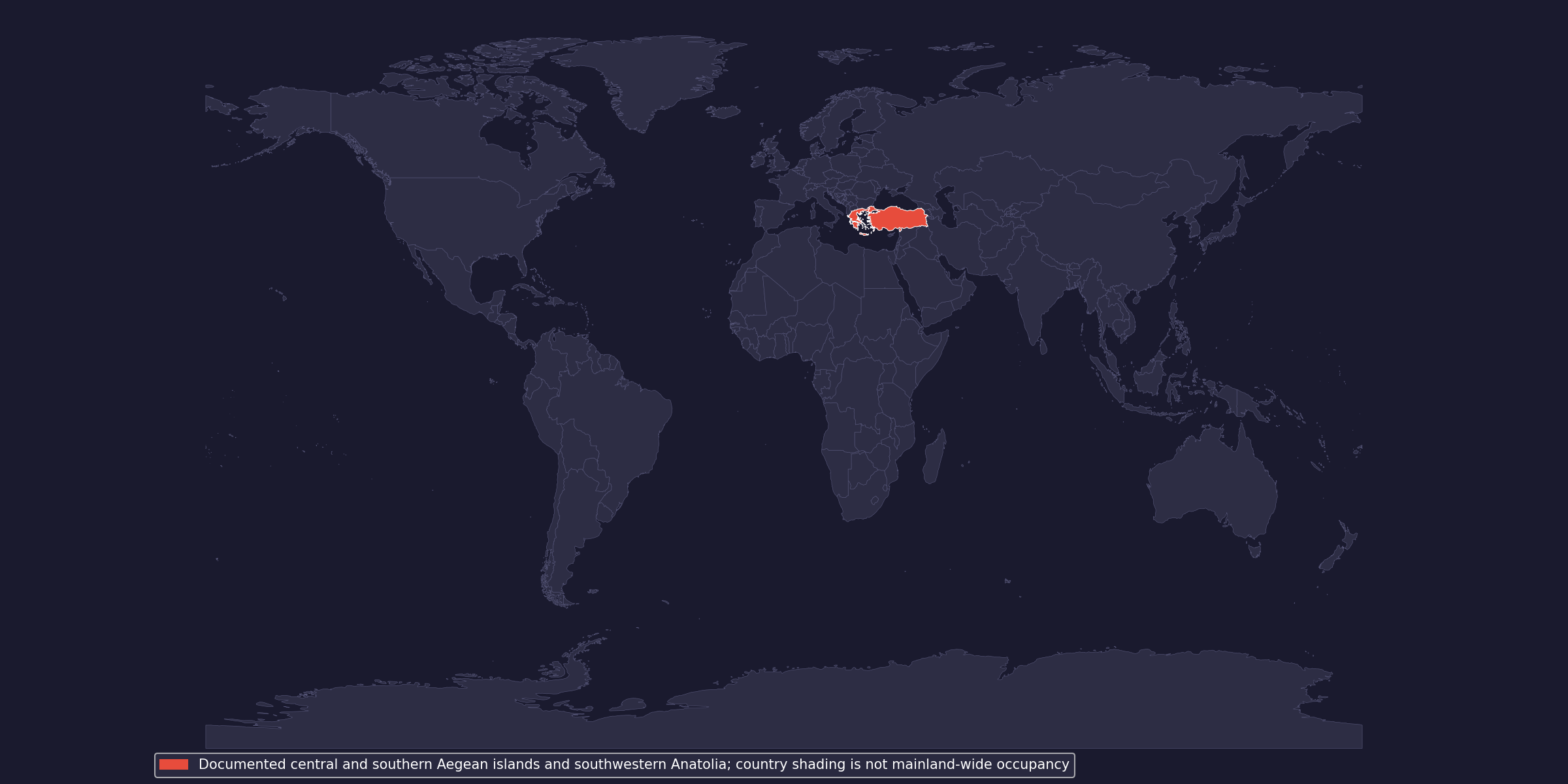
A detailed survey found P. flavomarginatus throughout Crete and on Gavdos, with the wider range covering central and southern Aegean islands and southwestern Anatolia near Marmaris. On Crete it is associated with calcareous ground and occurs from lowlands to above 1,500 m.
The Crete trade line should be maintained as a locality line when its provenance is traceable. The locality label does not justify mixing separate cultures or expanding the stated range beyond published records.
⚖️ Legal status
Checked on 2026-08-23: Porcellio flavomarginatus is absent from the CITES Appendices, EU wildlife-trade Annexes A-D under Regulation (EU) 2026/1383, and Bern Convention Appendices II-III. Site protection, collection restrictions, and national transport or export rules remain separate matters.
Prefer documented captive-bred Crete stock and retain invoices and transfer records. Do not collect from protected Greek sites, and never release a colony or discard viable substrate outdoors.
🤌 Husbandry
A 30 × 20 × 15 cm container suits a starter colony of 10-20. Give it broad high and low cross-ventilation, with most openings over the dry side. Fine mesh or very small holes prevent mancae escaping. Provide several tight shelters so animals can choose moisture without crowding.
Quarantine new stock for 30-60 days with separate tools. Record the exact supplier locality wording, check for mites and unexplained loss, and never merge a verified Crete line with unproven or differently sourced stock.
💡 Lighting
UVB is not required. Use a diffuse 10-14-hour light cycle with deep shade below cork and stone-like décor. Direct sun and strong display lamps can overheat a dry enclosure quickly.
🌡 Heating and temperature
Keep most cultures at 18-26 °C, with a 16-21 °C retreat and nights around 16-22 °C. Seasonal room cooling is acceptable; deliberate cold dormancy is unnecessary for routine colony care.
Avoid sustained temperatures above 28 °C. Heat only one outer wall under thermostat control if needed, leaving the moist refuge and lower substrate cooler. Dry Mediterranean species can still dehydrate rapidly when warm air accelerates water loss.
💧 Humidity and water
Maintain a small but continuous damp zone occupying about one-quarter of the floor, preferably with moss and deeper soil beneath cork. The remaining surface can dry appreciably and should receive strong air exchange. Overall readings around 40-65% RH are less important than ensuring that the refuge stays available.
Add water directly to the damp end and allow the top of the middle and dry side to dry. Do not provide a water dish. A uniformly wet box encourages poor moults, fungus, and colony decline; a completely dry base causes failed moults and juvenile loss.
🌿 Enclosure and decoration
Use 5-7 cm of mineral-rich, pesticide-free topsoil with deciduous leaf mould and rotten hardwood. Add limestone pieces, cork flats, dry leaves, and one compact moss pocket. Heavy stone must sit securely on the container floor or fixed supports.
Supply cuttlebone or calcium carbonate continuously. Avoid a peat or coir-only base, aromatic conifer wood, fertilizer, treated garden material, and constant saturation. Calcareous habitat does not mean replacing edible leaf-and-wood substrate with sterile rock.
🪳 Feeding
Keep decayed hardwood leaves and soft rotten wood available at all times. Add small portions of carrot, squash, sweet potato, courgette, mushroom, dried nettle, or similar produce two or three times weekly. Provide a modest amount of dried shrimp, gammarus, or fish food once weekly, with slightly more only when the colony consumes it promptly.
Place food on bark or a dry leaf and remove moist leftovers after 24-48 hours. Permanent calcium is more useful than heavy protein feeding; excess protein quickly supports mites in a warm Mediterranean setup.
🥚 Breeding
Females brood eggs and embryos inside a fluid-filled marsupium beneath the body and release mancae. The repository uses “viviparous” for this reproductive mode; there are no exposed eggs and no incubation fields.
The species breeds steadily once mature but may establish more slowly than powder isopods. Preserve the damp lower refuge, offer calcium and modest protein, and avoid separating gravid females. Let the colony contain several age classes before dividing it.
🩺 Common problems
- Failed moults: check that the damp refuge reaches below the surface and that heat is not excessive.
- Fungal substrate: reduce the wetted footprint and increase cross-ventilation.
- Slow growth: improve the quality of rotten hardwood and leaf litter before adding more vegetables.
- Locality-label loss: keep Crete and other lines separately labelled and do not infer ancestry from colour.
- Crushed animals: stabilize limestone and cork before adding loose substrate around them.
📌 Conclusion
The yellow-margined isopod is best for an intermediate keeper who can keep most of a Mediterranean enclosure dry without removing its hydration refuge. For Crete stock, careful provenance records are as important as the colour pattern.
📚 Sources and further reading
- GBIF: Porcellio flavomarginatus
- World List of Isopoda: Porcellio flavomarginatus
- Schmalfuss, Paragamian and Sfenthourakis: terrestrial isopods of Crete
- Schmalfuss 2003 world catalog of terrestrial isopods
- ReptiFiles site check; general clean-up-crew reference
- CITES Appendices
- Current EU wildlife-trade Annexes: Regulation (EU) 2026/1383
- Bern Convention appendices