Share

Porcellio flavocinctus
🔤 Taxonomy
Porcellio flavocinctus Budde-Lund, 1885 is accepted by the World List of Isopoda and GBIF. It belongs to a group of large western Mediterranean Porcellio whose external appearance can overlap; the historic literature repeatedly confused it with related species. Culture labels and colour alone therefore do not establish an identification.
📌 Description
Adults are strongly convex, non-conglobating isopods about 1.8-2.5 cm long. Described animals have a brown to nearly black centre, paler lateral margins, and long uropods, especially in mature males. Pattern and granulation vary, so photographs are not a safe substitute for examination of adult diagnostic characters.
This is a dry-climate display species for an established isopod keeper. It needs vigorous airflow and a mostly dry surface, but it cannot survive without a permanent moist refuge for respiration and moulting.
🌍 Distribution
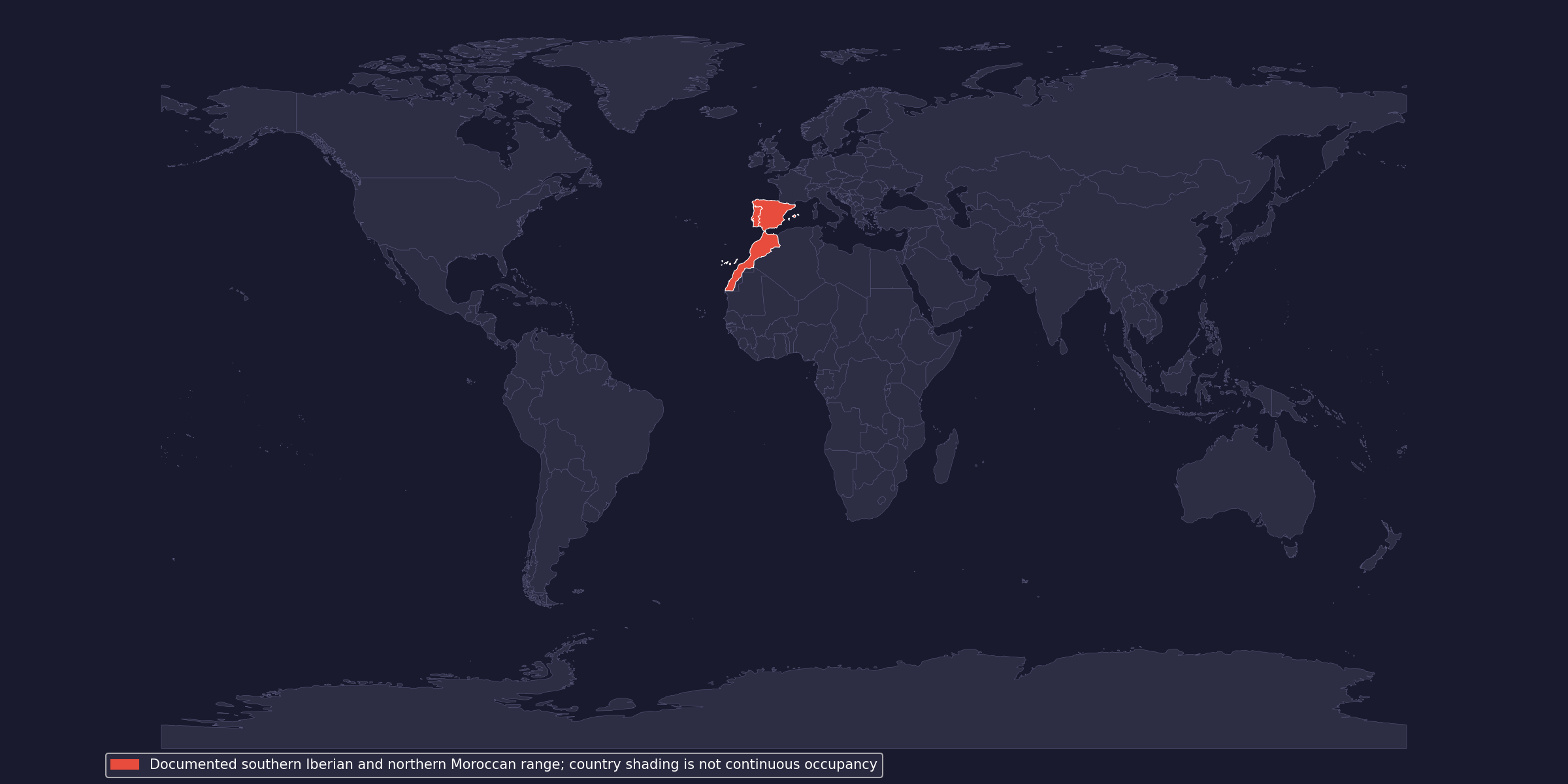
Published records place P. flavocinctus in southern Portugal, southern and central Spain, and northern Morocco. A modern taxonomic study confirmed it in Morocco’s Rif after older authors had questioned the North African records. Country shading does not imply continuous occupancy across all three states.
⚖️ Legal status
Checked on 2026-08-29: P. flavocinctus was not found in the CITES Appendices, EU wildlife-trade Annexes A-D under Regulation (EU) 2026/1383, or Bern Convention Appendices II-III. This does not override national collection, protected-area, export, import, transport, or animal-sale rules in Portugal, Spain, Morocco, or the keeper’s country.
Choose documented captive-bred stock and keep invoices and breeder records. Do not collect wild animals, claim an unsupported locality, release surplus, or discard live culture substrate outdoors.
🤌 Husbandry
Use at least 35 × 25 × 18 cm for a starter group, with fine-mesh vents high and low on opposing walls. Keep roughly one-quarter of the floor moist and the remaining surface dry. Several bark retreats let animals regulate moisture without concentrating under one hide.
| Parameter | Practical target |
|---|---|
| Adult length | 1.8-2.5 cm |
| Temperature | 18-25 °C |
| Moisture | small stable damp refuge; mostly dry surface |
| Substrate | 6-8 cm, mineral-rich and edible |
| Staples | deciduous leaves and rotten hardwood |
| Social housing | ventilated colony with several retreats |
Quarantine new cultures for 60-90 days with separate tools. Photograph the seller label, note any claimed country or locality, and do not merge cultures whose identification or origin differs.
💡 Lighting
UVB is unnecessary. Provide 10-12 hours of diffuse room or low-intensity plant light and deep shade below bark. Avoid direct sun and close lamps, which can overheat the dry side rapidly.
🌡 Heating and temperature
Maintain 18-25 °C, with a 16-21 °C retreat and similar night temperatures. Normal seasonal room cooling is preferable to driving growth with heat. Sustained temperatures above about 27 °C increase water loss and make a small hydration error more serious.
If the room is too cold, warm only one side wall with thermostatic control. Do not heat from below or warm the moist refuge more than the rest of the enclosure.
💧 Humidity and water
An overall reading near 45-65% RH is useful only as a trend. The critical feature is damp—not flooded—lower substrate and moss at one end, while leaves and bark across most of the box remain dry at the surface. Add water directly to the refuge and let it spread through the soil.
No water dish is needed. Whole-lid condensation, wet leaves everywhere, and persistent climbing indicate excessive water or inadequate ventilation. Failed moults and crowding in the last damp patch indicate that the refuge is too small or unstable.
🌿 Enclosure and decoration
Use 6-8 cm of pesticide-free topsoil or leaf soil mixed with deciduous leaf mould, rotten hardwood, and crushed limestone. Add a thick leaf layer, thin cork pieces, and one compact moss pocket. Set heavy stones securely on the container floor before surrounding them with substrate.
Keep cuttlebone, limestone, or plain calcium carbonate available. Avoid pure coconut fibre, aromatic conifer wood, fertilizer, treated timber, and sterile rock-only setups; much of the colony’s normal food should be built into the substrate.
🪳 Feeding
Decayed hardwood leaves and soft rotten wood remain available continuously. Every four to seven days offer a small portion of squash, carrot, mushroom, dried nettle, or a complete isopod diet. Give a small amount of dried shrimp, gammarus, or fish food about once weekly.
Use two feeding points in a growing colony and remove wet leftovers within 24-48 hours. More protein does not compensate for poor leaf litter and can quickly produce mites and mold.
🥚 Breeding
Females retain eggs and embryos in a ventral marsupium and release mancae; the repository therefore records this mode as viviparous, with no external egg-incubation fields. Published species-specific colony data are scarce, so breeding should be treated as moderate rather than guaranteed.
Stable moisture below the refuge, calcium, restrained protein, mature mixed-sex stock, and low disturbance are the safest starting points. Wait for several age classes before splitting a culture.
🩺 Common problems
- Sudden losses after watering: reduce the wetted footprint and improve cross-ventilation.
- Failed moults: check deep moisture and continuous calcium without soaking the dry zone.
- Mites or mold: reduce supplemental food and remove residues sooner.
- Damaged uropods or antennae: add floor space, flat hides, and more than one feeding point.
- Uncertain identification: retain the seller label and use an adult specimen and a qualified taxonomic key rather than renaming by colour.
📌 Conclusion
P. flavocinctus suits a keeper who already understands moisture gradients in dry-climate Porcellio. Establish the damp refuge and airflow before purchase; a uniformly humid container is the most avoidable risk.
📚 Sources and further reading
- World List of Isopoda: Porcellio flavocinctus
- GBIF species record: Porcellio flavocinctus
- Taiti and Rossano (2015), Rif material and distribution
- Arcangeli (1936), redescription and identification history
- Schmalfuss (2003), world catalogue of terrestrial isopods
- ReptiFiles site check; general clean-up-crew reference
- Warburg (2012), marsupial development in terrestrial isopods
- CITES Appendices
- EU wildlife-trade Annexes: Regulation (EU) 2026/1383
- Bern Convention appendices