Share

Porcellio expansus
🔤 Taxonomy
Porcellio expansus Dollfus, 1892 is an accepted species in the World List of Isopoda and GBIF. It is a large, non-conglobating member of Porcellionidae. Trade names and colour forms are not taxonomic ranks, so keep the scientific name and any documented locality attached to the culture.
📌 Description
Adults commonly reach about 3-4 cm and have an unusually broad, flattened outline, long uropods, and strongly expanded lateral plates. Colour varies from pale grey to orange-brown or darker patterned forms. It cannot roll into a ball and should be moved in a container, not pinched by the body or uropods.
This is an advanced dry-climate display isopod. Experienced breeders consistently report that it needs extensive airflow and a mostly dry surface, while one small deep refuge must stay moist. The numeric targets below are conservative captive starting points rather than values established by a controlled species trial.
🌍 Distribution
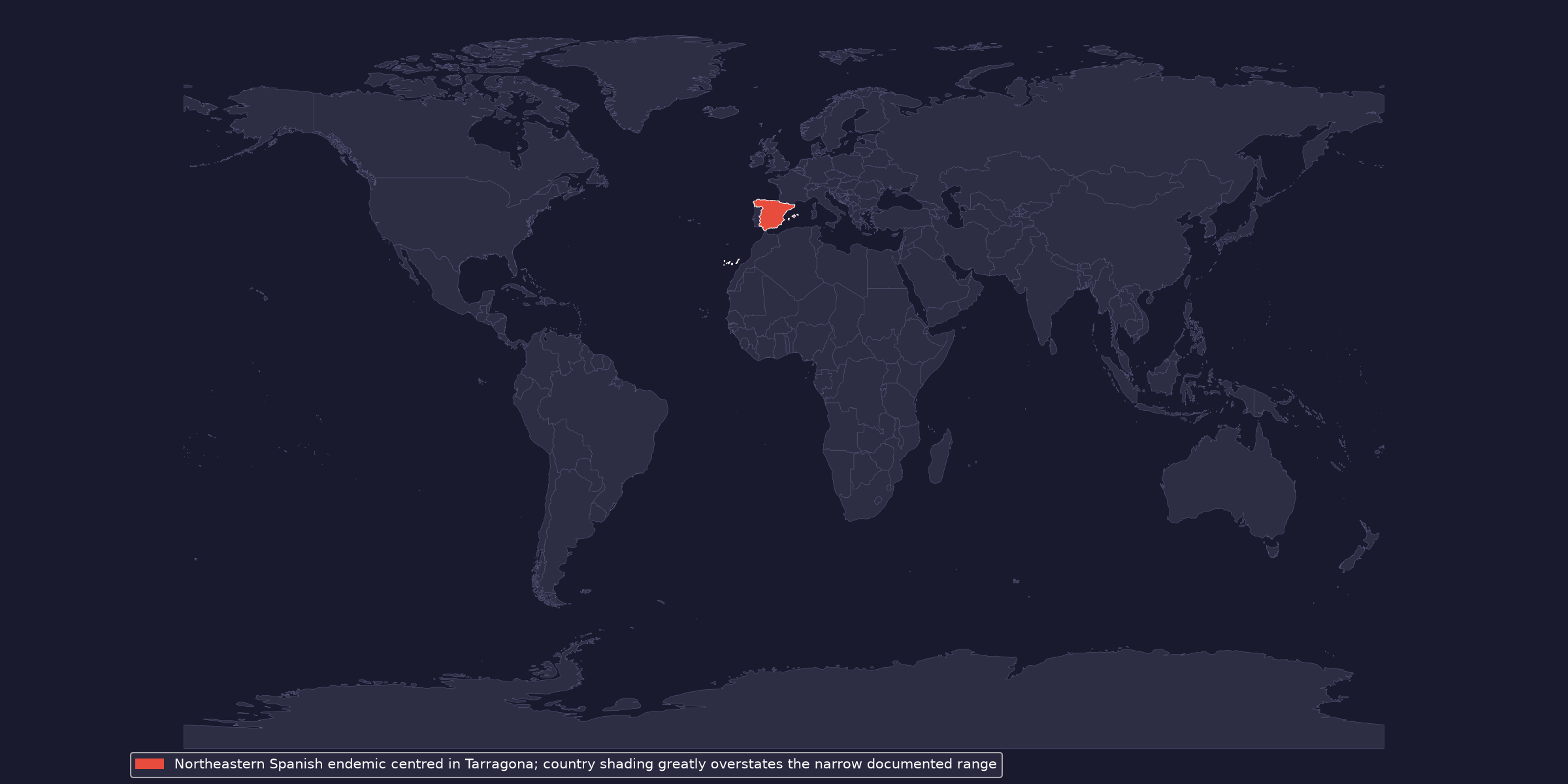
The world catalogue places P. expansus in northeastern Spain, specifically Tarragona Province. Country-level occurrence services also resolve the species to Spain. Its actual range is far smaller than the shaded country and should not be interpreted as continuous Spanish occupancy.
⚖️ Legal status
Checked on 2026-08-29: P. expansus was not found in the CITES Appendices, EU wildlife-trade Annexes A-D under Regulation (EU) 2026/1383, or Bern Convention Appendices II-III. Local and national rules may still restrict collection, protected-area access, export, import, transport, keeping, or animal sales.
Buy documented captive-bred animals, retain invoices and breeder/locality records, and quarantine every new culture. Do not collect from Spanish habitat without explicit authority, release animals, or discard live substrate outdoors.
🤌 Husbandry
Start a small colony in at least 40 × 25 × 18 cm. Fit fine mesh to generous vents high and low on opposing walls. Keep about 15-20% of the floor moist and the rest dry at the surface; several bark slabs reduce crowding and conflict among these large animals.
| Parameter | Practical starting point |
|---|---|
| Adult length | 3-4 cm |
| Temperature | 18-26 °C |
| Moisture | small permanent damp end; mostly dry surface |
| Substrate | 6-8 cm, edible and well drained |
| Staples | deciduous leaves and soft rotten hardwood |
| Social housing | spacious colony with several hides and feeding sites |
Quarantine for 60-90 days using separate tools. Check for mites, flies, unexplained deaths, and a false locality label before combining stock; cultures with different provenance should remain separate.
💡 Lighting
UVB is unnecessary. Provide 10-12 hours of diffuse room or plant light and deep shade beneath bark. Direct sun and close lamps can overheat a ventilated plastic enclosure surprisingly quickly.
🌡 Heating and temperature
Maintain 18-26 °C, with a 16-21 °C retreat and comparable nights. Ordinary seasonal room cooling is safer than constant warmth. Sustained temperatures above roughly 27 °C accelerate water loss and leave little margin if the damp refuge dries.
If supplementary heat is essential, warm one side wall with a thermostat and verify surface and deep-substrate temperatures. Never heat from below or place the heater against the only moist retreat.
💧 Humidity and water
An enclosure-average reading around 40-60% RH is only a trend indicator. Keep damp lower substrate and a compact moss pocket at one end, while leaf surfaces across most of the box remain dry. Add water directly to the refuge every few days as needed; use substrate condition, not a rigid spraying calendar.
No open water dish is needed. Whole-lid condensation, wet food that molds rapidly, and persistent wall climbing point to excessive moisture or poor airflow. Failed moults or every animal compressing into the last damp corner mean the refuge is too dry or too small.
🌿 Enclosure and decoration
Use 6-8 cm of pesticide-free topsoil or leaf soil mixed with leaf mould, crushed deciduous hardwood, and a little mineral grit. Cover it with a deep layer of oak, beech, maple, or other safe hardwood leaves. Add flat cork or hardwood slabs and anchor heavy stones before filling around them.
Keep cuttlebone, limestone, or plain calcium carbonate permanently available. Avoid pure coconut fibre, conifer shavings, fertilizer, treated wood, and a sterile substrate: the enclosure itself must supply much of the colony’s diet.
🪳 Feeding
Leaves and soft decomposed hardwood remain available continuously. Every four to seven days add a small portion of squash, carrot, mushroom, dried nettle, or a complete isopod feed. Offer a small protein portion such as dried shrimp, gammarus, or quality fish food about weekly, divided between two sites.
Remove wet residues within 24-48 hours. Large Porcellio benefit from protein, but excess produces mites, mold, and fouled substrate; it never replaces leaf litter or calcium.
🥚 Breeding
Females brood eggs and embryos in a ventral marsupium and release mancae. This is viviparous development, with no external egg-incubation stage. Keeper reports describe a slow start followed by moderate-to-large broods, but peer-reviewed colony measurements for this species were not located.
Use an established mixed-age group, stable deep moisture, multiple retreats, and minimal disturbance. Do not split the culture until several juvenile sizes are present. Sudden wetting, heat, crowding, or frequent searching under bark can stop progress.
🩺 Common problems
- Deaths after watering: shrink the wet footprint, increase cross-ventilation, and check for heat.
- Incomplete moults: restore deep moisture at the refuge and continuous calcium without soaking the dry end.
- Damaged antennae or uropods: provide more floor space, hides, and feeding points.
- Mites and mold: reduce supplemental portions and remove residues earlier.
- No juveniles: prioritize stability and mature stock; do not repeatedly rebuild the enclosure.
- Uncertain identity: preserve the seller label and seek adult morphological identification rather than renaming a colour form.
📌 Conclusion
P. expansus is impressive but unforgiving of a uniformly damp or cramped box. Establish generous ventilation, dry floor area, a dependable moist refuge, edible litter, and documented captive provenance before purchase.
📚 Sources and further reading
- World List of Isopoda: Porcellio expansus
- GBIF species record: Porcellio expansus
- Schmalfuss (2003), world catalogue of terrestrial isopods
- IsopodaPet, P. expansus husbandry
- PostPods, detailed keeper account for P. expansus
- ReptiFiles site check; general clean-up-crew reference
- EAZA invertebrate live-food husbandry manual
- Warburg (2012), marsupial development in terrestrial isopods
- CITES Appendices
- EU wildlife-trade Annexes: Regulation (EU) 2026/1383
- Bern Convention appendices