Share

Spiny Porcellio Isopod
🔤 Taxonomy
Porcellio echinatus Lucas, 1849 is accepted by GBIF and the World List of Isopoda. Spiny isopod and red-edge isopod are trade names, but colour labels are not taxonomic ranks. The granular, bristled dorsal surface is useful for recognition; obtain source-labelled animals because juvenile Porcellio can be difficult to identify reliably.
📌 Description
This robust, non-conglobating woodlouse reaches roughly 1.2-1.8 cm. Its dorsal texture is conspicuously rough or spiny, and some captive lines show warm reddish margins. It is active under bark and within the upper substrate, often appearing on the surface after dark.
The species comes from seasonally dry southwestern Mediterranean habitats. It copes with a larger dry area than many tropical isopods, but still respires through pleopodal structures that must remain hydrated. A dry box is not a semi-arid setup; the correct design combines strong airflow with a permanent moist refuge.
🌍 Distribution
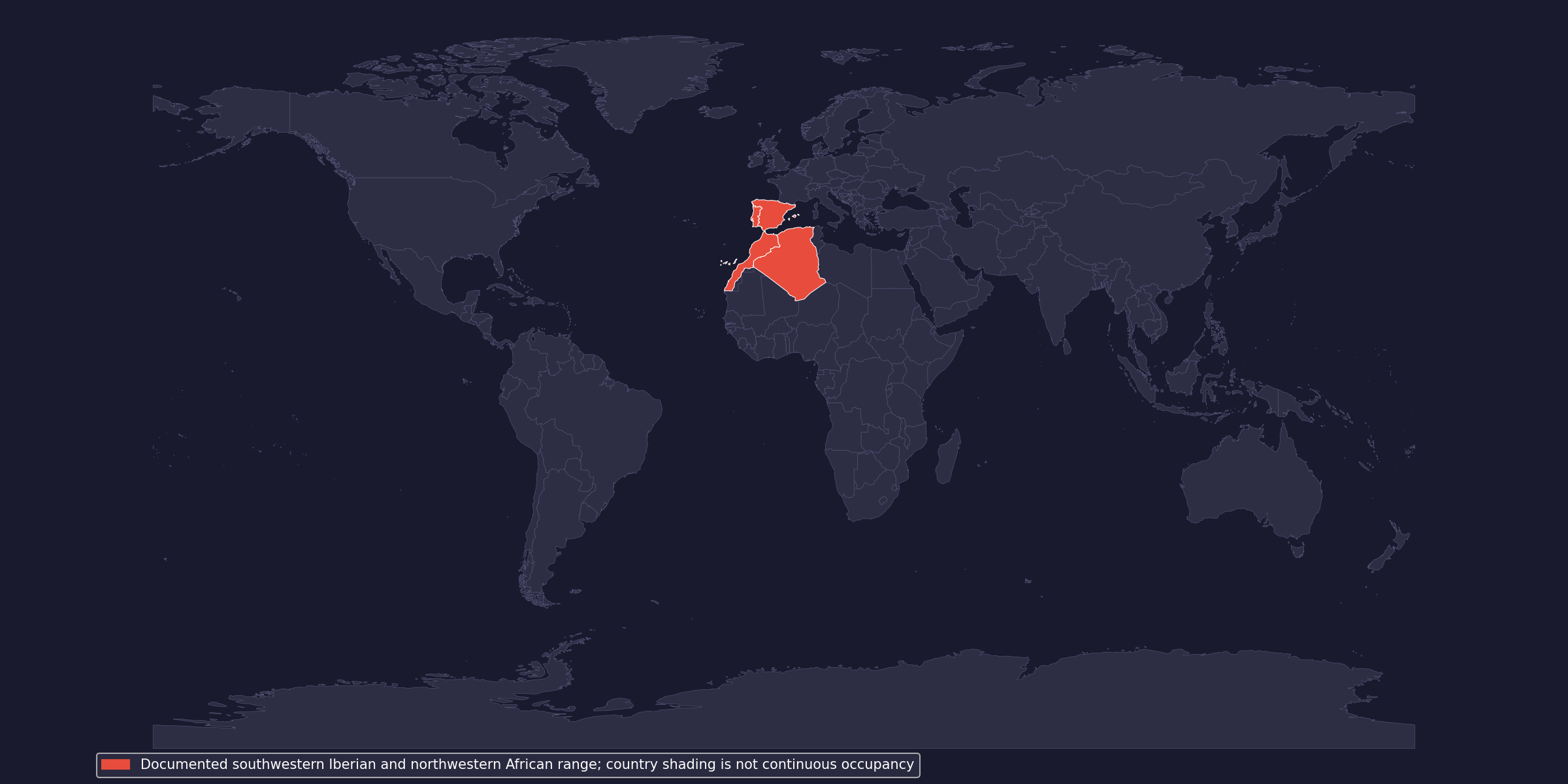
Published catalog and faunal records place P. echinatus in southern Portugal, southern Spain, northern Morocco, and northwestern Algeria. Records include open ground under stones, road margins, cork-oak woodland, and other surface habitats. A Portuguese cave survey classifies it as an epigean visitor rather than a cave-adapted species.
⚖️ Legal status
Checked on 2026-08-23: Porcellio echinatus is not listed by CITES, in EU wildlife-trade Annexes A-D under Regulation (EU) 2026/1383, or in Bern Convention Appendices II-III. Protected-area collection rules and national restrictions on live invertebrate movement can apply independently.
Buy captive-bred stock and retain the invoice and culture name. Do not collect on protected land or release animals, mancae, or substrate. Confirm import and transport requirements at both ends before sending a culture across borders.
🤌 Husbandry
For 10-20 animals use a 30 × 20 × 15 cm box or larger. Concentrate fine cross-ventilation above the dry two-thirds while keeping a lower-moisture route to the damp corner. Secure the lid and screen large holes because mancae are tiny.
Quarantine new animals for 30-60 days with separate forceps and substrate tools. Record deaths and moults, check for mites, and confirm the line before combining colonies. This also prevents fast cleanup species from overrunning a slower display culture.
💡 Lighting
UVB is not required. Supply 10-14 hours of diffuse room or plant lighting and abundant shaded cover. Never put the box in direct sun; a transparent container can exceed safe temperatures before the substrate appears dry.
🌡 Heating and temperature
Maintain 18-26 °C, preferably with a 16-21 °C retreat and nights around 16-22 °C. Moderate warmth supports growth, but prolonged temperatures above 28 °C sharply reduce the margin for moisture error.
If additional heat is necessary, apply it to one outer side and control it with a thermostat. Do not heat the moist refuge from below. Measure the substrate surface at both ends, not only the room air.
💧 Humidity and water
Keep one-quarter to one-third of the substrate damp beneath moss and cork. Let most of the surface remain distinctly less wet with steady airflow; an approximate room-level range of 45-70% RH is workable when the damp refuge never disappears. Pour water into that end rather than fogging the entire enclosure.
An open water dish is unnecessary and dangerous to mancae. Animals packed into the moss, incomplete moults, and mortality after ventilation changes point to dehydration. Condensation, fungus, and constant wall climbing point to excessive moisture or stagnant air.
🌿 Enclosure and decoration
Use 5-7 cm of pesticide-free soil, deciduous leaf mould, and crumbled white-rotted hardwood. Cover most of the surface with dry and partly decayed hardwood leaves. Add cork slabs with tight underside spaces, a small moss pocket, and stable porous limestone or cuttlebone.
Keep calcium carbonate available continuously. Avoid fine sand as the whole substrate, coir-only mixes, fresh resinous wood, fertilizer, treated garden waste, and heavy stones balanced on loose soil.
🪳 Feeding
Leaves and rotten hardwood form the permanent staple. Offer small pieces of carrot, sweet potato, squash, courgette, mushroom, or dried nettle two or three times a week. Give a small protein portion such as dried shrimp, gammarus, or quality fish food about weekly; use several small feeding points when many juveniles are present.
Remove damp remains within 24-48 hours. A protein-heavy diet increases mites and fouling, while a vegetable-only diet cannot replace decomposed fibre, microbial growth, and calcium.
🥚 Breeding
Females carry eggs and developing embryos in a ventral marsupium filled with fluid, then release mancae. This marsupial brooding is represented as “viviparous” in site metadata; do not add an egg-incubation box or isolate gravid females.
Breeding is moderate rather than explosive. Stable warmth, a connected damp lower layer, calcium, edible litter, and modest protein matter more than frequent misting. Allow the first generation to mature before splitting the colony.
🩺 Common problems
- Failed moults or curled deaths: re-establish the moist refuge and check heat.
- Fungus and grain mites: reduce supplementary food, then add airflow over the dry end.
- No juveniles: verify that both sexes are present and stop repeatedly disturbing the substrate.
- Animals constantly exposed: examine the lower substrate for waterlogging or sour anaerobic patches.
- Loss of locality or colour information: keep labelled cultures separate; a trade colour is not a species diagnosis.
📌 Conclusion
Porcellio echinatus suits a keeper ready to maintain a genuine moisture gradient rather than one uniform humidity value. Its rough texture and surface activity make it rewarding, but the damp refuge must remain available even when most of the tub is kept relatively dry.
📚 Sources and further reading
- GBIF: Porcellio echinatus
- World List of Isopoda: Porcellio echinatus
- Schmalfuss 2003 world catalog and geographic summary
- Reboleira et al.: Portuguese cave and surface records
- Taiti and Rossano: northeastern Morocco records and habitat observations
- ReptiFiles site search completed; general clean-up-crew reference
- CITES Appendices
- Current EU wildlife-trade Annexes: Regulation (EU) 2026/1383
- Bern Convention appendices