Share

Bolívar's Isopod
🔤 Taxonomy
Porcellio bolivari Dollfus, 1892 is an accepted Spanish species in Porcellionidae. Yellow Ghost is a captive colour line, not a subspecies or a separate species; keep the line name for provenance while using the same husbandry framework.
📌 Description
Adults are elongated giant Porcellio, commonly about 2-3 cm including their conspicuous projecting uropods. Pale antennae, a grey to yellowish body, and long rear appendages give the species its distinctive appearance. It cannot conglobate and is better observed beneath or alongside bark than handled.
This is the most delicate of the five species in this article batch. A small founder group can take months to establish, and repeated disturbance, whole-box wetness, heat, or a dried moist refuge can erase that progress quickly.
🌍 Distribution
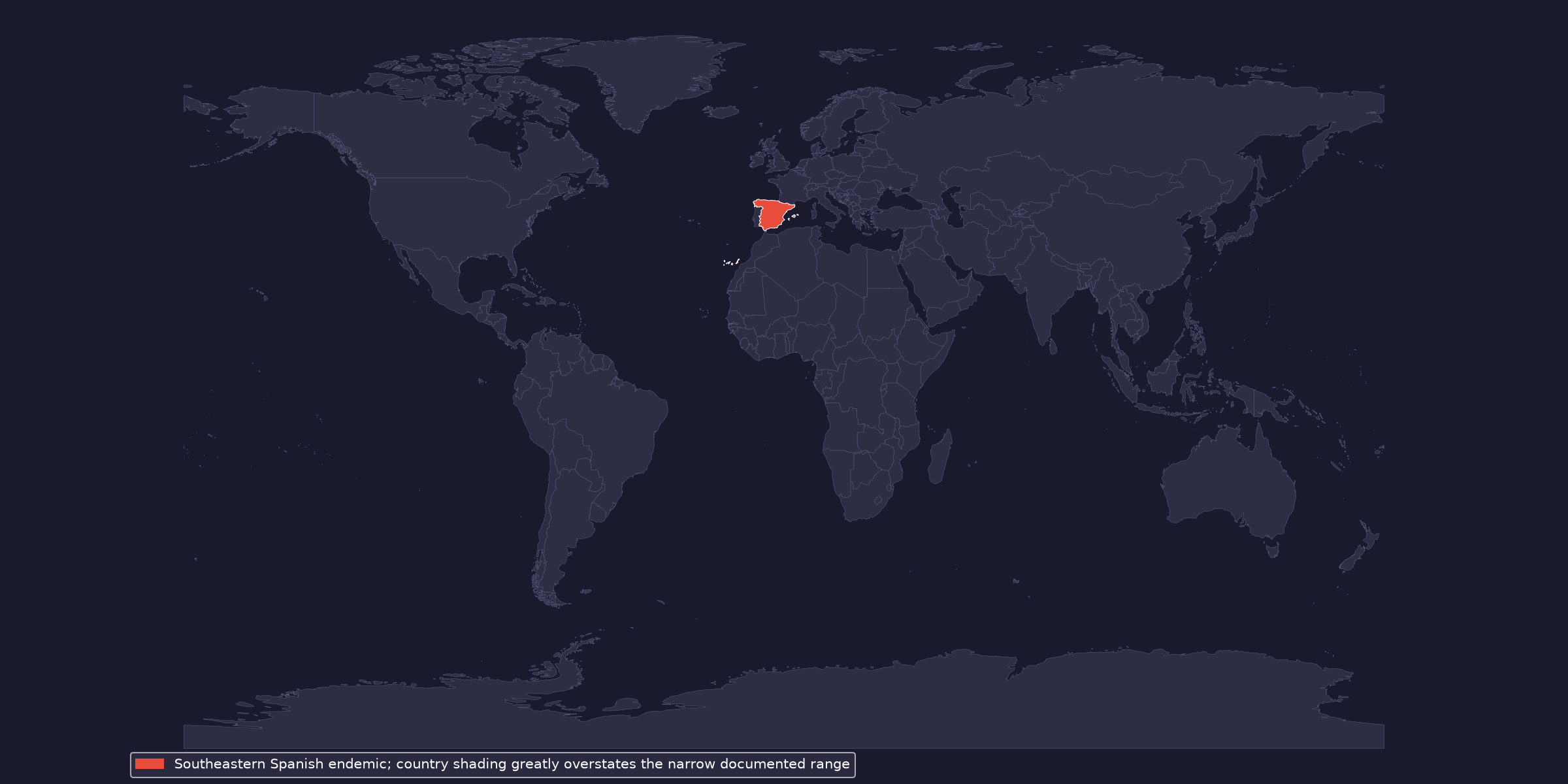
Faunal reviews treat P. bolivari as endemic to southeastern mainland Spain, with records from Alicante, Murcia, Valencia, and Málaga. The country-level map deliberately does not imply that it occurs throughout Spain or that hobby stock has a documented collection locality.
⚖️ Legal status
Checked on 2026-08-23: P. bolivari was not found in the current CITES Appendices, EU wildlife-trade Annexes A-D under Regulation (EU) 2026/1383, or Bern Convention Appendices II-III. Its restricted Spanish range still makes origin important: protected-area collection and removal of native fauna may be controlled under national or regional law.
Buy captive-bred stock, keep the invoice and breeder lineage, and do not market a generic culture as locality-specific. Never collect, import, release, or dispose of live animals without checking the relevant rules.
🤌 Husbandry
Prepare at least 40 × 30 × 20 cm for a starter group, with large mesh-covered vents on the lid and opposing walls. Keep only about one-fifth of the floor reliably moist. The rest should be dry at the surface, well supplied with leaves, and broken into several retreats so animals are not forced into one crowded shelter.
| Parameter | Practical target |
|---|---|
| Adult size | 2-3 cm including uropods |
| Temperature | 18-24 °C |
| Moisture | compact damp refuge, predominantly dry surface |
| Substrate | 8-10 cm, mineral-rich and edible |
| Staple diet | leaves and decayed hardwood; restrained supplements |
| Social housing | roomy colony, minimal disturbance |
Quarantine for at least 60-90 days with dedicated tools. Place the transport medium beside the humid refuge and avoid searching for animals during the first two weeks. Photograph labels and count visible adults without repeatedly lifting every hide.
💡 Lighting
UVB is unnecessary. Use diffuse ambient light for 10-12 hours and leave deep shaded cover. Direct sunlight and close lamps can overheat this dry-looking enclosure before a keeper notices.
🌡 Heating and temperature
Keep the culture mostly between 18 and 24 °C, with a cooler 18-21 °C end and nights down to about 16-21 °C. Do not chase faster reproduction with heat. Sustained temperatures above 26-27 °C increase desiccation and oxygen demand.
If supplemental heat is unavoidable, apply it to one side wall through a thermostat. Never heat the base or allow the entire box to warm uniformly.
💧 Humidity and water
The open zone can sit near 45-65% relative humidity, but the animals must always be able to retreat to damp—not wet—moss and deeper substrate. Add water slowly to that one area and wait for it to move through the soil rather than spraying every surface.
No water bowl is needed. Condensation across the lid, damp leaf litter everywhere, or animals persistently climbing high indicates too much water or too little airflow. Conversely, repeated failed molts and all animals wedged into the wettest moss call for a larger or more stable refuge.
🌿 Enclosure and decoration
Use 8-10 cm of pesticide-free topsoil or leaf soil with crushed limestone, rotten hardwood, and leaf fragments. Keep sphagnum concentrated at one end. Add a deep cover of dry hardwood leaves and several thin cork slabs; secure any rock before adding substrate.
Offer a permanent calcium source. Avoid coconut fibre as the sole substrate, aromatic conifer bark, fertilizer, treated wood, and frequently rearranged heavy décor. The enclosure should provide space and edible structure rather than a bare show surface.
🪳 Feeding
Hardwood leaves and soft decomposed wood should always be present. Offer small amounts of squash, carrot, mushroom, dried nettle, or a complete isopod food every four to seven days. Let the response of the colony, not a fixed heap, determine the portion.
Provide a small protein item such as dried shrimp or fish food weekly, split between two feeding points. Remove wet food within 24-48 hours and keep cuttlebone, limestone, or plain calcium carbonate available. Overfeeding a slow colony is more dangerous than missing one supplement meal.
🥚 Breeding
Females retain eggs and embryos in a ventral marsupium and later release mancae, so the structured reproduction term is viviparous and there are no incubation fields. Breeding is typically slow to moderate, especially from a small or immature founder group.
Avoid disturbing gravid females or harvesting juveniles from a young colony. Stable cool temperatures, an undisturbed damp retreat, protein, calcium, and ample space matter more than frequent feeding. Maintain Yellow Ghost separately and label every split with its source and date.
🩺 Common problems
- Founder group gradually disappears: stop searching, check the deep moist refuge, and remove spoiled food.
- Mold and mites: reduce supplemental portions and increase cross-ventilation without drying the refuge.
- Failed molts: verify calcium and moisture below the moss; never soak the dry zone.
- Damaged antennae or uropods: add flat hides, feeding points, and floor space.
- No mancae after many months: confirm that animals are mature and mixed-sex before changing stable conditions.
📌 Conclusion
P. bolivari is for a patient keeper who can leave a small colony alone while maintaining a narrow moisture refuge. Build and test that gradient before buying; repeatedly opening and wetting the box is more likely to delay breeding than to help it.
📚 Sources and further reading
- WoRMS: Porcellio bolivari
- GBIF species record: Porcellio bolivari
- Cifuentes (2021), Andalusian records and southeastern-Spain endemism
- Schmalfuss (2003), world catalogue of terrestrial isopods
- ReptiFiles cleanup-crew overview
- Warburg (2012), marsupial development in terrestrial isopods
- CITES Appendices
- EU wildlife-trade Annexes: Regulation (EU) 2026/1383
- Bern Convention appendices