Share

Baetic Woodlouse
🔤 Taxonomy
Porcellio baeticensis Vandel, 1953 is accepted as a species. Vandel originally described it as Porcellio incanus baeticensis; older sources and some trade listings can therefore place it under P. incanus.
Females and juveniles can be difficult to separate from P. incanus without scale-seta and male pleopod characters. “Violet” is a captive colour-line label, not a subspecies or locality.
📌 Description
Adults in the hobby are commonly about 1.5-2.0 cm. Unlike Armadillidium, this flatter, faster Porcellio cannot close into a complete ball. Typical animals are muted grey-brown; the Violet line may show a restrained purple cast rather than a bright solid colour.
The species does well in a ventilated temperate colony, but identification and lawful Spanish provenance deserve care. It is not a substitute for an unidentified generic clean-up crew.
| Care point | Practical target |
|---|---|
| Adult size | 1.5-2.0 cm |
| Starter colony | 30 x 20 x 15 cm or larger |
| Temperature | 18-24°C |
| Substrate | 7-9 cm with leaves and rotten hardwood |
| Moisture | damp quarter to third; strong dry-side airflow |
| Main failure | heat, stale wet substrate or poor identification |
🌍 Distribution
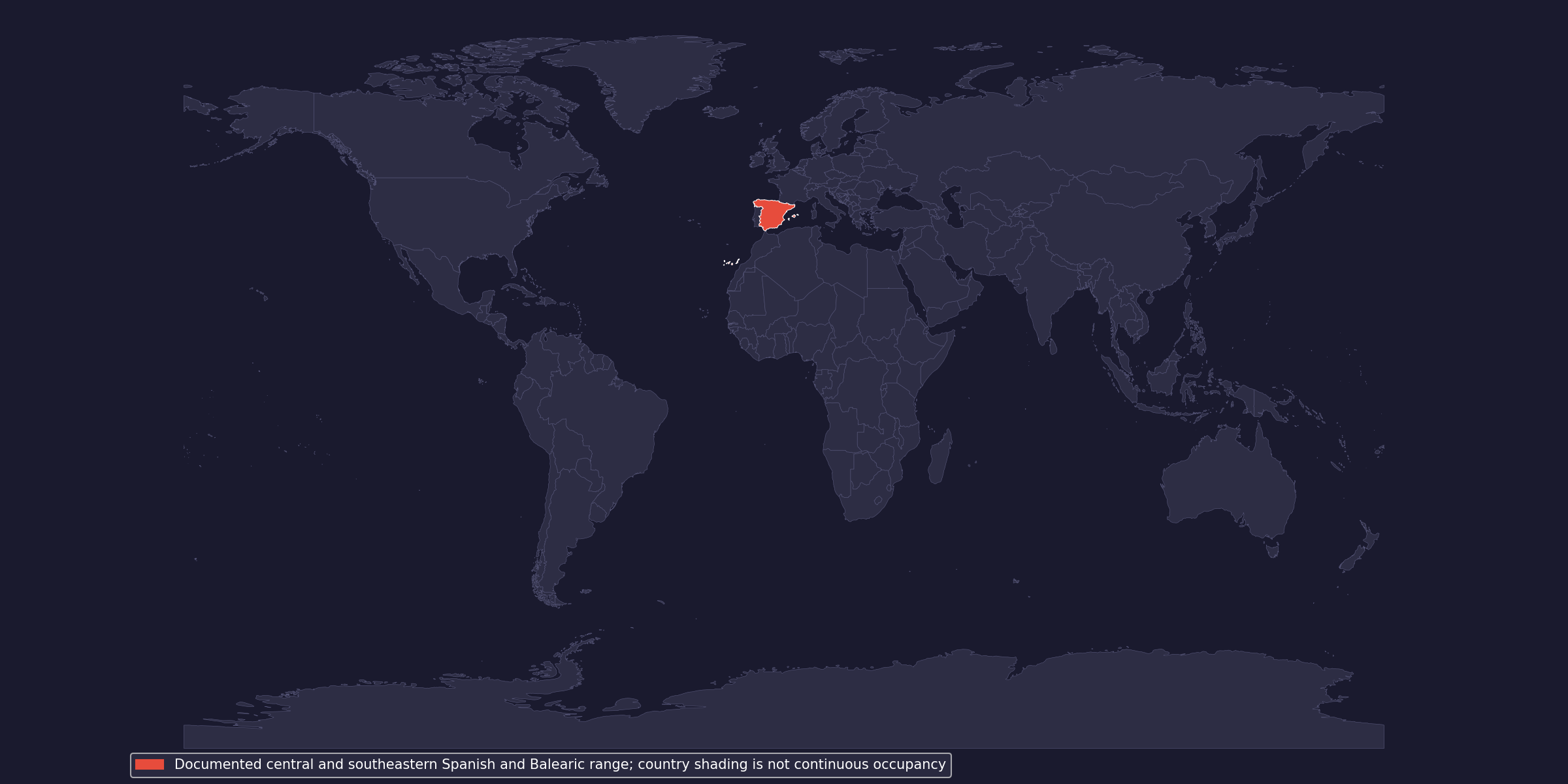
Published records place P. baeticensis in central and southeastern Spain, including Almería, Granada, Jaén, Cuenca, Murcia, Alicante, Castellón and Valencia, as well as the Balearic Islands. The map highlights Spain only and does not imply continuous occupancy across the country.
⚖️ Legal status
Checked on 2026-08-29: P. baeticensis is not listed in the CITES Appendices, EU wildlife-trade Annexes A-D under Regulation (EU) 2026/1383, or Bern Convention Appendices II-III. A 2025 peer-reviewed trade study nevertheless identified it as an endemic Iberian-Balearic woodlouse offered online; non-listing should not be mistaken for permission to collect.
Use captive-established stock, retain invoices and the full Violet or locality label, and check Spanish autonomous-community, protected-site, export, import and sale rules. Never release animals or viable substrate.
🤌 Husbandry
Begin 10-20 animals in a secure 30 x 20 x 15 cm tub with fine vents on at least two sides. Porcellio can move quickly and climb textured silicone or dirty walls, so keep vents and lid gaps escape-proof. Concentrate airflow over the less-wet half.
Quarantine for 45-60 days using separate tools. Track deaths and births, inspect for mixed P. incanus-like animals, and do not combine Violet with unlabelled cultures if line identity matters.
💡 Lighting
UVB is unnecessary. Use a 10-14-hour diffuse seasonal cycle with deep shade below cork and leaves. Direct sunlight and heat-producing lamps can rapidly dry or overheat the surface.
🌡 Heating and temperature
Maintain 18-24°C, with a 16-20°C retreat and nights around 15-20°C. A cooler room may slow activity without requiring planned dormancy. Avoid deliberate cooling of juveniles, new arrivals or weak colonies.
Sustained temperatures above 26°C increase drying and oxygen stress. If heat is needed, warm one external wall under thermostat control and keep the damp base cooler.
💧 Humidity and water
Keep one-quarter to one-third of the substrate damp through its full depth and the opposite surface substantially less wet. Approximate 45-70% RH is workable when a moist lower refuge survives. Add water to that refuge instead of misting the entire tub.
An open dish is unnecessary. Persistent condensation and sour smells call for less water and more airflow; incomplete moults and mass crowding in the dampest corner call for deeper hydration.
🌿 Enclosure and decoration
Use 7-9 cm of pesticide-free topsoil, mature deciduous leaf mould and soft rotten hardwood. Provide thick hardwood leaf litter, several low cork hides, moss at the damp end and permanent cuttlebone or limestone.
Avoid fertilized compost, aromatic woods, pesticide-exposed litter and sterile coir-only substrate. Deep edible substrate buffers moisture and lets juveniles feed below the exposed surface.
🪳 Feeding
Keep decayed leaves and rotten wood available at all times. Offer a little squash, carrot, courgette, sweet potato, mushroom or dried greens two or three times weekly. Add a modest portion of gammarus, dried shrimp or fish food weekly.
Use several feeding points in an established colony and remove wet food within 24-48 hours. Too much protein leads to mites, aggression around food and fouled substrate.
🥚 Breeding
“Viviparous” is the repository’s category for marsupial brooding. Females retain eggs and embryos in a ventral pouch and release mancae; keepers do not incubate exposed eggs.
Breeding is usually moderate once the colony settles. Stable moisture below leaves, fine detritus and calcium aid mancae. Do not isolate brooding females, and divide colonies with substrate and all age groups rather than adults alone.
🩺 Common problems
- Failed moults: restore lower-layer moisture and check calcium and overheating.
- Escapes: replace coarse mesh, clean climbing films and secure the lid.
- Mites or sour substrate: remove excess protein and improve cross-ventilation.
- Weak recruitment: provide finer leaves and reduce disturbance around the damp refuge.
- Misidentification: isolate uncertain P. incanus-like stock and preserve the supplier’s records.
📌 Conclusion
The Baetic woodlouse suits keepers who can pair strong ventilation with a dependable moist refuge and who take Iberian provenance seriously. Establish the deep substrate and secure lid first; colour alone does not verify a Violet culture as P. baeticensis.
📚 Sources and further reading
- GBIF: Porcellio baeticensis
- Cifuentes 2021: records from Valencia and Murcia
- Cifuentes 2021: terrestrial isopods of Andalusia
- Garcia and Cruz 1996: Balearic terrestrial isopods
- Robla et al. 2025: unregulated trade in Spanish woodlice
- Kight 2008: reproductive ecology of terrestrial isopods
- ReptiFiles — checked; no species-specific care guide was found
- CITES Appendices, valid from 5 March 2026
- Commission Regulation (EU) 2026/1383
- Bern Convention appendices