Share

Ant Woodlouse
🔤 Taxonomy
Platyarthrus hoffmannseggii Brandt, 1833 is accepted by GBIF and WoRMS. Genetic work has found deep divergence among populations, so locality records should never be discarded or merged casually. Its broad, blind form can be mistaken for a juvenile or another white soil woodlouse.
📌 Description
Adults are about 4–5 mm, broad and oval, white and eyeless, with short stout antennae. The species is a strict myrmecophile recorded in nests of many ants. Its association is ecological, not permission to collect an ant nest or combine ants with a home culture.
There is no credible published demonstration that an ant-free line completes its full life cycle over generations. The setup below is only a cautious ant-free observation and containment trial for already established, legally obtained stock—not validated long-term husbandry.
🌍 Distribution
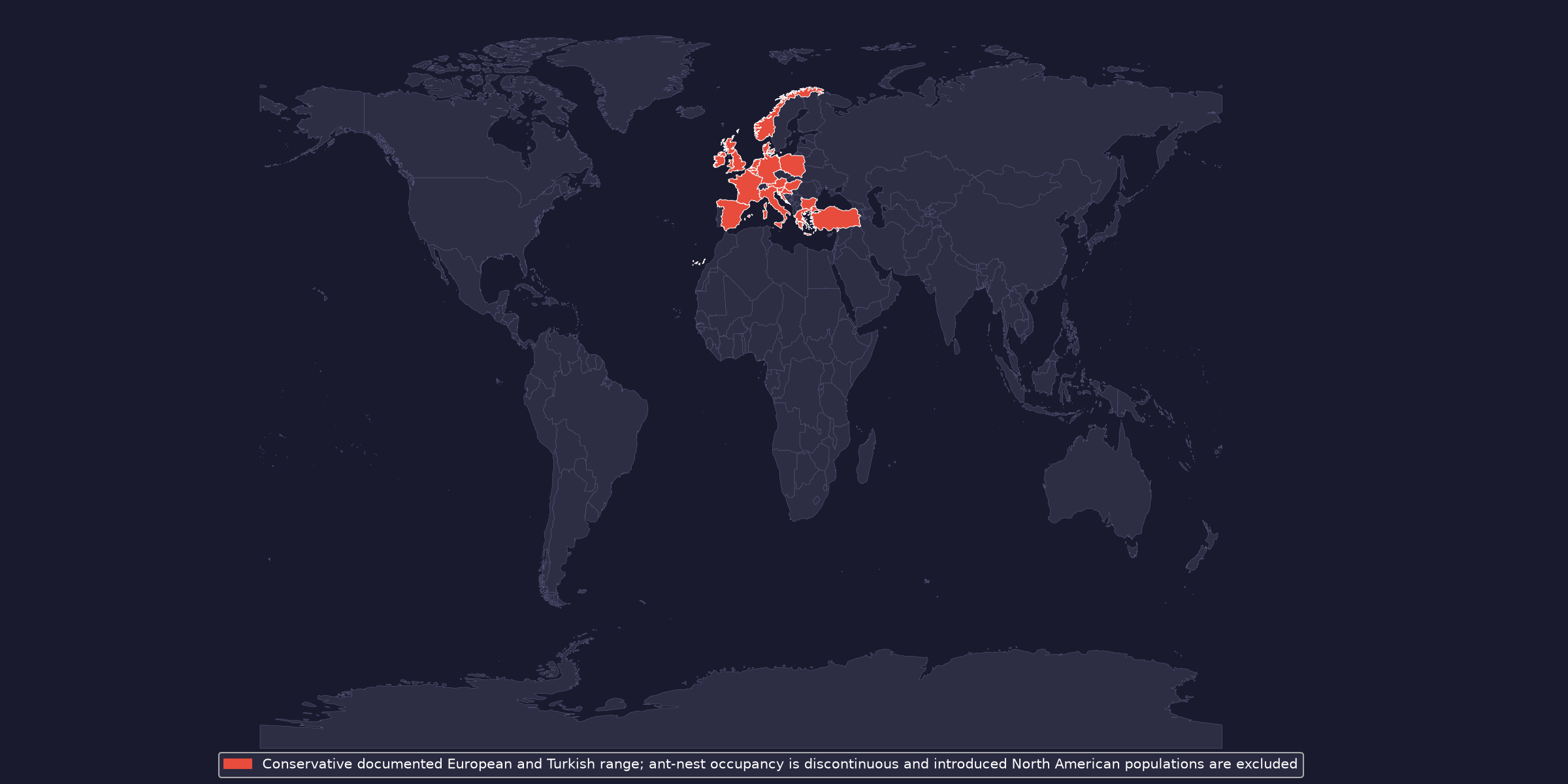
The species occurs widely in Europe, North Africa and Asia Minor and has been introduced to North America. Its true distribution follows suitable ant nests and can be extremely discontinuous even inside a shaded country.
The map shows a conservative documented European and Turkish range. It excludes introduced North American populations and unlocalized North African reports.
⚖️ Legal status
Checked on 2026-08-29: P. hoffmannseggii was not found in CITES, EU wildlife-trade Annexes A–D under Regulation (EU) 2026/1383, or Bern Appendices II–III. Local and national collection, protected-ant, reserve, soil, import and non-native-species rules may still prohibit or condition possession.
Do not dig wild nests, collect nest soil or move ants. Acquire only a traceable ant-free culture represented as established by the breeder, retain its provenance, and never release animals or substrate.
🤌 Husbandry
This species is unsuitable for routine pet keeping. If already responsible for legally sourced stock, contain it in a gasketed 20 × 15 × 15 cm box with fine mesh, 8 cm of mature humid humus, fine leaf material, decayed wood and shallow cover. Keep the trial completely ant-free. Do not add a queen, workers, brood or wild nest material.
Quarantine for at least 60 days with dedicated tools and inspect the container only inside a catch tub. Stop transfers or sales unless several ant-free generations can be documented. ReptiFiles has no species-level guide.
💡 Lighting
UVB is unnecessary. Provide only dim indirect room light and complete dark refuges. This blind nest associate gains no demonstrated benefit from bright display lighting.
🌡 Heating and temperature
Use stable mild room conditions without direct heat. The broad geographic range and temperatures measured outside nests do not reveal the buffered nest microclimate. Avoid guessing a warmer “breeding temperature”; duplicate observation boxes are safer than changing all stock.
💧 Humidity and water
Keep most lower substrate evenly damp and aerated, with a small less-wet surface sector. Add water into one edge and provide no open dish. Very small animals can drown in saturated pore spaces.
Clustering at the wettest point and incomplete moults suggest drying. Sour odour, heavy condensation or mass surface movement indicates waterlogging or inadequate air exchange.
🌿 Enclosure and decoration
Use pesticide-free mineral soil, mature leaf mould, fine decomposed hardwood and crumbled leaves. Add shallow bark, a little moss and finely crushed limestone or cuttlebone. The mix should contain fine pores but remain loose.
Never use soil, refuse or fungus taken from an ant nest. Climate accordions are omitted because nest microclimates, not regional weather-station normals, govern exposure.
🪳 Feeding
Offer microbially mature humus, fungal films, fine leaf particles and soft-decayed wood continuously. Trial minute mushroom or vegetable shavings and very small dried protein fragments; remove anything uneaten promptly. Keep calcium available.
The species’ diet within nests is incompletely resolved, and no ant-free captive ration has been validated. Record acceptance and survival rather than assuming feeding proves long-term viability.
🥚 Breeding
Females brood embryos in a ventral marsupium and release mancae, represented in metadata as viviparous. Published work confirms ant association but does not supply a defensible ant-free breeding protocol.
Juveniles in one box do not establish a self-sustaining culture. Document multiple generations, dates and age classes before making that claim. Do not introduce ants in an attempt to trigger reproduction.
🩺 Common problems
- Unverified identity: preserve locality and obtain adult examination.
- Loss after transfer: the culture may depend on conditions or materials not reproduced ant-free.
- Drying or flooding: adjust deep contact moisture in small measured steps.
- Food mould: reduce experimental foods and increase gentle airflow.
- Ant contamination: isolate the box; do not release or deliberately retain wild ants.
- Ethical sourcing: reject animals obtained by destroying wild nests.
📌 Conclusion
The ant woodlouse is best treated as a research-level obligate associate, not a clean-up crew. An ant-free box can provide cautious observation and containment, but current evidence does not support promising durable culture.
📚 Sources and further reading
- GBIF: Platyarthrus hoffmannseggii
- WoRMS: Platyarthrus hoffmannseggii
- British Myriapod and Isopod Group species account
- European Journal of Entomology: acceptance by the invasive ant Lasius neglectus
- University of Antwerp: host-dependent body size
- Schmalfuss world catalog
- ReptiFiles search completed; no species guide found
- CITES Appendices, valid from 5 March 2026
- Commission Regulation (EU) 2026/1383
- Bern Convention appendices