Share

Brown Cockroach
🔤 Taxonomy
Periplaneta brunnea Burmeister, 1838 is the accepted name. “Brown cockroach” and “southern brown cockroach” are both used in English. It closely resembles P. americana; P. brunnea is usually smaller, has shorter, stouter cerci, and produces a larger ootheca with a pronounced terminal point that is firmly cemented to the surface.
Do not rely on the word “brown,” since several Periplaneta species share that colour. Keep unidentified or mixed stock outside a named breeding colony.
📌 Description
Adults measure about 3.3-3.8 cm and are reddish brown with developed wings. Flight is usually short or gliding, but the animals climb smooth surfaces and run rapidly. Nymphs show dark abdominal areas edged by lighter brown.
The useful display feature is the colony’s deliberate use of warm, tight crevices and its conspicuous attached egg cases. The main difficulty is that those same glued oothecae can travel unnoticed on cork, lids, and equipment, creating a serious escape pathway.
🌍 Distribution
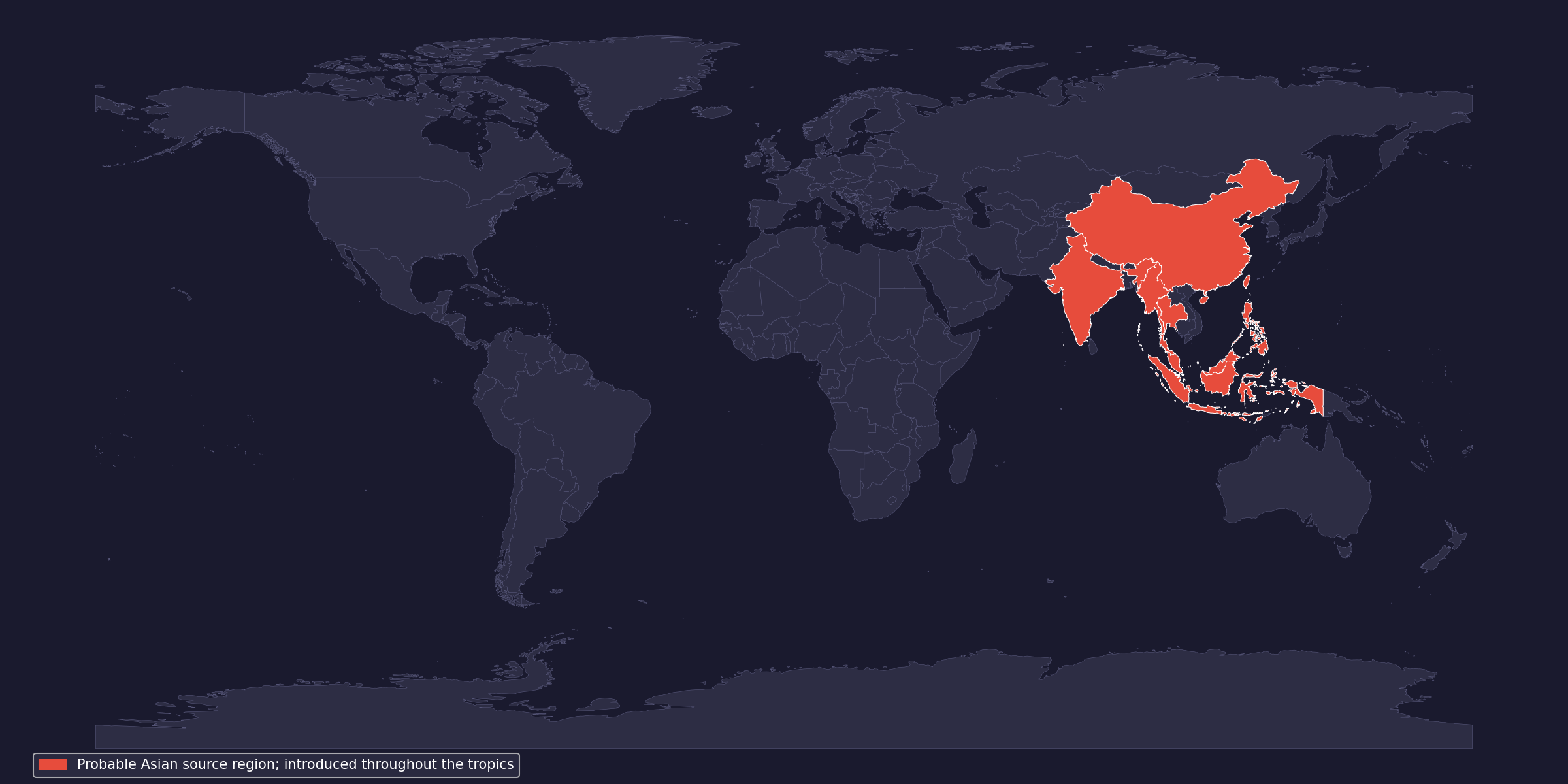
The original range is unresolved, though an Asian origin is commonly proposed. The species is now transported through tropical regions and occurs outdoors and in heated buildings, including introduced populations in the Americas. The map conservatively highlights a probable Asian source region rather than presenting every scattered introduced record as native.
⚖️ Legal status
Checked on 2026-08-22: P. brunnea is not present in the CITES Appendices, EU wildlife-trade Annexes A-D, Bern Convention appendices, or the current EU list of invasive alien species of Union concern. Local authorities may nevertheless regulate pest organisms, live-insect imports, transport, sale, or housing.
Confirm rules at both origin and destination. Retain invoices and identification notes, and inspect every object leaving the colony. Never release animals or discard viable oothecae in household compost.
🤌 Husbandry
House a small group in at least 45 × 30 × 35 cm with a gasketed, latched lid and fine metal ventilation. Keep cork below the rim and open the enclosure inside a smooth catch tub. Wall barriers help during maintenance but cannot replace sealed construction.
| Parameter | Practical target |
|---|---|
| Adult size | 3.3-3.8 cm |
| Main temperature | 25-29 °C; limited warm side 29-31 °C |
| Cool / night | 21-25 °C / 21-24 °C |
| Humidity | 60-80%, moist refuge plus dry food area |
| Substrate | 4-6 cm with leaf litter |
| Reproduction | 21-28 eggs per cemented ootheca |
Quarantine new animals for at least 60 days. Use dedicated forceps and containers, photograph adult cerci and egg cases, and never mix with P. americana merely because both arrived under the “palmetto bug” label.
💡 Lighting
No UVB is required. A dim 10-12-hour cycle allows normal nocturnal activity. Avoid direct sun and bright maintenance lamps, which can produce sudden running and heat a humid box rapidly.
Red or weak indirect observation light is preferable to repeatedly lifting hides under a flash. Darkness should come from shelters, not a permanently unlit room with no stable cycle.
🌡 Heating and temperature
Provide 25-29 °C through most of the box, 29-31 °C in a limited zone, and a 21-25 °C retreat. Keep nights near 21-24 °C. UF/IFAS records an egg-to-adult development time of about 224-340 days, so do not force growth with uniform high heat.
Apply thermostatted heat to a side or the room. Monitor the interior of the tightest cork stack, where warm humid air and colony metabolism accumulate.
💧 Humidity and water
Maintain 60-80% humidity while allowing the surface to dry between watering. Keep one moist lower end for molts. Brown cockroaches favor hot humid sites, but waterlogged substrate and condensation promote mold and foul egg cases.
Supply a very shallow rough water dish or insect-safe water source and moisture-rich vegetables. Hatchlings drown easily. Persistent edge chewing and molt failure warrant checks of water access, crowding, and the moist refuge.
🌿 Enclosure and decoration
Use 4-6 cm of pesticide-free soil/coir with hardwood leaf litter and soft rotten wood. Stand cork securely and add numbered removable strips or clay tiles as egg-laying surfaces. This is especially valuable because females attach oothecae with a strong cement-like secretion.
Never scrape a case from the main wall unless it is being destroyed. Move the entire slip for incubation. Examine the underside of lids, dishes, bark, and tool boxes before they leave the closed work room.
🪳 Feeding
Keep a plain dry roach diet or grain-legume mix available. Offer squash, carrot, sweet potato, leafy greens, apple, or pear every one to two days and a moderate protein portion once or twice weekly. Use several shallow dishes to reduce crowding.
Remove fresh food within 24 hours in warm humid conditions. Do not feed kitchen scraps exposed to cleaning chemicals or pesticides, and do not use this pest-capable culture as loose live prey.
🥚 Breeding
A female may produce many oothecae in her life, each averaging about 24 eggs within a reported 21-28 range. At 25-29 °C, allow roughly 40-70 days as a conservative culture window; published data are stronger for total development and brood size than for one universal incubation value.
Sex adults by male terminal styli and a narrower abdomen. Count attached cases before they hatch, isolate removable slips in fine-mesh nurseries, and freeze surplus viable material before disposal where local waste rules allow.
🩺 Common problems
- Oothecae spread on equipment: use numbered laying slips and inspect every removable item on all sides.
- Confusion with P. americana: compare adult cerci and ootheca form and keep the colony isolated until confirmed.
- Failed molts: provide rough vertical surfaces, reliable water, and a moist refuge.
- Sour substrate or mites: remove food and dead insects promptly, ventilate, and split overcrowded groups.
- Allergy: cockroach frass and exuviae are inhalant allergens; dampen dusty waste and use appropriate protection.
📌 Conclusion
P. brunnea is best suited to a keeper interested in identification and attached-ootheca biology. Success depends less on complicated feeding than on labelled egg-laying surfaces, secure transfers, and the discipline to inspect everything that exits the colony.
📚 Sources and further reading
- GBIF: Periplaneta brunnea
- UF/IFAS: brown cockroach identification and life history
- Cockroach Species File
- ReptiFiles — checked first; no species care guide was found
- CITES Appendices, valid from 5 March 2026
- EU wildlife-trade Annexes, Regulation (EU) 2026/1383
- Bern Convention appendices
- European Commission: current Union list of invasive alien species
- US EPA: cockroaches, pests, and asthma