Share

Australian Cockroach
🔤 Taxonomy
Periplaneta australasiae (Fabricius, 1775) is the accepted species name. The common name “Australian cockroach” is historical and does not demonstrate an Australian origin. It is often mistaken for P. americana, but adults normally show a clear yellow strip along the outer base of each forewing and a more sharply contrasting pale edge around the pronotum.
Use those marks with size and nymph pattern, not seller colour alone. A colony whose identity is uncertain should remain Periplaneta sp. until adults and oothecae can be checked.
📌 Description
Adults are 3.2-3.5 cm long, reddish to dark brown, fully winged, and competent fliers. Yellow marks along the forewing bases are the quickest distinction from the larger American cockroach. Nymphs carry conspicuous pale-yellow abdominal spots and climb readily.
This is a warm, moisture-dependent outdoor and greenhouse pest across much of its introduced range. In captivity it makes an active display colony, but its combination of flight, wall climbing, rapid ootheca production, and interest in living plant tissue makes it unsuitable for casual keeping.
🌍 Distribution
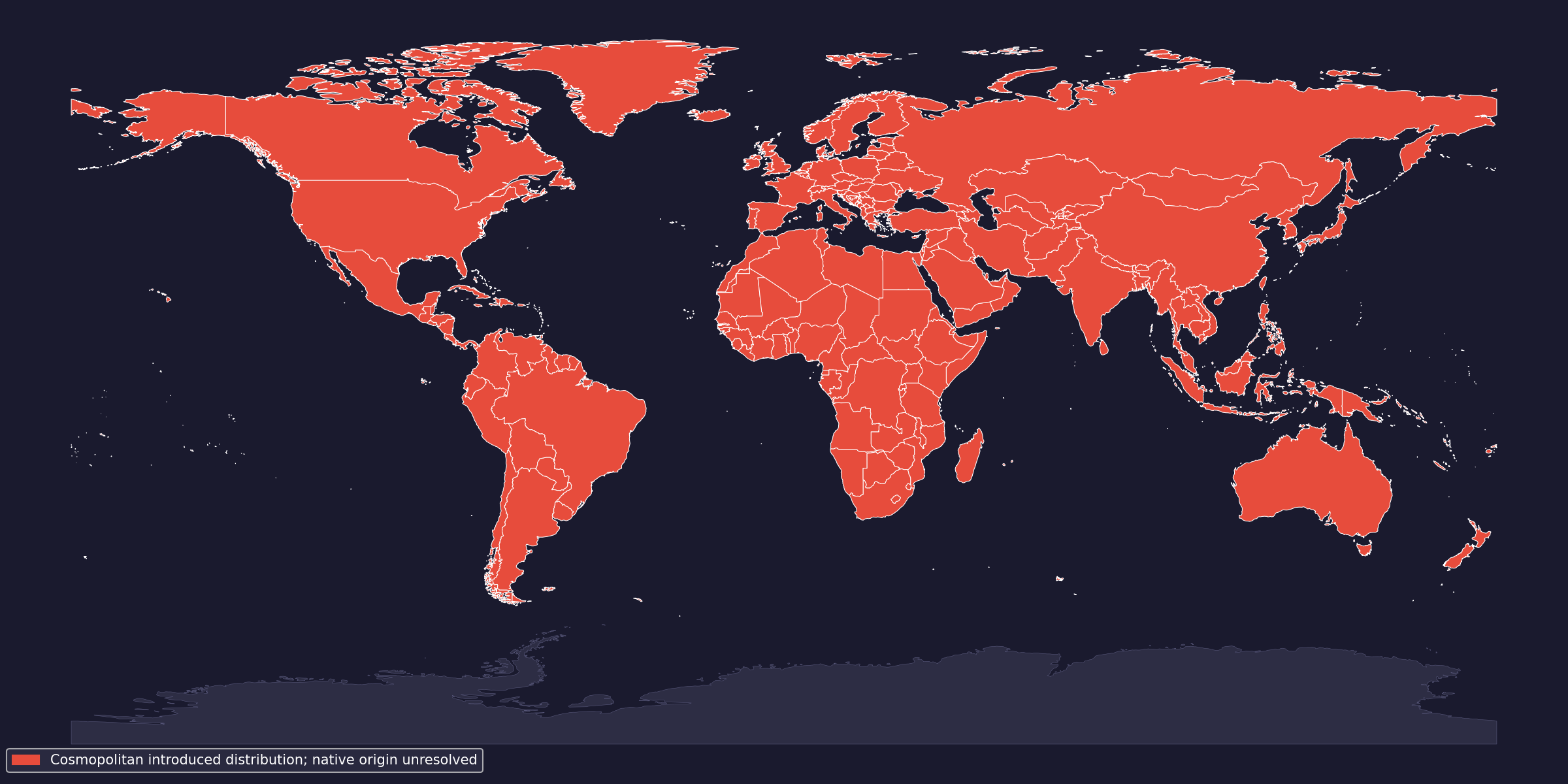
Human transport has established P. australasiae through tropical and subtropical regions worldwide, especially in warm greenhouses, gardens, ports, and buildings. Published sources do not support a simple native-country list, so the map shows current cosmopolitan distribution and explicitly treats the native origin as unresolved.
⚖️ Legal status
Checked on 2026-08-22: P. australasiae is absent from the CITES Appendices, EU wildlife-trade Annexes A-D, Bern Convention appendices, and the current EU Union list of invasive alien species. None of those non-listings overrides national or local controls on pest organisms, live-insect imports, plant health, transport, sale, or rental and workplace use.
Ask the destination authority before shipping. Keep a dated invoice and positive identification. Never release the animals or place culture substrate, oothecae, or fed plant material in garden compost.
🤌 Husbandry
Use at least 45 × 30 × 40 cm for a starter group; the extra height gives adults safe wing-hardening surfaces without bringing them close to the lid. Fit a gasketed multi-latch top and firmly bonded fine metal mesh. Work inside a tall smooth catch bin in a closed room, ideally at a cooler time when flight is less likely.
| Parameter | Practical target |
|---|---|
| Adult size | 3.2-3.5 cm |
| Main temperature | 25-29 °C; limited warm side 29-31 °C |
| Cool / night | 21-25 °C / 21-24 °C |
| Humidity | 60-80%, with drying surfaces and airflow |
| Substrate | 4-6 cm leaf-rich, moist at one end |
| Food | dry staple plus greens, vegetables, and fruit every 1-2 days |
Quarantine new insects and every plant or bark item for at least 60 days with separate tools. Mixing other Periplaneta ruins identification and makes escaped animals harder to trace.
💡 Lighting
UVB is not required. Provide a subdued 10-12-hour cycle. Adults are active after dark and can launch toward light when disturbed, so turn off bright room lights and close curtains before maintenance rather than chasing a flying animal across the room.
Plants used as occasional food do not justify horticultural lighting over the colony. Strong lamps add heat and dry the upper hides; grow feed plants elsewhere.
🌡 Heating and temperature
Maintain 25-29 °C across most usable space, a small 29-31 °C area, and a 21-25 °C retreat. Nights may fall to 21-24 °C. Continuous cooler conditions lengthen the already slow nymphal period; uniform high heat produces a large colony faster than it can be safely serviced.
Use thermostatted room or side heating. Keep a probe among the upper cork sheets, where both radiant heat and colony metabolism can produce a hot pocket.
💧 Humidity and water
Hold a working range of 60-80% with strong ventilation. Keep one lower zone moist for molts and let feeding platforms and upper bark dry. The species favors humid habitats, but stale saturated air encourages mold, phorid flies, and fouled oothecae.
Offer a shallow, textured water source protected from hatchlings and water-rich food. Dry nymphs with split cuticle need more accessible moisture; condensation dripping from the lid calls for more airflow or less watering.
🌿 Enclosure and decoration
Build 4-6 cm of pesticide-free topsoil/coir, decayed hardwood leaves, and a little rotten hardwood. Stand cork securely from floor to mid-height, leaving a clear gap beneath vents and lid. Add removable rough strips where females can glue egg cases.
Because this cockroach can feed on seedlings and greenhouse plants, never move décor or substrate from the culture directly into a planted terrarium. Freeze or heat-treat reusable natural items as appropriate, and quarantine them again before use.
🪳 Feeding
Keep a balanced dry grain-legume or cockroach diet available. Provide leafy greens, carrot, squash, sweet potato, apple, pear, and occasional pesticide-free soft leaves every one to two days. A small protein portion once or twice weekly is sufficient.
Plant feeding distinguishes this species operationally from colonies managed mainly on dry feed and fruit. Offer plant material on a dish, inspect it for oothecae before removal, and discard it sealed rather than composting it. Do not use sprayed ornamentals.
🥚 Breeding
Females produce roughly 20-30 oothecae over a lifetime; each can contain 24-28 eggs. The case is dropped or glued into a crevice. At suitable warmth, embryonic development is commonly about 40 days, so 35-50 days at 25-29 °C is a practical monitoring range.
Move deposited cases on their removable support to a fine-mesh nursery if numbers must be controlled. Hatchlings pass through gaps that hold adults. Count oothecae weekly and decide the maximum colony size before the first generation matures.
🩺 Common problems
- Adult flight at opening: dim the room, cool maintenance conditions slightly, and always use the catch bin.
- Misidentification: confirm the yellow forewing stripe and spotted nymphs; keep dubious stock separate.
- Failed molts: add vertically stable rough surfaces and a moist refuge without making the whole box wet.
- Mold and flies: remove plant food within 24 hours, ventilate, and reduce colony density.
- Allergy: frass and shed skins can cause respiratory sensitization; dampen dusty waste and wear suitable protection.
📌 Conclusion
P. australasiae rewards careful observation with bold markings and active behaviour, but it demands greenhouse-level biosecurity. Its enclosure must control hatchlings, climbers, and fliers before plant-rich feeding or breeding begins.
📚 Sources and further reading
- GBIF: Periplaneta australasiae
- UF/IFAS Extension: Australian cockroach
- UF/IFAS photo guide and life history
- ReptiFiles — checked first; no species care guide was found
- CITES Appendices, valid from 5 March 2026
- EU wildlife-trade Annexes, Regulation (EU) 2026/1383
- Bern Convention appendices
- European Commission: current Union list of invasive alien species
- US EPA: cockroaches, pests, and asthma