Share

American Cockroach
🔤 Taxonomy
Periplaneta americana (Linnaeus, 1758) is accepted by GBIF and the Blattodea Species File. Linnaeus described it as Blatta americana; Kakerlac americana and Periplaneta stolida also occur in synonym lists. The common name is geographical history, not origin: the species is not native to the Americas.
This guide covers the standard wild type and named captive lines. “Venom” and “White eye” denote colour and eye-colour lines of P. americana, not separate taxa. Their basic care and containment are the same, so both are covered here; retain line records and do not present them as separate species. This is a containment-first account of a major peridomestic pest, not a recommendation to collect household or sewer animals.
📌 Description
Adults are large, fast reddish-brown cockroaches, usually 3.5-5.3 cm long, with a pale yellow margin on the pronotum. Both sexes are winged; males’ wings extend farther beyond the abdomen. Adults can glide or fly in warm conditions and every life stage climbs rough surfaces and uses narrow gaps.
The species is robust, long-lived, and extremely productive under warm humid conditions. Those advantages in a laboratory culture are liabilities in a home: one escaped ootheca can become a pest-control problem, and accumulated frass is a clinically important source of inhalant allergen.
🌍 Distribution
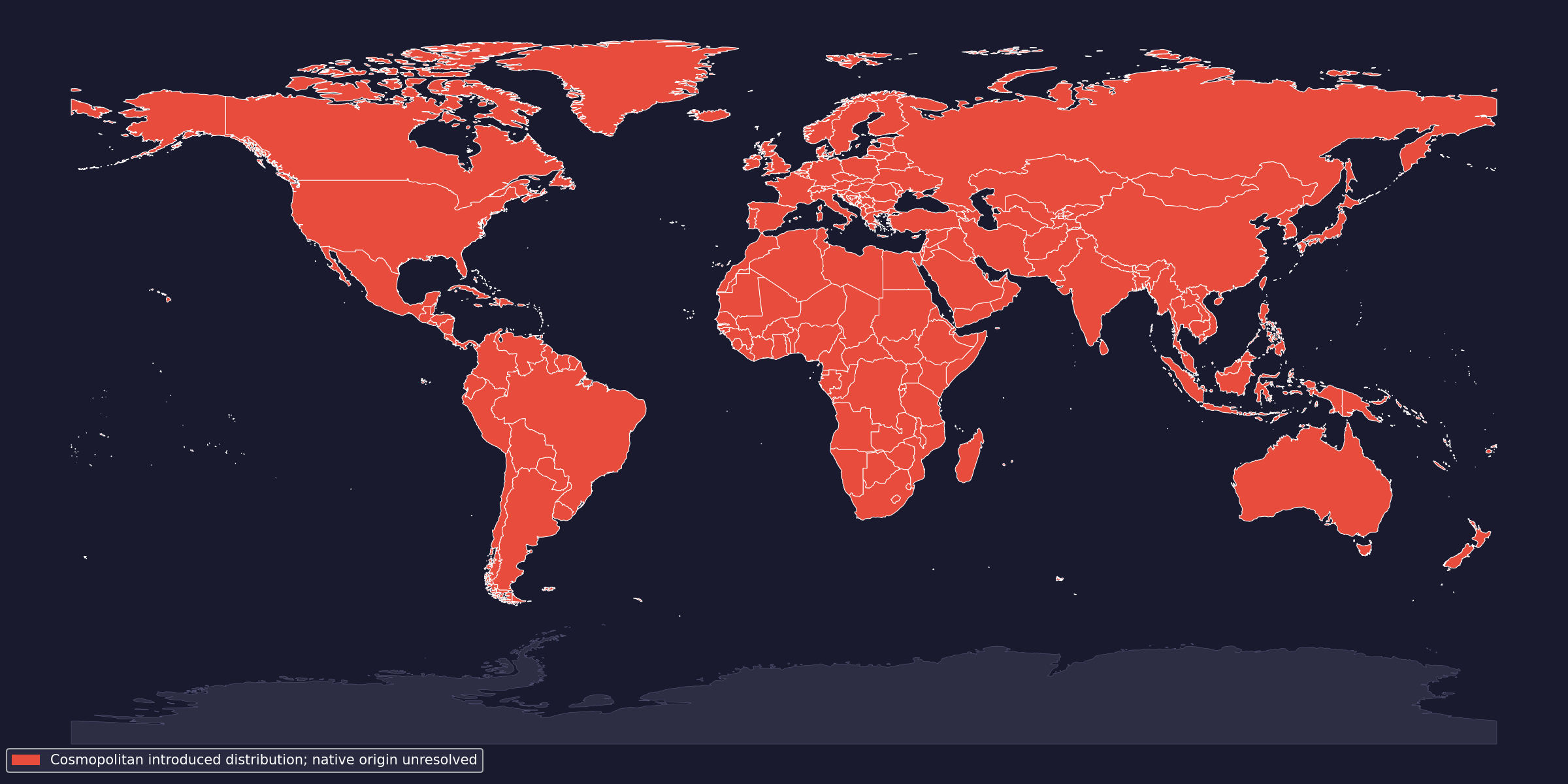
The prehistoric native range remains unresolved. Tropical Africa is the traditional leading hypothesis, while genetic work explicitly leaves tropical Africa or South Asia open and shows extensive human-mediated mixing. What is certain is that the American populations are introduced and that shipping and commerce created a near-cosmopolitan urban distribution.
Today the species is established in warm regions worldwide and survives in heated buildings, sewers, basements, service tunnels, food premises, greenhouses, and animal facilities in cooler climates. The map shows that introduced cosmopolitan distribution; it must not be read as proof that every coloured area is native habitat.
⚖️ Legal status
Checked on 2026-08-22: P. americana was not found in the CITES Appendices, EU wildlife-trade Annexes A-D, the EU list of invasive alien species of Union concern, or the Bern Convention appendices. “Not listed” is not permission to culture a regulated pest. National and local rules for live-insect import, plant and food hygiene, rental housing, schools, laboratories, transport, and nuisance pests may prohibit or condition possession.
Obtain only documented closed-colony stock. Retain the invoice, strain history, and import papers. Never collect from sewers, kitchens, traps, or insecticide-treated buildings: those animals may carry contaminants and resistant pest genetics. Never release stock or give it to a keeper without explaining the escape consequence.
🤌 Husbandry
Use a seamless 60 × 40 × 40 cm gasketed box for a modest colony, placed inside a second smooth-sided lidded container. Ventilation must be nymph-proof metal mesh mechanically fixed over openings. Use lid clips and a broad internal barrier only as a secondary measure. No cable hole, feeding hatch, or mesh seam may remain accessible.
| Parameter | Practical target |
|---|---|
| Adult size | 3.5-5.3 cm |
| Main air temperature | 24-29 °C |
| Limited warm side | 29-32 °C |
| Night | 20-24 °C |
| Moisture | 55-75% RH with a humid refuge |
| Enclosure | 60 × 40 × 40 cm inside secondary containment |
| Feeding | dry staple plus fresh food every 1-3 days |
Open the primary box only inside a closed, uncluttered room and over a catch tub. Count and log breeder adults and inspect waste for oothecae. Quarantine all incoming cultures for at least 60 days in a different room with separate tools; an animal originating from a pest population should not enter the collection.
💡 Lighting
UVB is unnecessary. Provide a dim 10-12-hour day-night cycle. Keep refuges dark, but maintain enough task light to inspect lid seams, oothecae, dead animals, and waste before removal. Avoid direct sun and switch off nearby lights before opening, because adults may run or fly toward them.
🌡 Heating and temperature
Maintain most of the enclosure at 24-29 °C, a limited warm side at 29-32 °C, and a 22-25 °C retreat. Nights of 20-24 °C are safe for established stock. The colony breeds more slowly below the upper range, but deliberately suppressing reproduction with cold produces unhealthy management rather than secure containment.
Heat the room or one side wall with thermostat control and a separate thermometer. Do not heat from below; animals hiding at the base must be able to move away from warmth. The secondary tub also needs ventilation and must not trap heat from electrical equipment.
💧 Humidity and water
Keep a humid lower refuge and a drier feeding surface, with roughly 55-75% RH and strong cross-ventilation. American cockroaches favour warm damp microhabitats, but a wet box accumulates bacteria, odour, mites, and allergenic debris. Condensation should not persist across the lid.
Provide a shallow textured water dish protected from small nymphs or a securely mounted insect-safe drinking source. Clean it frequently. Do not use open bowls, wet sponges that sour, or fruit as the colony’s only water source.
🌿 Enclosure and decoration
For a display colony, use 4-8 cm of pesticide-free soil or coir with hardwood leaves, plus cork slabs fixed vertically with inspection gaps. For quarantine or audited laboratory culture, paper substrate and removable stacked shelters make counting and ootheca recovery easier. Choose one system deliberately; a deep decorative setup is unsuitable when every egg case must be accounted for.
Avoid cardboard in chronically damp areas, resinous wood, fertilizer, perlite, loose foam backgrounds, and hollow decorations that cannot be inspected. No branch should touch the lid. Label both the primary and secondary containers with species, date, and an escape-response contact.
🪳 Feeding
Use a balanced cockroach diet or grain-legume dry mix as the staple. Add carrot, squash, sweet potato, greens, apple, pear, and occasional mushroom. A modest weekly protein ration is enough; unlimited dog or fish food raises waste, odour, and mite pressure.
Feed on removable dishes and use several stations. Size fresh portions to disappear within 24 hours and remove the rest with forceps while working over the catch tub. Never use individuals from an urban infestation as food for other animals, and do not feed cultured stock items exposed to pesticides, mould, or unknown pathogens.
🥚 Breeding
Females produce a hardened ootheca containing commonly 14-16 eggs and glue or conceal it near food and shelter. At 27-30 °C, eggs typically hatch in about 42-60 days. Development from hatch to adult is much longer—often 6-12 months—and adults may live roughly another year.
Breeding requires no special trigger, which is precisely the hazard. Inspect every removed shelter and waste portion. Keep oothecae only if growth is planned; otherwise destroy them without opening the case. Freezing sealed waste at −18 °C for at least one week, followed by disposal under local rules, is a practical conservative protocol.
🩺 Common problems
- Escape or missing ootheca: close the room, block drains and door gaps, use monitored sticky traps outside animal enclosures, and contact a licensed pest professional if containment is not immediately restored.
- Frass allergy: saliva, faeces, shed skins, and dried bodies contain recognised allergens. Wear gloves, dampen waste, use suitable respiratory protection, and do not keep the culture in living or food-preparation areas.
- Sour smell, mites, or flies: reduce colony density and protein, remove corpses and wet food daily, and improve ventilation.
- Wing and antenna damage: add floor area, vertical shelters, feeding stations, and water access; split crowded colonies.
- Failed molts: restore a stable humid refuge and rough vertical surfaces while checking heat and water access.
📌 Conclusion
Standard P. americana belongs only with experienced keepers or institutions that can maintain double containment, auditable waste handling, and an escape response. If the room, landlord, workplace, or local authority cannot tolerate one escaped ootheca, choose a non-pest display cockroach instead.
📚 Sources and further reading
- GBIF: Periplaneta americana
- University of Florida: American cockroach biology and life cycle
- Penn State Extension: American cockroaches
- Global mitochondrial lineages and unresolved native origin
- Review of cockroach allergens
- ReptiFiles — checked; no species care guide was found
- CITES Appendices, valid from 5 March 2026
- EU wildlife-trade Annexes, Regulation (EU) 2026/1383
- EU Union list update, Regulation (EU) 2025/1422
- Bern Convention appendices