Share

Red Goblin Cockroach
🔤 Taxonomy
Paratemnopteryx couloniana (Saussure, 1863) is accepted by GBIF and the Australian Faunal Directory. Older sources place it in Blattellidae; GBIF uses Ectobiidae. Names still encountered include the original Blatta couloniana, Shawella couloniana, Paratemnopteryx blattoides, and Blatta brunneri.
“Red goblin cockroach” is a captive-trade name, while Australian sources sometimes call the species the Coulon. Neither name is a separate colour line.
📌 Description
Adults are compact reddish-brown cockroaches about 1.8-2 cm long. Both sexes have shortened forewings, with males generally longer-winged and slimmer. Adults can climb smooth surfaces; nymphs usually cannot. Hobby stock is regarded as flightless, although wild populations include different wing-length forms, so containment should never rely on presumed flightlessness.
They live above the substrate among bark and debris rather than spending all day buried. A healthy colony is visible after dark and reproduces readily, but dry oothecae and lid gaps can erase a starter group quickly.
🌍 Distribution
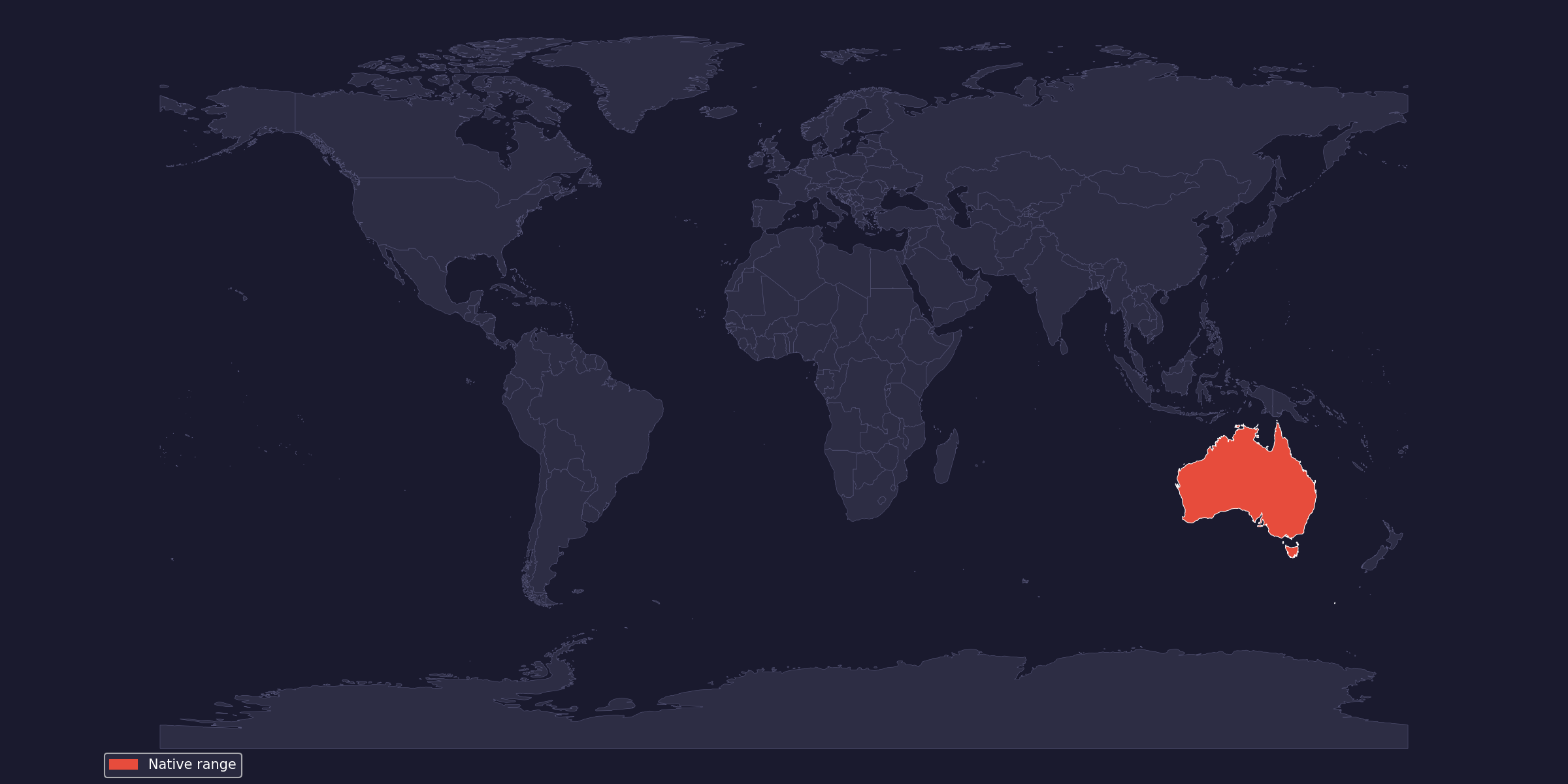
This is a widespread Australian species recorded from several states and sometimes around buildings. It was introduced to New Zealand, where established populations and pest records are documented. The range map shows Australia as the native country; New Zealand is an introduced range and is deliberately not coloured as native.
⚖️ Legal status
Checked on 2026-08-22: P. couloniana was not found in the CITES Appendices, EU wildlife-trade Annexes A-D, the EU list of invasive alien species of Union concern, or the Bern Convention appendices. Its establishment outside Australia still gives it a meaningful biosecurity signal: national live-insect import and pest rules may be stricter than conservation-trade rules.
Retain invoices, culture locality if supplied, and import papers. Never release animals or oothecae. Freeze surplus stock and used substrate in sealed packaging before disposal where local rules allow.
🤌 Husbandry
Use at least 30 × 20 × 20 cm for a working colony. Fit a clipped lid and fine mesh, and keep a broad smooth-wall barrier below the rim as secondary protection. Adults climb; oothecae and newly hatched nymphs can be carried out with bark or waste, so perform maintenance inside a catch tub.
| Parameter | Practical target |
|---|---|
| Adult size | 1.8-2 cm |
| Main air temperature | 20-28 °C |
| Productive warm side | 26-29 °C |
| Night | 18-22 °C |
| Moisture | 50-75% RH; one-third of substrate moist |
| Substrate | 3-5 cm with protected ootheca sites |
| Feeding | dry staple plus fresh produce 2-3 times weekly |
Quarantine additions for 60 days. Keep this species alone if maintaining an identified culture; mixed feeder bins turn escaped adults, small nymphs, and oothecae into an identification and disposal problem.
💡 Lighting
UVB is unnecessary. A low-intensity 10-12-hour light cycle is sufficient. Maintain dark cork retreats and protect the enclosure from direct sun.
🌡 Heating and temperature
The species tolerates ordinary room conditions better than many tropical roaches. Keep most of the box at 20-28 °C and a limited side at 26-29 °C for strong reproduction, while retaining an 18-22 °C retreat. Nights of 18-22 °C are acceptable.
Use thermostatically controlled side heat or warm the room. Heating from below dries the very substrate into which females place oothecae and removes the cooler lower refuge.
💧 Humidity and water
Keep roughly one-third of the substrate lightly moist and the remainder merely humid to dry at the surface. A 50-75% RH range is practical when there is cross-ventilation. The protected egg cases need moisture, but wet cardboard, constant condensation, and sour substrate favour mould and mites.
Offer a shallow textured dish or insect-safe water source and moisture-rich vegetables. Do not use a deep open dish with small nymphs.
🌿 Enclosure and decoration
Provide 3-5 cm of unfertilised soil or coir mixed with hardwood leaf litter. Add cork flats and vertical strips, leaving narrow contact spaces where adults gather. Keep one leaf-covered corner suitable for deposited oothecae and avoid turning it during routine feeding.
Egg cartons can work in a dry production bin but become unhygienic when they wick moisture. Cork is easier to inspect and clean. Avoid resinous softwood, fertilizer, perlite, and a saturated base.
🪳 Feeding
Keep a balanced cockroach diet, chick crumb, or grain-legume mix available in a dry dish. Add zucchini, cucumber, carrot, squash, apple, greens, and occasional mushroom. Supply modest protein; this species can store and recycle nitrogen, but that is not a reason to overload the colony with dog food.
Several thin feeding points reduce crowding. Remove fresh leftovers within 24-48 hours and keep food away from the moist egg-laying corner.
🥚 Breeding
Females deposit a rotated ootheca into sheltered substrate. Captive reports give about 4-12 eggs per case, with many cases produced in a successful colony. At 24-28 °C, a practical incubation expectation is roughly 30-60 days; cooler or drier cases can take longer or fail. These are breeder ranges, not a published fixed threshold.
Leave oothecae in the colony when conditions are stable. If a case must be moved, place it on moist—not wet—substrate with ventilation and the same temperature gradient. Development may pause near the final nymphal instars, so a colony with many subadults is not necessarily failing.
🩺 Common problems
- Dry, empty oothecae: preserve moisture below leaf cover and move feeding waste away from the incubation corner.
- Adults on the lid: renew the secondary barrier, repair mesh edges, and open only inside containment.
- Stalled subadults: confirm warmth and regular food before assuming disease; maturation can be uneven.
- Mould and mites: remove soaked cardboard and oversized fresh portions while improving cross-ventilation.
- Culture escape: because the species has established outside its native country, treat every escape seriously and do not distribute stock without clear containment advice.
📌 Conclusion
The red goblin cockroach is productive and compact, but it is not a casual open-bin feeder. Adults climb and the oothecae need a protected moist zone. A secure lid and deliberate waste handling are the price of keeping this Australian species responsibly outside its native range.
📚 Sources and further reading
- GBIF: Paratemnopteryx couloniana
- Australian Faunal Directory account via Atlas of Living Australia
- Queensland Museum revision: wing forms, ootheca, and introduced New Zealand population
- Cockroaches: Ecology, Behavior, and Natural History
- ReptiFiles — checked; no species care guide was found
- CITES Appendices, valid from 5 March 2026
- EU wildlife-trade Annexes, Regulation (EU) 2026/1383
- EU Union list update, Regulation (EU) 2025/1422
- Bern Convention appendices