Share

Little Kenyan Cockroach
🔤 Taxonomy
Paraplecta minutissima (Shelford, 1908) is accepted by GBIF and the Blattodea Species File. It was described as Stilpnoblatta minutissima and moved to Paraplecta by Princis in 1964.
The cultivated “Little Kenyan” stock is often written Paraplecta cf. minutissima. That qualifier matters: its identification has not been published from comparison with the type specimens, which came from Umangi in the former Belgian Congo. Keep the breeder’s exact label and do not silently remove “cf.” from a culture record.
📌 Description
Adults measure only about 8-10 mm. Males have short wings and can climb smooth surfaces; females have extremely reduced wings, and females and nymphs are much poorer climbers. None of those differences makes an open container safe—the newborns are around fruit-fly scale and vanish into lid seams.
This species spends daylight in the upper substrate, leaf litter, and narrow spaces under wood. Its husbandry is forgiving once established, but tiny starter groups can be lost through drying, over-cleaning, or an unnoticed ventilation gap.
🌍 Distribution
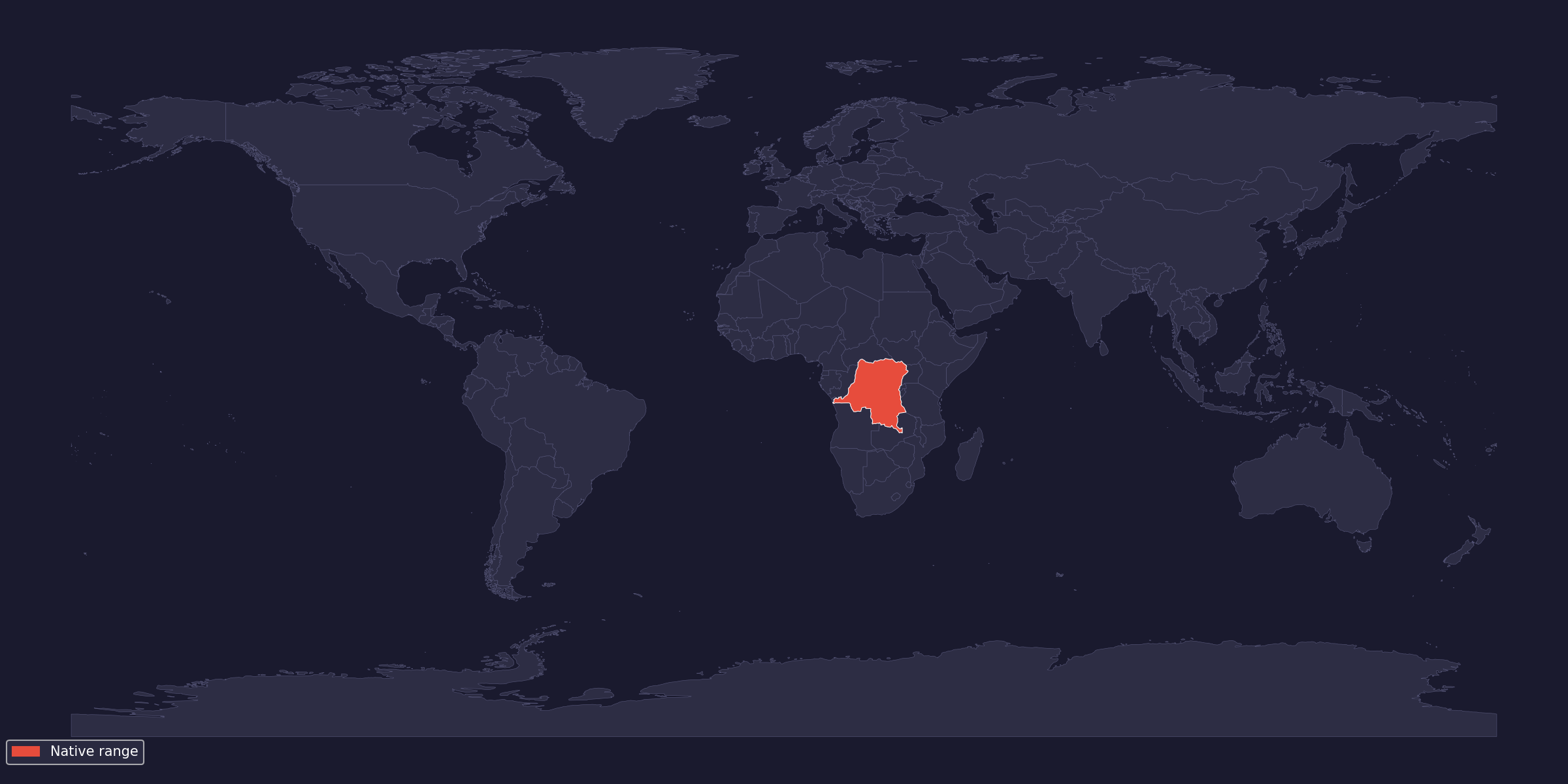
The name-bearing specimens were collected at Umangi, in the present-day Democratic Republic of the Congo. Hobby stock is sold with a Kenya origin, but no published voucher comparison currently demonstrates that the Kenyan culture is the same species. The map highlights the documented type country, not the unverified culture locality or a speculative African range.
⚖️ Legal status
Checked on 2026-08-22: P. minutissima was not found in the CITES Appendices, EU wildlife-trade Annexes A-D, the EU list of invasive alien species of Union concern, or the Bern Convention appendices. National rules for importing and transporting soil-associated live insects may still apply.
Keep the invoice, breeder label, and any import documents. Never release surplus stock. Freeze unwanted animals, leaf litter, and substrate in a sealed bag before disposal where local rules permit; visually sorting a used culture is not reliable at this size.
🤌 Husbandry
A 20 × 15 × 15 cm box can hold a starter colony, provided its lid closes firmly and every opening is covered by fine metal or polyester mesh smaller than a newborn nymph. Standard fly screen and loose-fitting feeding hatches are too coarse. Open the box inside a large smooth catch tub.
| Parameter | Practical target |
|---|---|
| Adult size | 0.8-1 cm |
| Main air temperature | 21-27 °C |
| Limited warm side | 26-28 °C |
| Night | 19-23 °C |
| Moisture | 55-75% RH; moist lower layer |
| Substrate | 4-6 cm of leaf-rich organic mix |
| Feeding | tiny dry ration continuously; fresh food 2-3 times weekly |
Start with enough mixed animals to buffer ordinary losses. Quarantine new cultures for 60 days with dedicated tools. Do not combine them with another micro-roach: sorting species or recovering a pure line later is almost impossible.
💡 Lighting
UVB is unnecessary. Indirect room light on a 10-12-hour cycle is sufficient. Keep most leaf litter shaded so the colony can choose cover, and never place the small enclosure in direct sun.
🌡 Heating and temperature
Keep the main enclosure at 21-27 °C, with only one side reaching 26-28 °C. A 20-23 °C retreat and nights of 19-23 °C are acceptable. Warmer conditions speed production but also dry a micro-enclosure quickly and accelerate food spoilage.
If additional heat is needed, warm the room or one side wall with thermostat control. Do not heat the base beneath the birthing layer.
💧 Humidity and water
Maintain a damp—not waterlogged—lower layer and a drier leaf-litter surface. Relative humidity around 55-75% is workable with cross-ventilation. Because the colony is so small, judge moisture by substrate colour and texture rather than by a cheap dial gauge.
Use vegetables and droplets on moss or a textured surface for drinking. Open water and large water crystals can trap newborns. Re-water a limited corner before the entire lower layer becomes dusty.
🌿 Enclosure and decoration
Provide 4-6 cm of fine pesticide-free soil or coir mixed with crumbled hardwood leaves and soft rotten hardwood. Females excavate small birthing spaces near the base, so the substrate must hold a cavity without becoming mud. Add thin bark flakes and leaf stacks that can be lifted without turning over the whole colony.
Avoid cedar, fertilizer, perlite, coarse bark with large hidden gaps, and decorative moss that is kept saturated. Seal ventilation edges mechanically rather than trusting peeling tape inside a humid box.
🪳 Feeding
Keep a very small quantity of finely ground cockroach diet, chick crumb, or grain-legume mix available on a dry lid. Add tiny slices of carrot, squash, apple, mushroom, or greens two or three times weekly. Leaf litter and decayed hardwood are part of the long-term diet, not just decoration.
Portion size is the main skill. A pea-sized piece may already be too much for a new colony. Remove wet leftovers after 24-48 hours and replace dry food before it becomes mouldy; starving a tiny culture and burying it in food waste are equally avoidable.
🥚 Breeding
Females retain the ootheca internally and release live nymphs, so the metadata uses “viviparous”; “ovoviviparous” remains common in the hobby. Reliable published brood-size and development measurements for the cultured line are lacking, so no precise clutch number is claimed here.
Breeding is steady under warmth, food continuity, and a moist lower substrate. Do not search for birth chambers. A gradual increase in tiny feeding marks and cast skins is safer evidence than repeated excavation.
🩺 Common problems
- Colony disappears after transfer: check ventilation seams, then examine the moist bottom corners under strong light; newborns are easy to overlook.
- No young: preserve a compactable moist layer, stable warmth, and enough adult females; avoid frequent substrate disturbance.
- Mould or mites: reduce fresh portions and exchange only the fouled patch so young hidden elsewhere are not discarded.
- Failed molts: restore local moisture and fine bark surfaces without wetting the entire container.
- Loss of identity: keep the original label with the enclosure and photograph it; do not sell an uncertain line as taxonomically confirmed.
📌 Conclusion
The Little Kenyan culture rewards precise small-scale management rather than a large display. Its enclosure must be nymph-proof before arrival, and its “cf.” identity should travel with every transfer. Those two details protect both the house and the value of the culture.
📚 Sources and further reading
- GBIF: Paraplecta minutissima
- Blattodea Species File: nomenclatural history
- Royal Belgian Institute catalogue: type specimens and Umangi locality
- Phylogenomics and placement of Paraplecta minutissima
- ReptiFiles — checked; no species care guide was found
- CITES Appendices, valid from 5 March 2026
- EU wildlife-trade Annexes, Regulation (EU) 2026/1383
- EU Union list update, Regulation (EU) 2025/1422
- Bern Convention appendices