Share

Transvaal Thick-tailed Scorpion
🔤 Taxonomy
Parabuthus transvaalicus is the accepted name. Historic combinations and broad trade labels occur, so locality and lineage records are necessary; colour and a thick tail are not a species diagnosis.
📌 Description
This is a large black-brown burrowing buthid; it can spray venom toward the eyes. It is treated here as expert-only and display-only. Direct handling is never acceptable, and the enclosure must be designed around the consequences of a sting or escape rather than around the animal’s modest space requirement.
☠️ Venom
This species is venomous. Venom exposure can cause pain, swelling or other systemic effects, and severity varies with species, locality, bite site and the amount delivered. A small wound or apparently dry bite is not proof of safety; every bite or sting requires urgent medical assessment.
If an incident occurs, move away, call emergency services or a poison centre, keep the patient still, remove rings and other constricting items, and follow dispatcher instructions. Do not use a tourniquet, cut or suck the wound, apply ice or electricity, give alcohol or medicines as a home treatment, or attempt to catch the animal. Antivenom choice and dosing are hospital decisions; verify the relevant product and local availability in advance. Sources: WHO snakebite guidance and appropriate species-specific toxinology or medical references listed below.
🌍 Distribution
The supported range covers Botswana, Mozambique, South Africa and Zimbabwe. It occupies hot dry scrub, savanna and semi-arid ground with firm burrows. Wild shelters buffer surface heat and water loss; captive gradients must offer the same choices without reproducing outdoor extremes.
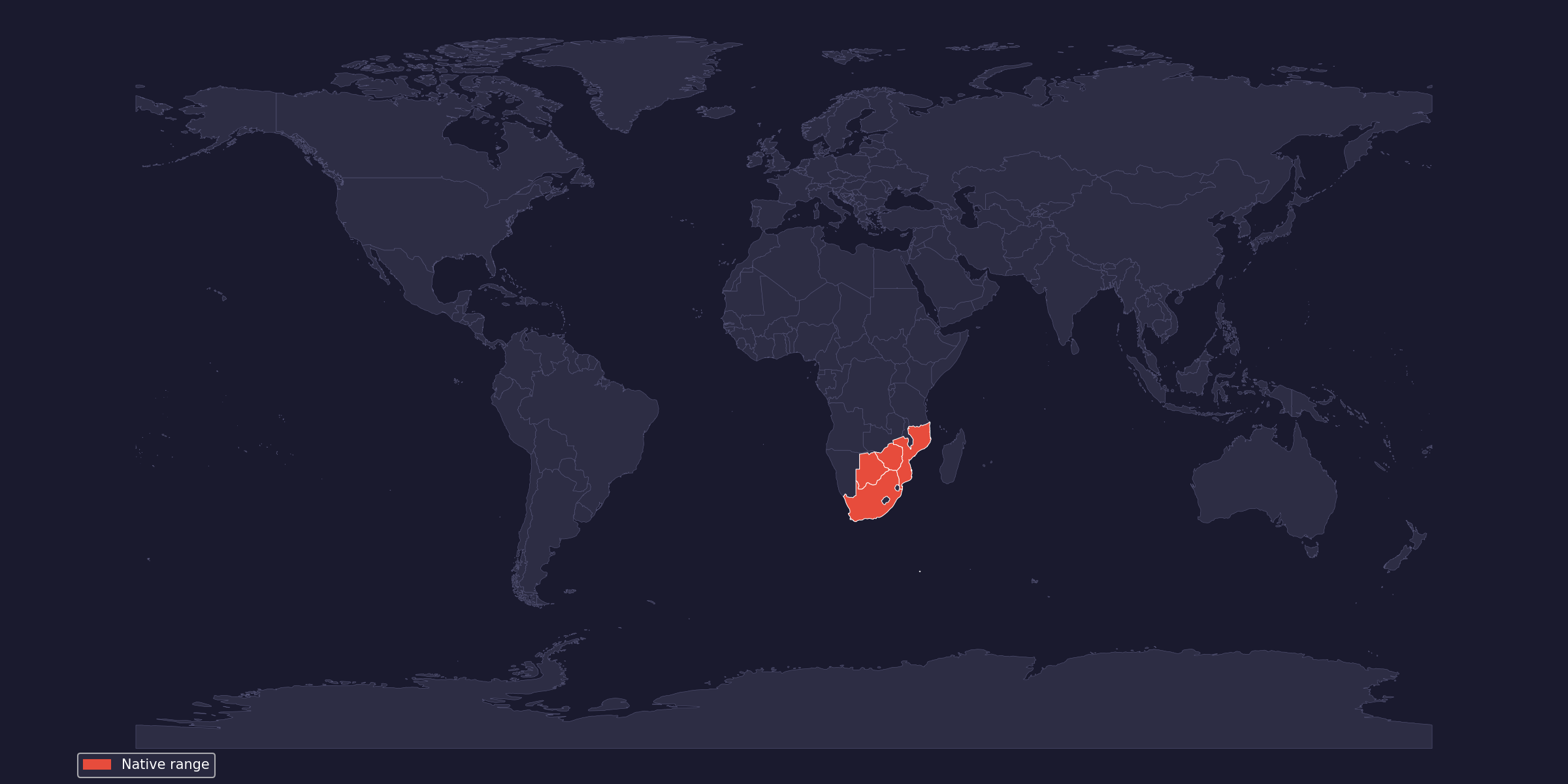
🌡 Climate across the native range
Monthly climate normals from reviewed GBIF occurrences across the southern African range:
Limpopo — South Africa
| Month | Min °C | Mean °C | Max °C | RH % |
|---|---|---|---|---|
| January | 20.6 | 26 | 31.4 | 66 |
| February | 20.3 | 25.6 | 31 | 68 |
| March | 19.3 | 24.8 | 30.3 | 67 |
| April | 16.5 | 22.8 | 29 | 68 |
| May | 12.6 | 20.1 | 27.6 | 61 |
| June | 9.4 | 17.5 | 25.6 | 58 |
| July | 9.2 | 17.3 | 25.3 | 57 |
| August | 11 | 19 | 27 | 56 |
| September | 14.1 | 21.5 | 28.9 | 56 |
| October | 17 | 23.6 | 30.2 | 59 |
| November | 18.1 | 24.2 | 30.4 | 64 |
| December | 19.5 | 25.2 | 30.9 | 66 |
Central District — Botswana
| Month | Min °C | Mean °C | Max °C | RH % |
|---|---|---|---|---|
| January | 21 | 27.3 | 33.6 | 58 |
| February | 20.4 | 26.5 | 32.5 | 61 |
| March | 18.5 | 24.9 | 31.2 | 63 |
| April | 15.2 | 22.3 | 29.4 | 63 |
| May | 9.8 | 18.3 | 26.8 | 60 |
| June | 6.2 | 15.1 | 24 | 61 |
| July | 6.1 | 15 | 23.9 | 59 |
| August | 8.9 | 17.8 | 26.7 | 53 |
| September | 13.3 | 21.5 | 29.7 | 49 |
| October | 17.1 | 24.3 | 31.5 | 50 |
| November | 19 | 25.8 | 32.5 | 54 |
| December | 20.2 | 26.7 | 33.1 | 58 |
Masvingo — Zimbabwe
| Month | Min °C | Mean °C | Max °C | RH % |
|---|---|---|---|---|
| January | 18.6 | 24.6 | 30.7 | 66 |
| February | 18.4 | 24 | 29.5 | 69 |
| March | 17.1 | 23 | 28.8 | 70 |
| April | 14.4 | 21.2 | 28 | 65 |
| May | 9.7 | 17.9 | 26 | 61 |
| June | 6.5 | 15 | 23.5 | 61 |
| July | 6.6 | 15.1 | 23.6 | 58 |
| August | 8.8 | 17.5 | 26.1 | 53 |
| September | 12.8 | 20.8 | 28.9 | 50 |
| October | 16.7 | 23.9 | 31 | 51 |
| November | 17.8 | 24.3 | 30.9 | 57 |
| December | 18.5 | 24.6 | 30.7 | 63 |
Weather data by WorldClim v2.1 · Monthly normals queried by Herpeton Academy from raster values; relative humidity is derived from vapor pressure and mean temperature.
Location references use GBIF.org occurrence data where available; original occurrence records retain their source dataset licenses.
⚖️ Legal status
Checked on 2026-08-17 against the official CITES Appendices and EU wildlife-trade annex framework: Parabuthus transvaalicus is not specifically listed. The Bern Convention is not relevant to this non-European native species. Non-listing is not permission to own it. Dangerously venomous-animal laws, licensing, insurance, transport, workplace and exhibition rules may prohibit or condition possession. Local and national rules must still be checked before acquisition or transfer. Obtain written confirmation before acquisition and retain invoice, breeder identity, origin and import documents.
🤌 Husbandry
House one P. transvaalicus in a mechanically latched primary enclosure inside a second locked cabinet or dedicated room. The service port must be reached from the side without leaning over the burrow, and the permanent label should state both the scientific name and the eye-spray hazard. Quarantine for at least 90 days in a separate secure unit; use dedicated long tools, preserve southern-African locality records and confirm the animal through an inspectable burrow before signing each count.
| Parameter | Conservative target |
|---|---|
| Adult enclosure | 40 × 30 × 30 cm |
| Day air | 25–30 °C |
| Warm area | 30–33 °C |
| Night | 18–22 °C |
| Relative humidity | 25–45%; 45–55% in the protected premoult refuge |
| Substrate | at least 15 cm |
| Feeding | one suitable invertebrate every 10–14 days |
This large burrower can emerge explosively and can direct a venom spray toward the face. Put on sealed goggles or a full face shield before entering the secondary work area; spectacles are inadequate. One trained person controls long forceps and a clear shield while another watches the scorpion, door and catch cups. Never lean over the burrow entrance. If sight is lost, stop, close the room and restore the count methodically.
💡 Lighting
UVB is unnecessary; use subdued diffuse light for 10–12 hours and complete darkness at night. Keep every lamp outside the two barriers and away from the service opening, where glare can make the dark scorpion harder for the observer to track. A display lamp must not warm the burrow roof or force the animal toward the entrance; measure the substrate after the full light period.
🌡 Heating and temperature
Keep daytime air at 25–30 °C, a restricted warm side at 30–33 °C and the deep cool end at 21–24 °C, with nights of 18–22 °C. Apply thermostatted heat to one side wall and monitor both the surface and the formed burrow; never heat from below. A locked cabinet retains heat, so verify the cool tunnel after room heating or display lights have cycled for several hours.
💧 Humidity and water
Keep the general range around 25–45% RH with cross-ventilation and a protected retreat around 45–55% during premoult or for small juveniles. Add water to one deep corner rather than spraying the animal or saturating the whole floor. Supply a shallow stable water dish. Condensation, mould or flies mean moisture and airflow are out of balance.
🌿 Enclosure and decoration
Build at least 15 cm of a firmly packed mix of about two parts sand, one part clay and one part pesticide-free topsoil. Start one burrow beneath a flat stone seated directly on the base; leave the tunnel inspectable from a side or removable roof rather than creating an invisible chamber. Keep open floor around the entrance so a large dark animal cannot disappear among decorations. Every service port must be operable without placing a face or hand above it.
🪳 Feeding
Present one robust captive-bred roach, locust or cricket at the burrow entrance every 10–14 days, adjusting to abdominal condition rather than provoking repeated strikes. Work from the side with long forceps, sealed eye protection and a clear shield available; never lean over the opening to see whether prey was taken. Remove an uneaten feeder within 24 hours and immediately at premoult, without dismantling the tunnel while the animal is exposed.
🦂 Breeding and young
This viviparous species may produce about 20–40 young, but courtship and brood work multiply both the sting and venom-spray hazards. Breeding should be confined to authorised professional programmes with a documented purpose, sealed eye protection, a second observer and enough numbered juvenile units to establish a count before the burrow is opened. Do not add prey while young ride on the female, and record every birth, death and transfer before any container leaves the room.
🩺 Common problems
- Eye exposure: working without sealed eye protection ignores the species’ documented venom-spraying ability.
- Collapsed burrow: loose dry sand or an undermined stone can trap or injure the animal.
- Lost count below ground: an uninspectable tunnel can hide a birth, death or escape.
- Severe sting: clinical series include systemic and life-threatening cases; call emergency services immediately and avoid driving yourself.
- Overheating: a deep burrow still needs a cool end; bottom heat removes that refuge.
📌 Conclusion
Parabuthus transvaalicus is a large medically significant burrower with the additional hazard of venom spray. Expert status here means sealed eye protection, witnessed transfers, a countable engineered burrow and two locked containment layers—not merely long forceps. If the site cannot support those controls and an emergency plan, the species should not be acquired.
📚 Sources and further reading
- GBIF species backbone: Parabuthus transvaalicus
- The Scorpion Files: P. transvaalicus
- Bergman (1997): clinical description of P. transvaalicus scorpionism
- African Snakebite Institute: southern African scorpions
- Amateur Entomologists’ Society: scorpion husbandry and safety
- CITES Appendices
- European Commission: EU wildlife trade
- Council of Europe: Bern Convention