Share

Kalahari Thick-tailed Scorpion
🔤 Taxonomy
Parabuthus raudus is the accepted name; it was originally described as Buthus raudus. The 2004 revision diagnoses true P. raudus as uniformly pale yellow to light brown, although tail segments III–V and the telson may be darker.
The hobby label “P. raudus bicolor” must not be treated as a valid morph. A 2024 captive-behaviour report explains that the so-called bicolor animals were long misidentified and are regarded as a Richtersveld form of P. schlechteri. Their exact limits still need systematic revision. Do not breed, transfer or relabel such an animal as P. raudus without expert morphological identification and traceable locality data.
📌 Description
This is a large, powerful yellow-brown thick-tailed scorpion, usually about 8–12 cm. It is adapted to sand and builds long burrows. The species-specific venom has not been characterized well enough to justify a lower safety category; as a large Parabuthus, it must be managed as medically significant and capable of a severe sting.
| Parameter | Conservative captive target |
|---|---|
| Adult enclosure | At least 40 × 30 × 30 cm |
| Burrowing layer | At least 15 cm of compactable sandy soil |
| Day / warm side | 25–30 °C / 30–33 °C |
| Cool end / night | 21–24 °C / 18–22 °C |
| General humidity | 25–45%; one 45–55% deep refuge |
| Feeding | One suitable insect every 10–14 days |
| Containment | Latched primary enclosure inside a locked second barrier |
☠️ Venom
This species is venomous. Venom exposure can cause pain, swelling or other systemic effects, and severity varies with species, locality, bite site and the amount delivered. A small wound or apparently dry bite is not proof of safety; every bite or sting requires urgent medical assessment.
If an incident occurs, move away, call emergency services or a poison centre, keep the patient still, remove rings and other constricting items, and follow dispatcher instructions. Do not use a tourniquet, cut or suck the wound, apply ice or electricity, give alcohol or medicines as a home treatment, or attempt to catch the animal. Antivenom choice and dosing are hospital decisions; verify the relevant product and local availability in advance. Sources: WHO snakebite guidance and appropriate species-specific toxinology or medical references listed below.
🌍 Distribution
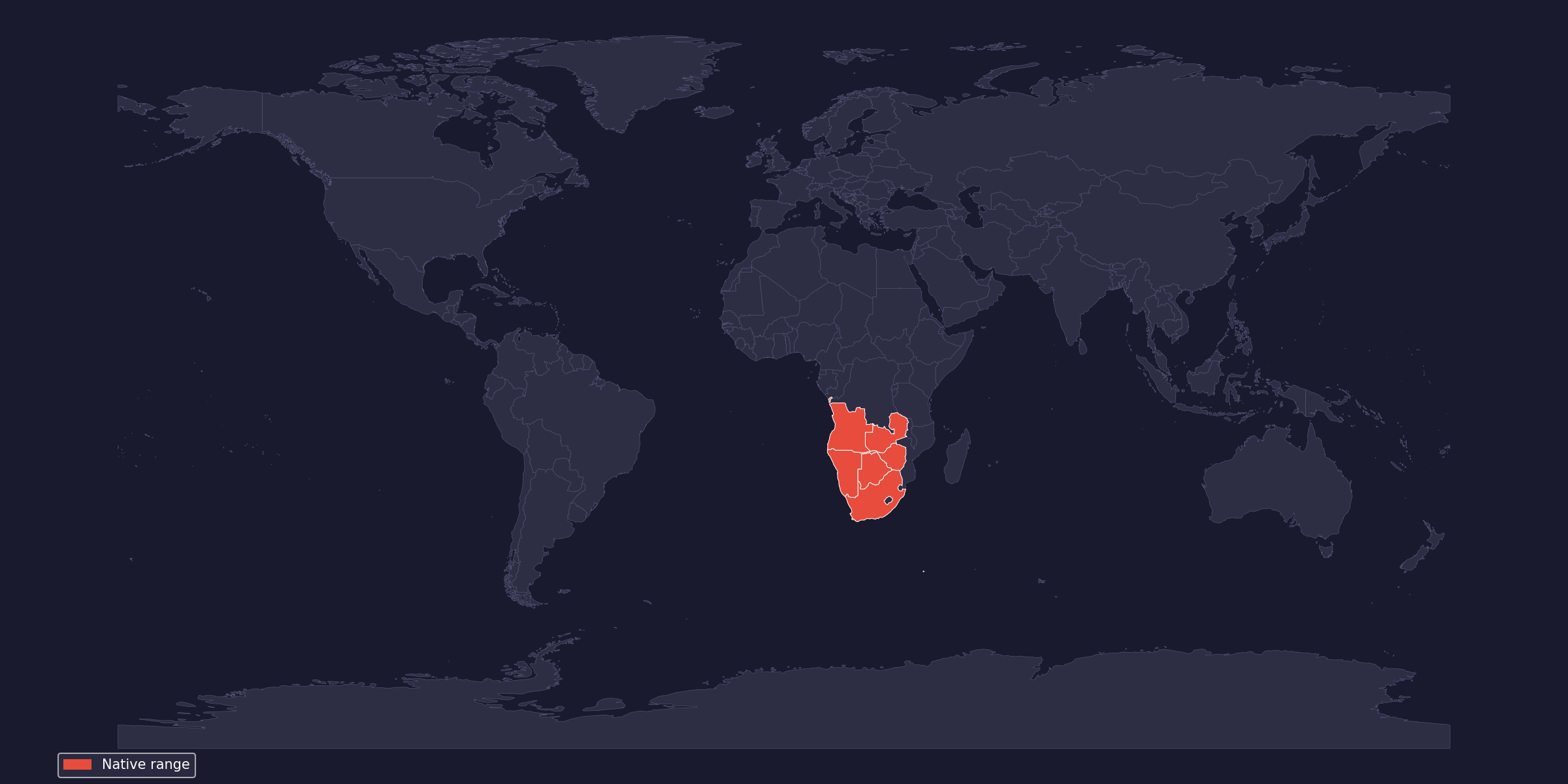
The modern revision records P. raudus from Angola, Botswana, Namibia, South Africa, Zambia and Zimbabwe. Its distribution follows the Kalahari sand system and alluvial sand along the Orange River. It is semi-psammophilous, excavating in open ground and at the bases of grass tufts and shrubs, and is especially common in interdune valleys.
🌡 Climate across the native range
Monthly climate normals from reviewed GBIF occurrences across the central Kalahari sand system:
Hardap — Namibia (reviewed Kalahari occurrence)
| Month | Min °C | Mean °C | Max °C | RH % |
|---|---|---|---|---|
| January | 18.5 | 26 | 33.4 | 39 |
| February | 18.2 | 25.3 | 32.5 | 44 |
| March | 16.6 | 23.8 | 31 | 45 |
| April | 12.5 | 20.5 | 28.5 | 45 |
| May | 7.3 | 16.3 | 25.3 | 40 |
| June | 4.1 | 13.3 | 22.5 | 37 |
| July | 3.6 | 13.1 | 22.6 | 34 |
| August | 5.1 | 15.1 | 25.1 | 28 |
| September | 9 | 18.9 | 28.7 | 27 |
| October | 12.4 | 21.6 | 30.9 | 31 |
| November | 15.3 | 24.1 | 32.9 | 29 |
| December | 18.8 | 25.8 | 32.7 | 32 |
Kgalagadi — Botswana (reviewed Kalahari occurrence)
| Month | Min °C | Mean °C | Max °C | RH % |
|---|---|---|---|---|
| January | 19.4 | 26.3 | 33.1 | 48 |
| February | 18.7 | 25.7 | 32.6 | 51 |
| March | 17 | 24.2 | 31.3 | 51 |
| April | 13.3 | 21.4 | 29.4 | 49 |
| May | 8.4 | 17.7 | 27.1 | 43 |
| June | 5 | 14.7 | 24.5 | 42 |
| July | 4.6 | 14.6 | 24.5 | 38 |
| August | 7.1 | 17.3 | 27.6 | 32 |
| September | 11.7 | 21.6 | 31.6 | 29 |
| October | 16 | 24.7 | 33.4 | 32 |
| November | 17.8 | 25.8 | 33.8 | 36 |
| December | 19.1 | 26.4 | 33.6 | 43 |
Northern Cape — South Africa (reviewed Kalahari occurrence)
| Month | Min °C | Mean °C | Max °C | RH % |
|---|---|---|---|---|
| January | 19.7 | 27.7 | 35.8 | 38 |
| February | 19.5 | 27.1 | 34.7 | 44 |
| March | 17.1 | 24.9 | 32.7 | 46 |
| April | 12.3 | 20.6 | 29 | 50 |
| May | 6.3 | 15.6 | 25 | 49 |
| June | 2.1 | 11.9 | 21.6 | 50 |
| July | 1.6 | 11.6 | 21.6 | 45 |
| August | 3.5 | 13.8 | 24 | 37 |
| September | 8 | 18.1 | 28.2 | 31 |
| October | 12.7 | 22.1 | 31.4 | 34 |
| November | 15.6 | 24.7 | 33.7 | 32 |
| December | 18.3 | 26.8 | 35.4 | 33 |
Weather data by WorldClim v2.1 · Monthly normals queried by Herpeton Academy from raster values; relative humidity is derived from vapor pressure and mean temperature.
Location references use GBIF.org occurrence data where available; original occurrence records retain their source dataset licenses.
⚖️ Legal status
As checked on 17 August 2026, P. raudus was not listed in CITES or the EU wildlife-trade annexes; the Bern Convention is not relevant to its southern African range. It may nevertheless fall under dangerously venomous-animal licensing, import, transport, exhibition, insurance or landlord rules. Before acquisition, verify the scientific identity on the permit and invoice—especially if “bicolor” appears—and retain breeder, locality and import records.
🤌 Husbandry
House one animal alone. Use a clipped or mechanically latched primary box inside a locked cabinet or dedicated locked room. Arrange the opening so the keeper works from the side rather than above the burrow. Mark the enclosure with the scientific name, the identification caveat and a high-venom warning.
Quarantine for 90 days using dedicated long tools. Photograph diagnostic features through the wall when possible and preserve every label received with the animal. A questionable “bicolor” specimen should remain isolated from both P. raudus and P. schlechteri breeding stock.
💡 Lighting
Use subdued diffuse light for 10–12 hours; UVB is unnecessary. Leave the burrow dark. Mount lights outside the secondary barrier and avoid glare across yellow sand, which can hide the animal’s outline during a count.
🌡 Heating and temperature
Maintain 25–30 °C daytime air, with a limited 30–33 °C warm side and a 21–24 °C cool tunnel; let nights fall to 18–22 °C. Apply thermostatted heat to one side wall. Bottom heating is unsafe for a burrower because descending should lead to cooler, not hotter, substrate.
Wild populations encounter strong seasonal differences across a broad range. Do not impose winter cooling on a thin animal, juvenile, new import or animal approaching a moult.
💧 Humidity and water
Keep the surface dry and cross-ventilated at roughly 25–45% RH. Add water occasionally to one deep corner, producing a slightly more humid pocket rather than a wet enclosure. Provide a shallow stable dish. Condensation, mould and flies indicate excess water; a uniformly dust-dry burrow can cause dehydration and moulting failure.
🌿 Enclosure and decoration
Pack at least 15 cm of a sand-rich mixture strengthened with clay and pesticide-free soil. Start a tunnel beneath a flat slab fixed directly to the enclosure floor. The substrate must hold a burrow when compressed; loose dune sand collapses. Keep an inspection window or tool-removable roof over the main chamber so the animal and any young can be counted.
Do not use an unstable stone pile or clutter the entrance. All ventilation holes and cable ports must exclude juveniles as well as the adult.
🪳 Feeding
Offer one captive-reared roach, locust or cricket every 10–14 days. Prey should not exceed the scorpion’s main body length. Adjust by abdominal condition rather than provoking repeated feeding responses. Remove untaken prey within 24 hours and immediately at premoult. Never put a hand or face over the burrow to check whether food was taken.
🦂 Breeding and young
P. raudus is viviparous, but brood sizes in hobby summaries should not be treated as verified species data. Breeding is appropriate only for correctly identified, locality-documented adults in an authorised expert collection. Supervise introductions through a clear shield, separate the pair after courtship and prepare numbered secure tubs before a gravid female gives birth. Young remain on her until their first moult.
🩺 Common problems
- Wrong identity: the “bicolor” label can substitute a form of P. schlechteri for true yellow P. raudus.
- Burrow collapse: dry loose sand or an undermined slab can injure the animal.
- Overheating: bottom heat removes the only cool direction available underground.
- Premoult injury: live prey left in the tunnel can attack a soft scorpion.
- Sting: treat it as an emergency, call emergency services and do not drive yourself.
📌 Conclusion
True P. raudus is a yellow Kalahari sand specialist, not a catch-all name for contrasting dark trade animals. Safe care begins with correct identity, then adds a stable inspectable burrow, a lateral heat gradient and two locked barriers.
📚 Sources and further reading
- GBIF species record: Parabuthus raudus
- Prendini (2004), systematic revision and ecology of southern African Parabuthus
- Tang (2024), identification note on the mislabelled “bicolor morph”
- The Scorpion Files: Buthidae and accepted species list
- Veterinary Care of Scorpions
- CITES Appendices
- European Commission: EU wildlife trade