Share

Granulated Thick-tailed Scorpion
🔤 Taxonomy
Parabuthus granulatus is the accepted name, originally described as Buthus granulatus. The granulated surface and dark to orange-brown colour are useful characters but do not replace a key: southern Africa contains many Parabuthus, and locality-free trade stock can be confused with P. transvaalicus or other large species.
📌 Description
This is a robust 8–12 cm thick-tailed scorpion from dry southern Africa. Clinical literature identifies it as the most medically important scorpion in South Africa, with potentially life-threatening neurotoxic envenomation. Unlike some congeners, it is not known for projecting venom, but that does not reduce the consequence of a sting.
It is suitable only for permitted expert or professional display. Direct handling, tail holding and open-table transfers are unacceptable. The modest enclosure size must not obscure the need for two locked barriers and a rehearsed medical plan.
☠️ Venom
This species is venomous. Venom exposure can cause pain, swelling or other systemic effects, and severity varies with species, locality, bite site and the amount delivered. A small wound or apparently dry bite is not proof of safety; every bite or sting requires urgent medical assessment.
If an incident occurs, move away, call emergency services or a poison centre, keep the patient still, remove rings and other constricting items, and follow dispatcher instructions. Do not use a tourniquet, cut or suck the wound, apply ice or electricity, give alcohol or medicines as a home treatment, or attempt to catch the animal. Antivenom choice and dosing are hospital decisions; verify the relevant product and local availability in advance. Sources: WHO snakebite guidance and appropriate species-specific toxinology or medical references listed below.
🌍 Distribution
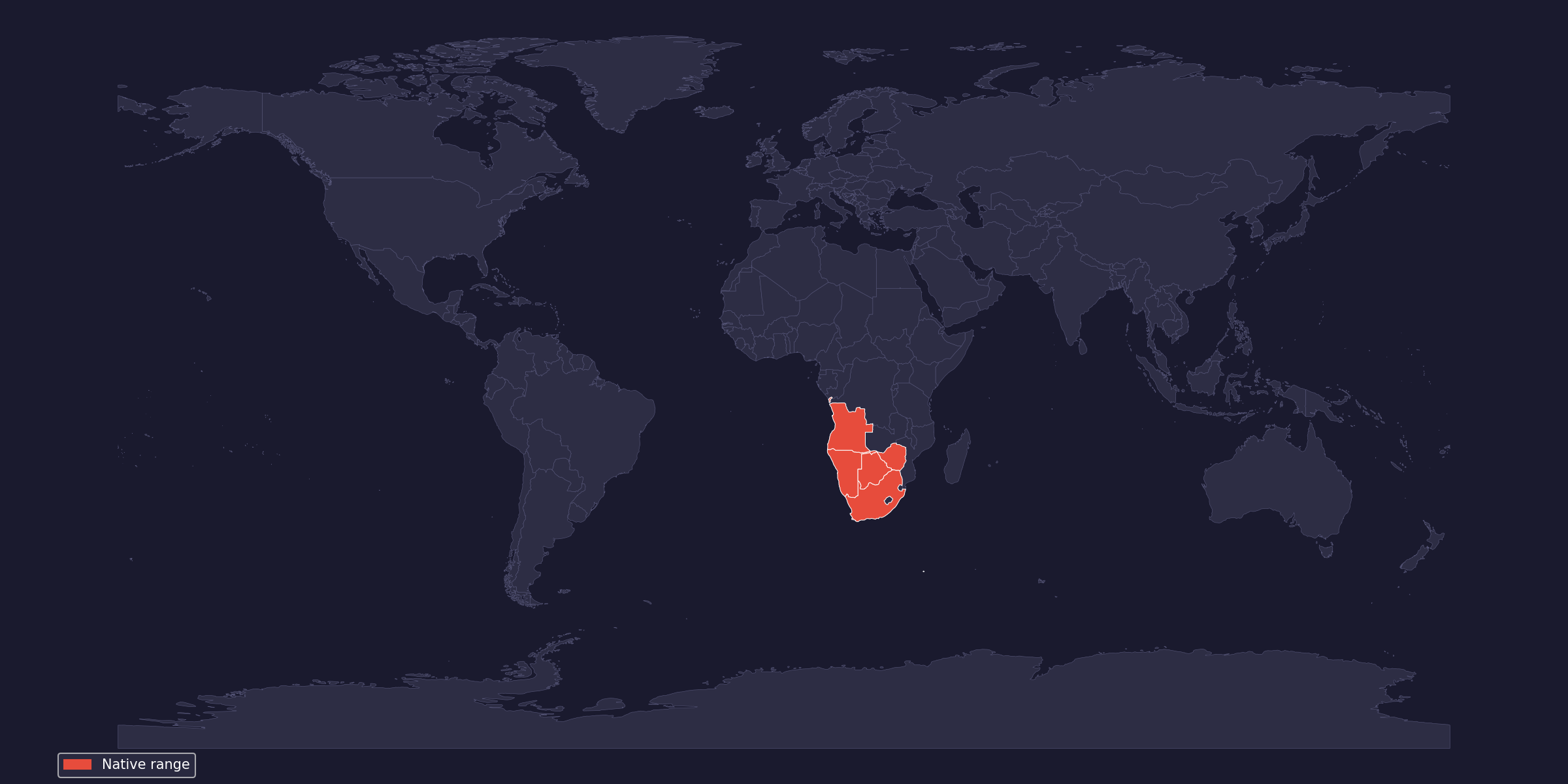
The documented range includes Angola, Botswana, Namibia, South Africa and Zimbabwe. It favours dry areas receiving generally less than about 600 mm of rain, using shallow burrows at the base of shrubs or scrapes beneath rocks in sandy to consolidated soil. Records around buildings show that it can use disturbed habitat as well.
⚖️ Legal status
Checked on 2026-08-29 against the official CITES Appendices and EU wildlife-trade annex framework: P. granulatus is not specifically listed. The Bern Convention is not relevant. Non-listing is not permission to keep or move a medically important scorpion.
Dangerous-animal licensing, import and export controls, transport, tenancy, insurance and public-display requirements may apply. Confirm all rules before acquisition and retain the invoice, lawful-origin evidence, exact locality and transfer records. Do not assume that a captive-bred label removes national restrictions.
🤌 Husbandry
House one adult in a bolted or mechanically latched 40 × 30 × 30 cm primary enclosure within a locked cabinet or dedicated secure room. Use fine metal ventilation, captive fasteners, permanent warning labels and a controlled key list. The enclosure must allow a reliable visual count without forcing the animal out of its burrow.
| Parameter | Conservative target |
|---|---|
| Adult enclosure | at least 40 × 30 × 30 cm |
| Day air | 25–30 °C |
| Warm area | 30–33 °C |
| Night | 18–22 °C |
| Relative humidity | 25–45%; one 45–60% deep refuge |
| Substrate | at least 15 cm of compact sandy soil |
| Feeding | one suitable invertebrate every 10–14 days |
Quarantine for at least 90 days in a separate locked unit. A wild-collected animal may be dehydrated, parasitized, gravid or incorrectly identified. Use dedicated tools and record weight, feeding, moults and the animal count.
For transfers, isolate the room, seal the door gap and put the enclosure inside a large smooth-sided tub. Prepare two rigid locking cups before opening. Coax the scorpion rather than excavating toward it; never pin, grasp or tail-hold it, and never work alone. Inspect the substrate, cup rims and tools before restoring both locks.
Post the scientific name, count, site address, poison-centre and emergency contacts and access route outside the secure area. A sting requires immediate emergency assessment. Keep the person still, remove constricting items and report the exact species; do not cut, suck or tourniquet the site.
💡 Lighting
UVB is not required. Provide low diffuse light for 10–12 hours and uninterrupted darkness at night. Mount all fixtures outside both barriers. Strong overhead lamps desiccate the burrow entrance and can overheat the warm side.
🌡 Heating and temperature
Maintain 25–30 °C daytime air, a limited 30–33 °C warm area and a 21–24 °C cool retreat. Allow nights to fall to 18–22 °C. These gradients represent buffered shelters, not exposed Kalahari surface temperatures.
Heat one outer side with a thermostat and fixed probes. Never heat beneath the substrate, where a digging animal would move toward increasing heat. Check the deep refuge and the secondary cabinet for accumulated temperature.
💧 Humidity and water
Keep the enclosure well ventilated at 25–45% RH. Maintain one slightly moist deep corner around 45–60% for premoult and young animals while keeping the surface mostly dry. Do not mist the entire enclosure or create condensation.
Provide a shallow stable water dish. Refill through a protected opening where the design permits. A collapsed damp tunnel, mould or flies indicate excessive moisture; a dusty, unstable burrow indicates the mix is too dry or loose.
🌿 Enclosure and decoration
Provide at least 15 cm of compact sand, pesticide-free soil and clay that will hold a shallow tunnel. Start a burrow beneath a flat stone or cork slab seated on the base. Keep heavy items supported independently so excavation cannot cause collapse.
Avoid elaborate hollow decor. The scorpion needs a stable retreat, but the keeper must be able to locate and close both exits with tools before any intervention. Test every vent and service port before use.
🪳 Feeding
Offer one appropriately sized captive-bred roach, cricket or locust every 10–14 days. Place prey at the burrow entrance with long tools. Remove leftovers within 24 hours and all prey before a moult or birth.
No routine supplement dust is required. Adjust feeding to abdomen condition and temperature; large Parabuthus are easily overfed in captivity. Never use wild insects.
🦂 Breeding and young
P. granulatus is viviparous. The young ride on the mother until after their first moult. Brood size varies, and a practical containment plan should allow for approximately 20–40 young rather than relying on an average.
Breeding a medically important species multiplies transfer and escape risk. It belongs only in licensed, purpose-led programmes with individually numbered juvenile enclosures ready before pairing. Do not disturb a female carrying young or add loose prey to the maternal enclosure.
🩺 Common problems
- Sting: potentially life-threatening envenomation requires immediate emergency care.
- Burrow collapse: loose sand and unsupported stones can trap or crush the animal.
- Excess moisture: continuously damp substrate causes mould and poor moults.
- Taxonomic error: colour and size overlap with other southern African Parabuthus.
- Unsafe excavation: dismantling a burrow without closing both exits creates an escape route.
📌 Conclusion
Parabuthus granulatus needs less space than many reptiles but far more procedural control. Its medical importance, digging behaviour and speed make a compactable burrow, double locks, no-touch transfers and immediate access to emergency advice inseparable parts of husbandry. Without that infrastructure, it should not be kept.
📚 Sources and further reading
- GBIF species backbone: Parabuthus granulatus
- The Scorpion Files: Parabuthus granulatus
- The Scorpion Files: medically important scorpions
- Lamoral (1979): scorpions of Namibia
- CITES Appendices
- EU wildlife trade