Share

Kindred Narrow-winged Wood Cockroach
🔤 Taxonomy
Panesthia angustipennis cognata Bey-Bienko, 1969 is accepted as a subspecies by Cockroach Species File and has a GBIF subspecies record (key 6253719). The taxonomy widget stops at the GBIF parent species P. angustipennis because the site schema displays kingdom-to-species ranks.
Adults resemble P. a. spadica and some distinguishing characters are variable. Keep “Laos,” “Cambodia,” or any other locality only when it came with traceable stock; the unqualified name in this guide does not establish a locality.
📌 Description
This is a heavy black wood-feeding cockroach, around 4.5-5 cm as an adult. Young nymphs in some hobby lines show orange banding that fades toward adulthood. Nymphs and adults tunnel through decayed wood and spend long periods hidden; their slow colony cycle and specialized food base make them advanced display animals.
| Care point | Practical target |
|---|---|
| Adult size | about 4.5-5 cm |
| Small group enclosure | 45 x 30 x 30 cm |
| Temperature | 23-27°C; avoid sustained heat |
| Humidity | 70-85%; substrate moist, airy, never waterlogged |
| Substrate | at least 15-20 cm, mostly white-rotted hardwood and leaf mould |
| Social management | females/groups often coexist; watch adult males for conflict |
🌍 Distribution
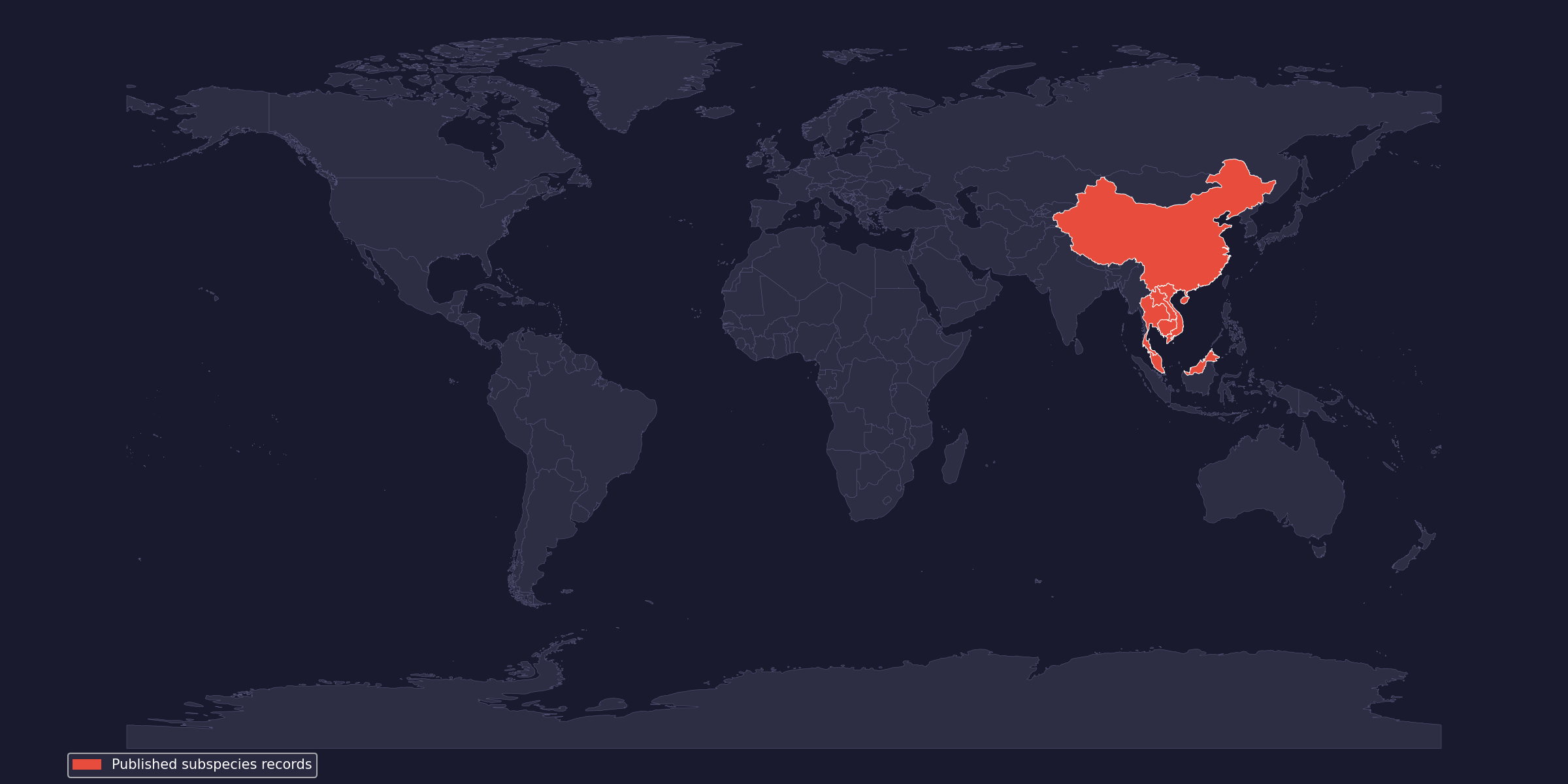
Taxonomic literature records the subspecies from southern China, especially Yunnan and Guangdong, as well as Vietnam, Laos, and Malaysia. Additional studied or museum populations are documented from Cambodia and Thailand. A captive line label should not be inferred from that broad range.
The country map shows those published records at coarse scale. It does not assign the stock covered here to one of them.
⚖️ Legal status
Checked on 2026-08-22: neither Panesthia angustipennis nor the subspecies P. a. cognata is listed in the CITES Appendices valid from 5 March 2026 or Annexes A-D of Commission Regulation (EU) 2026/1383. The Bern Convention is not relevant to this Southeast Asian taxon.
Import and movement of live cockroaches, wood, soil, and leaf material may be controlled separately by animal, plant-health, customs, and invasive-species rules. Keep invoice, exact line/locality label, breeder history, and import papers. Never collect substrate from protected sites or release animals or cultured wood outdoors.
🤌 Husbandry
A 45 x 30 x 30 cm box is a practical starting size for a small group, but most usable volume should be food-rich substrate rather than empty headroom. Use a secure lid and moderate fine ventilation. Minimize digging and major rearrangement.
Quarantine new stock for 90 days with separate tools. Keep locality lines separate, count adults and nymph size classes when visible, and monitor mass of edible wood rather than waiting for the surface to look empty. Adult males may fight; add space and multiple log sections, and separate an injured or persistently excluded male.
💡 Lighting
UVB is not required. Give 10-12 hours of indirect room light and keep the deep galleries dark. A dim observation light is preferable to lifting every log. Direct sun and strong lamps dry the top while heat builds below.
🌡 Heating and temperature
Maintain 23-27°C, with a cooler pocket at 20-23°C and nights around 20-24°C. Captive lines are often kept at room temperature and develop slowly. Do not assume that tropical origin means 30°C is safe inside an insulated mass of wood.
If the room is cool, heat only one side through a thermostat and place a probe in the substrate. Stop heating if the wood dries rapidly or animals crowd the cool end.
💧 Humidity and water
Keep the interior of the wood-and-leaf layer evenly moist, roughly corresponding to 70-85% air humidity, while retaining air spaces. The correct texture is crumbly and damp, not dripping. A dry core can destroy a colony slowly; saturation causes anaerobic odor, mold, and mites.
Fresh vegetables and substrate moisture usually supply water. A shallow textured dish may be added, but it cannot compensate for dry edible wood.
🌿 Enclosure and decoration
Provide at least 15-20 cm of pesticide-free, very soft white-rotted hardwood broken into chunks and fibers, mixed with decomposed hardwood leaves and leaf mould. Include intact punky logs large enough to tunnel into. Oak, beech, and other safe deciduous woods are useful only when correctly decayed and free of chemicals.
Avoid conifers, fresh hard wood as the sole substrate, ornamental mulch, fertilizer, and wood collected beside roads or sprayed land. Replace no more than part of the material at once; frass-like substrate may still contain nymphs.
🪳 Feeding
White-rotted hardwood is the staple, not decoration. Keep it available throughout the entire substrate. Add occasional leaf litter, mushroom, carrot, squash, apple, and a little fish flake or balanced insect food.
Offer small extras every two to four days and remove them before mold spreads. Fruit and protein cannot replace wood; a colony may eat them while still starving as its structural food is exhausted.
🥚 Breeding
Females retain the ootheca and produce live nymphs. Maturity and recruitment are slow compared with feeder roaches, and dependable brood-size or gestation values for the unqualified hobby stock are not established strongly enough to place in metadata.
Do not separate newborns automatically. Panesthia aggregate in food galleries, although work on another P. angustipennis subspecies indicates that aggregation should not be oversold as obligatory parental care. Stability, edible wood, and limited disturbance matter more than forced family-group narratives.
🩺 Common problems
- Slow disappearance of the colony: inspect moisture and remaining soft wood; apparent “substrate” may have become mostly frass.
- Drying: rehydrate part of the lower layer gradually and improve moisture retention without sealing out all air.
- Mites or sour odor: remove spoiled extras, replace a small affected section, and restore ventilation.
- Male injuries: add separate log galleries and isolate a repeatedly attacked animal.
- Crushed molts: stop compacting substrate and leave stable cavities.
- Line confusion: never merge locality stocks or relabel descendants without records.
📌 Conclusion
P. a. cognata suits a patient keeper who can maintain a deep edible habitat for years. The central task is not frequent feeding but preserving moist white-rotted hardwood, stable galleries, and the line’s provenance.
📚 Sources and further reading
- GBIF parent species: Panesthia angustipennis
- GBIF subspecies record: P. a. cognata
- Cockroach Species File: P. a. cognata
- Wang, Wang & Che 2014: taxonomy and Southeast Asian distribution
- Ito & Osawa 2017: aggregation in P. angustipennis spadica
- Roach Crossing: line-specific culture observations
- ReptiFiles — checked first; no taxon-specific guide was found
- CITES Appendices, valid from 5 March 2026
- Commission Regulation (EU) 2026/1383: current wildlife-trade annexes
- Council of Europe: Bern Convention text and appendices