Share

Emperor Scorpion
🔤 Taxonomy
Pandinus imperator is the accepted scientific name for the emperor scorpion. In the pet trade, the common name has been used loosely for other large black scorpions, so legal documents, invoices, and enclosure labels should use the Latin name.
Common names used in the hobby:
- Emperor scorpion
- Common emperor scorpion
Names that can be confused with it in trade:
- Pandinus dictator
- Pandinus gambiensis
- Asian forest scorpions sold as Heterometrus species
📌 Description
The emperor scorpion is a large West African forest scorpion. Adults commonly reach 15-20 cm total length, have heavy black pincers, and usually live 5-8 years with stable care.
This is a display animal, not a handling pet. Its venom is not usually treated as medically significant for healthy adults, but a sting can be painful and allergies or individual reactions are possible. Use tools and catch cups during maintenance.
☠️ Venom
This species is venomous. Venom exposure can cause pain, swelling or other systemic effects, and severity varies with species, locality, bite site and the amount delivered. A small wound or apparently dry bite is not proof of safety; every bite or sting requires urgent medical assessment.
If an incident occurs, move away, call emergency services or a poison centre, keep the patient still, remove rings and other constricting items, and follow dispatcher instructions. Do not use a tourniquet, cut or suck the wound, apply ice or electricity, give alcohol or medicines as a home treatment, or attempt to catch the animal. Antivenom choice and dosing are hospital decisions; verify the relevant product and local availability in advance. Sources: WHO snakebite guidance and appropriate species-specific toxinology or medical references listed below.
🌍 Distribution
Pandinus imperator is native to humid tropical parts of West Africa, where it uses burrows, roots, leaf litter, and shaded retreats. In the enclosure, the useful habitat cues are deep slightly damp substrate, a secure hide, warm air, high humidity, and enough ventilation to prevent stagnant wet conditions.
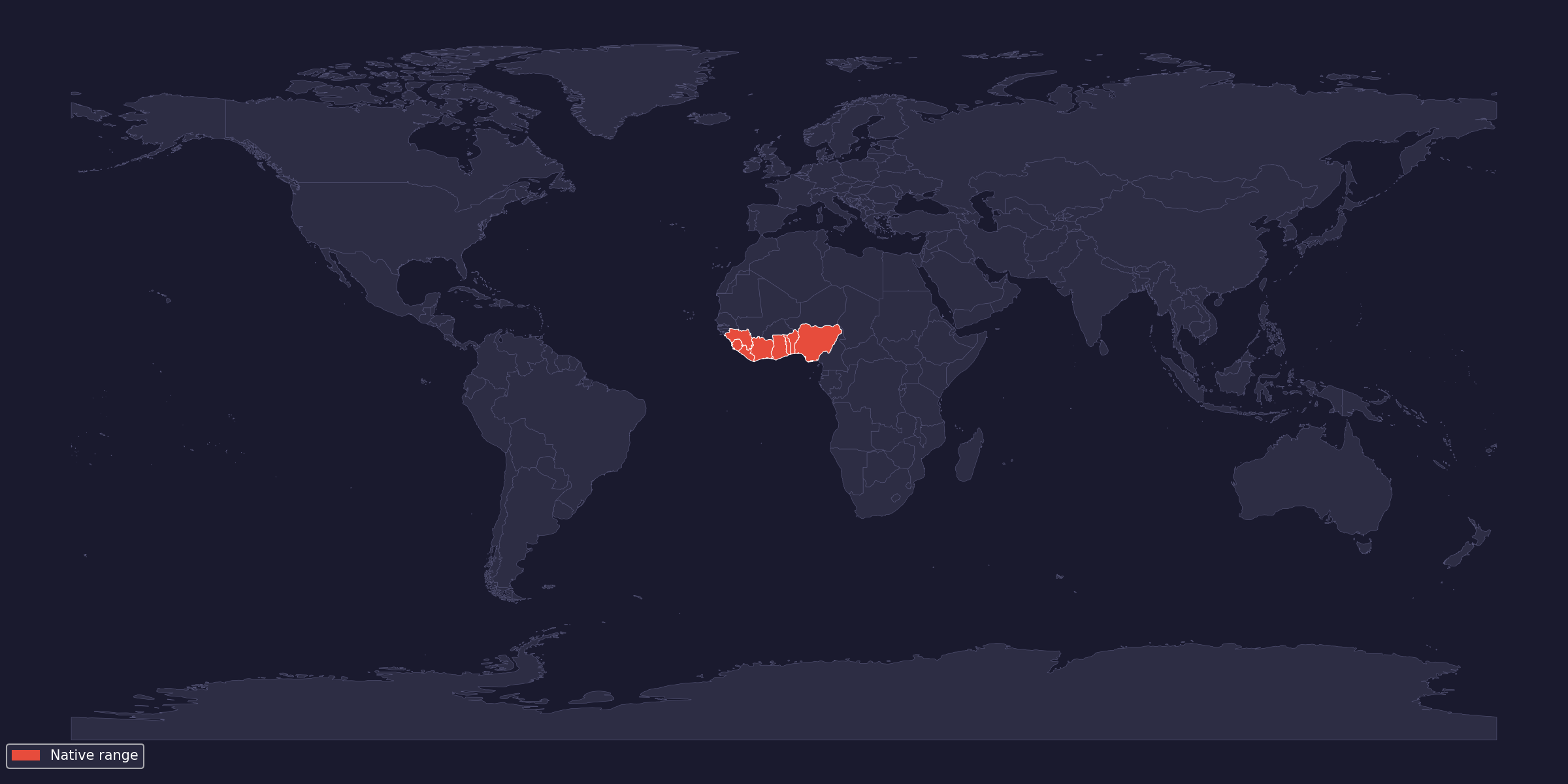
🌡 Climate across the native range
Monthly climate normals from reviewed GBIF occurrence locations:
Plateaux — Togo
| Month | Min °C | Mean °C | Max °C | RH % |
|---|---|---|---|---|
| January | 21.3 | 26.9 | 32.4 | 65 |
| February | 22.3 | 27.8 | 33.4 | 69 |
| March | 22.7 | 27.8 | 32.9 | 75 |
| April | 22.7 | 27.5 | 32.3 | 79 |
| May | 22.2 | 26.7 | 31.2 | 82 |
| June | 21.5 | 25.4 | 29.4 | 87 |
| July | 20.9 | 24.4 | 27.8 | 88 |
| August | 20.8 | 24.3 | 27.8 | 87 |
| September | 21.2 | 25.1 | 28.9 | 85 |
| October | 21.5 | 25.8 | 30 | 84 |
| November | 21.5 | 26.3 | 31.2 | 80 |
| December | 20.8 | 26 | 31.2 | 75 |
Bas-Sassandra — Côte d’Ivoire
| Month | Min °C | Mean °C | Max °C | RH % |
|---|---|---|---|---|
| January | 21 | 26 | 30.9 | 73 |
| February | 21.8 | 26.9 | 32.1 | 71 |
| March | 22.3 | 27.2 | 32.2 | 74 |
| April | 22.6 | 27.3 | 31.9 | 74 |
| May | 21.7 | 26 | 30.3 | 79 |
| June | 22 | 25.6 | 29.2 | 79 |
| July | 21.4 | 24.8 | 28.1 | 78 |
| August | 21.2 | 24.5 | 27.8 | 79 |
| September | 22 | 25.5 | 29 | 77 |
| October | 22.3 | 26.3 | 30.3 | 75 |
| November | 21.3 | 25.8 | 30.3 | 78 |
| December | 21.5 | 26 | 30.6 | 75 |
Central Region — Ghana
| Month | Min °C | Mean °C | Max °C | RH % |
|---|---|---|---|---|
| January | 21.8 | 26.1 | 30.4 | 81 |
| February | 22.7 | 27 | 31.2 | 81 |
| March | 22.9 | 27.1 | 31.2 | 83 |
| April | 23.1 | 27 | 30.9 | 83 |
| May | 23 | 26.7 | 30.3 | 84 |
| June | 22.5 | 25.5 | 28.5 | 86 |
| July | 21.9 | 24.5 | 27.2 | 87 |
| August | 21.4 | 23.9 | 26.5 | 87 |
| September | 21.9 | 24.8 | 27.7 | 86 |
| October | 22.2 | 25.5 | 28.8 | 85 |
| November | 22.6 | 26.3 | 30.1 | 84 |
| December | 22.5 | 26.4 | 30.2 | 83 |
Weather data by WorldClim v2.1 · Monthly normals queried by Herpeton Academy from raster values; relative humidity is derived from vapor pressure and mean temperature.
Location references use GBIF.org occurrence data where available; original occurrence records retain their source dataset licenses.
⚖️ Legal status
Checked on 2026-06-03: Pandinus imperator is listed in CITES Appendix II and in EU Annex B. The Bern Convention is not normally relevant because this is not a European native protected-species care issue. That means international trade and EU wildlife-trade movement may require valid origin and trade documents even when private keeping is allowed.
Keep purchase receipts, breeder or importer details, CITES/EU paperwork where relevant, and clear species identification. Local rules for venomous invertebrates, public display, school use, sale, breeding, import, and transport can still apply.
🤌 Husbandry
Keep adults singly unless there is a controlled breeding reason and spare separation enclosures are ready. The practical adult minimum is 45 x 30 x 30 cm; use a clipped lid or latch, escape-proof ventilation, and a low layout with no serious fall risk.
Use 10-15 cm of soil, coco fiber, clay mix, or similar substrate that can hold a burrow without collapsing. Keep the lower layers slightly moist and the surface only lightly damp, not swampy.
💡 Lighting
UVB is not required. Provide a normal day-night cycle with room light or a dim low-heat lamp. Avoid bright exposed lamps over the main hide, because emperor scorpions spend most active time under cover.
🌡 Heating and temperature
- ambient air: 24-28°C
- warm area: 28-30°C
- cool retreat: 22-24°C
- night: 21-24°C
Heat one side of the enclosure with a thermostat-controlled heat mat on the side wall or a low-wattage overhead source. Do not heat the whole floor; a scorpion must be able to burrow away from warmth.
💧 Humidity and water
Aim for 70-85% humidity, with a slightly more humid hide during molts. Provide a shallow water dish at all times. Mist lightly when the upper substrate dries, then allow ventilation to clear excess condensation.
Constantly wet substrate, sour smell, mites, and mold indicate too much water or too little airflow. Dehydration, repeated failed molts, and refusal to leave the water dish can indicate the enclosure is too dry.
🌿 Enclosure and decoration
Give at least one tight ground hide, cork bark, flat stones seated on the enclosure floor, leaf litter, and visual cover. Heavy decor must rest on the base, not on loose substrate, so burrowing cannot cause a collapse.
Use smooth-sided feeding dishes or remove uneaten prey quickly. All gaps must be secure; a strong adult can push loose lids, light decor, and poorly fitted doors.
🪳 Feeding
Feed appropriately sized crickets, roaches, locusts, or other safe feeder insects. Most adults do well with one moderate meal every 7-14 days. Juveniles can be fed smaller prey more often.
Do not leave active prey in the enclosure during a molt or when the scorpion is hiding for long periods. Remove uneaten feeders by the next day.
🦂 Breeding and young
This species is viviparous. Females give birth to live young that ride on the mother’s back until after their first molt. Breeding should be planned only when adults are mature, well fed, correctly identified, and legally sourced.
Separate young once they leave the mother and start feeding. Keep small juveniles in simple secure tubs with shallow substrate, a hide, moisture gradient, and tiny prey.
🩺 Common problems
Common problems include dehydration, wet stagnant substrate, mold, mites, failed molts, heat stress, injuries from falls or feeder insects, escape attempts, and misidentified imports. Many failures come from either keeping the enclosure too dry or trying to keep it wet without enough ventilation.
📌 Conclusion
Keep Pandinus imperator only when the legal paperwork, secure humid setup, and no-handling routine are ready before purchase. The animal is physically robust, but its CITES status and moisture-sensitive housing make it a poor impulse buy.
📚 Selected sources
- GBIF Backbone Taxonomy
- Animal Diversity Web: Pandinus imperator
- CITES Appendices, valid from 7 February 2025
- European Commission wildlife trade overview
- The Tarantula Collective: Emperor Scorpion