Share

Pandinurus exitialis
🔤 Taxonomy
Pandinurus exitialis is an accepted species in Scorpionidae. It was described as Scorpio exitialis in 1888 and was later widely listed as Pandinus exitialis or Pandinus (Pandinurus) exitialis. Current sources place it in Pandinurus.
Modern revisions have separated several populations formerly grouped under this name. The type locality is the broad historical region of Shoa, Ethiopia, while examined recent material supports southwestern Ethiopia. Old records from Somalia, Kenya, Eritrea and Sudan cannot all be accepted without re-examining specimens. “Gold-claw scorpion” is a trade name, not a reliable identification.
📌 Description
Adults measure about 9–13 cm. They are robust brown to dark-brown scorpions with strongly granulated pincers; the chelae, legs and telson may be yellowish or lighter brown. Adult males have a pronounced tooth on the movable pedipalp finger, but sexing and species identification should use several characters, not colour alone.
No strong clinical evidence shows this species to be medically significant, but published sting data are sparse. The Latin name does not prove lethal venom, and the large pincers do not prove harmless venom. Treat it as venomous, defensive and unsuitable for handling.
| Quick reference | Target |
|---|---|
| Adult enclosure | At least 60 × 30 × 35 cm for one |
| Burrowing substrate | 15–20 cm, firmly compacted |
| Warm side | 30–32 °C |
| Cool side / night | 22–25 °C / 20–24 °C |
| Humidity | 40–60%; mildly damp lower retreat |
| Feeding | One or two insects every 7–14 days |
| Social housing | Solitary |
☠️ Venom
This species is venomous. Venom exposure can cause pain, swelling or other systemic effects, and severity varies with species, locality, bite site and the amount delivered. A small wound or apparently dry bite is not proof of safety; every bite or sting requires urgent medical assessment.
If an incident occurs, move away, call emergency services or a poison centre, keep the patient still, remove rings and other constricting items, and follow dispatcher instructions. Do not use a tourniquet, cut or suck the wound, apply ice or electricity, give alcohol or medicines as a home treatment, or attempt to catch the animal. Antivenom choice and dosing are hospital decisions; verify the relevant product and local availability in advance. Sources: WHO snakebite guidance and appropriate species-specific toxinology or medical references listed below.
🌍 Distribution
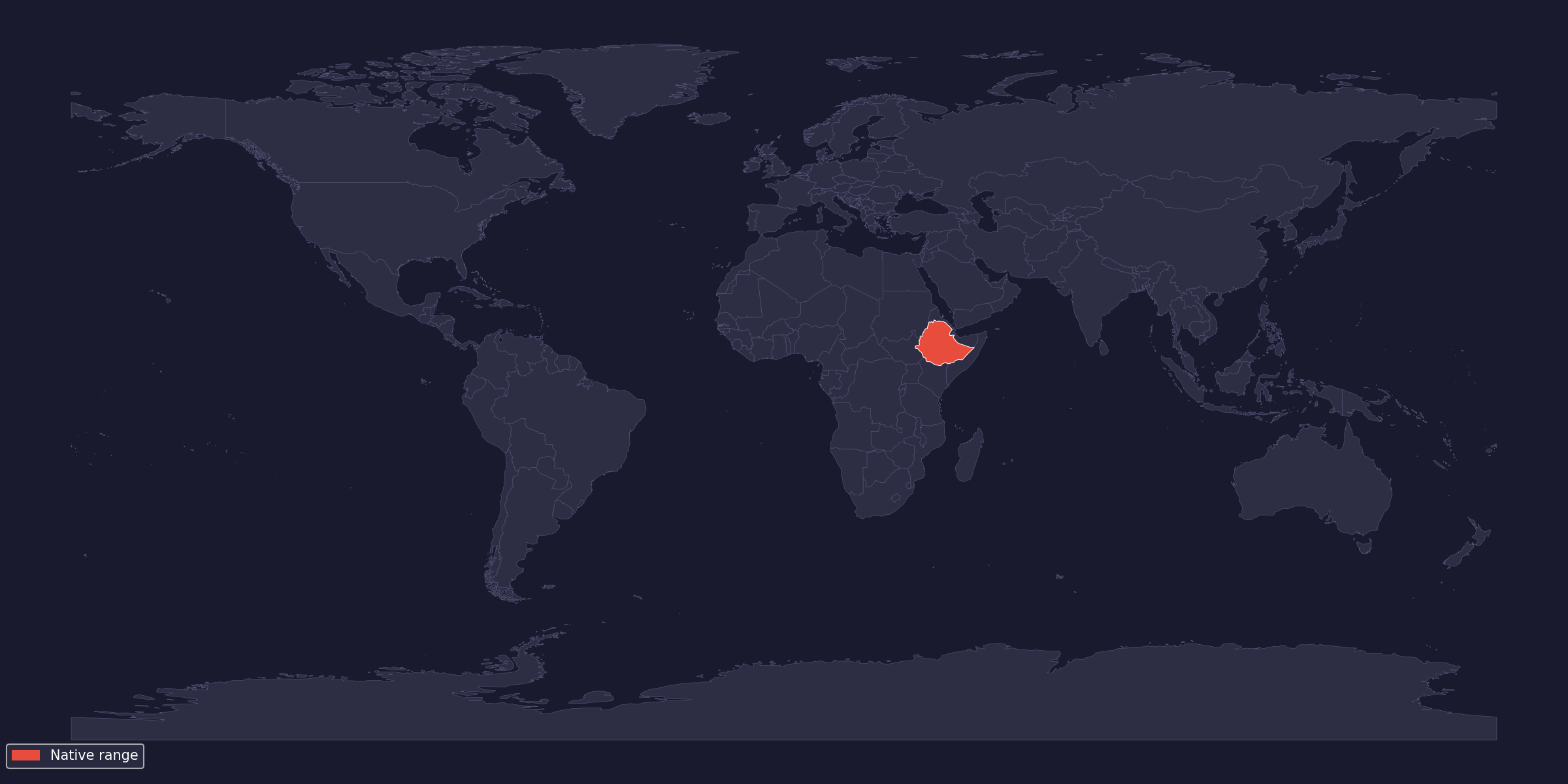
The type came from Shoa in Ethiopia, an imprecise historical region. A modern revision documents the species from southwestern Ethiopia, including Turmi in the Southern Nations, Nationalities and Peoples’ Region. Older literature applied the name much more widely, but later work reassigned several northern, Somali, Kenyan and Sudanese populations to other species.
The confirmed southern Ethiopian locality is hot, seasonally dry thorn-savanna country. At Turmi, expedition measurements reached 33.8 °C by day; nighttime values fell from 27.1 to 24.3 °C, with daytime humidity near 40% and nighttime humidity of 55–72%. These field readings describe weather around the animals, not constant terrarium targets; burrows buffer both heat and dryness.
🌡 Climate across the native range
Monthly climate normals from Turmi, a modern examined locality in the confirmed southwestern Ethiopian range:
Turmi — Ethiopia (modern examined P. exitialis locality)
| Month | Min °C | Mean °C | Max °C | RH % |
|---|---|---|---|---|
| January | 22.3 | 27.6 | 32.9 | 43 |
| February | 23.5 | 28.8 | 34.3 | 38 |
| March | 23.4 | 28.2 | 33.3 | 49 |
| April | 22.1 | 26 | 30.6 | 66 |
| May | 22.2 | 26 | 30.3 | 62 |
| June | 22.2 | 26 | 30.2 | 52 |
| July | 21.7 | 25.6 | 29.6 | 50 |
| August | 21.8 | 26 | 30.3 | 48 |
| September | 22.6 | 27.1 | 31.8 | 44 |
| October | 22.1 | 26.2 | 30.7 | 58 |
| November | 21.2 | 25.5 | 30.2 | 62 |
| December | 21.2 | 26.3 | 31.4 | 52 |
Weather data by Open-Meteo.com · CC BY 4.0 · Monthly normals calculated by Herpeton Academy from daily archive values.
⚖️ Legal status
As checked on 22 August 2026, P. exitialis was not listed in the CITES Appendices, the EU wildlife-trade annexes or the Bern Convention appendices. Do not confuse it with CITES-listed species historically placed in Pandinus. Ethiopian wildlife and export rules, destination-country import controls and local venomous-animal rules may still apply. Retain invoices, origin and breeder data, and all import or transfer papers.
🤌 Husbandry
House each adult alone. A dealer’s “pair” label describes the sale, not a safe permanent housing arrangement. These strong, defensive scorpions can injure or kill one another underground before a keeper notices.
Quarantine a new arrival for 60–90 days in a secure, simple enclosure with separate tools. Record weight, feeding and moults; look for dehydration, mites, missing limbs and dark or fuzzy lesions. Because historical names were applied broadly, photograph the animal and preserve locality, parentage and seller records.
Never free-handle it. Prepare a catch cup and long tools before maintenance, work in a closed room and clip or lock the lid. Keep hands away from burrow entrances even when the animal is not visible.
💡 Lighting
UVB is not required. Use subdued lighting on a 10–12-hour day cycle and provide complete darkness in the burrow. Direct sun can overheat a dry enclosure within minutes.
🌡 Heating and temperature
Maintain 24–29 °C ambient, with a 30–32 °C warm surface and a 22–25 °C cool zone. Nights may fall to 20–24 °C. Apply thermostat-controlled heat to one side or from above; never heat the entire base beneath a burrow.
Measure the surface and the occupied lower layer. The scorpion must be able to retreat from the warm side. Field peaks above 33 °C are not a reason to hold the whole enclosure at that temperature.
💧 Humidity and water
This is a dry-savanna species, not a rainforest Pandinus. Keep the surface mostly dry and well ventilated, around 40–60%, while one lower section remains faintly moist. A burrow should feel cooler and slightly more humid, never wet or stagnant. Provide a shallow water dish at all times.
Recharge the humid zone by adding a small amount of water down one side rather than spraying the whole surface. Increase local moisture modestly before a moult. Condensation, sour substrate and persistent mould mean that moisture or ventilation is wrong.
🌿 Enclosure and decoration
Provide 15–20 cm of a firmly packed soil–clay–sand mixture that holds a tunnel. Start a burrow beneath anchored cork, slate or a half-buried hide. Loose sand alone collapses; pure coconut fibre stays too soft and can remain uniformly damp.
Place heavy stone directly on the enclosure base before adding substrate, then bond or support it so excavation cannot undermine it. Include cross-ventilation near substrate level and enough headroom that the scorpion cannot reach the lid or ventilation mesh.
🪳 Feeding
Offer captive-reared roaches, crickets or locusts no larger than the carapace. Adults generally take one or two prey items every 7–14 days; growing juveniles can receive smaller meals more often. Body condition matters more than forcing a fixed schedule.
Remove uneaten prey after 24 hours and always before a moult. Do not feed a soft, newly moulted animal until the exoskeleton and sting have hardened. Wild-caught insects and routine supplement powders are unnecessary risks.
🦂 Breeding and young
Breed only confirmed adults with traceable identity and separate permanent enclosures. Introductions require a neutral, escape-secure area, direct observation, barriers and catch containers. Separate the animals after courtship or at the first sustained aggression.
The species is viviparous: the female gives birth to live young that climb onto her back and remain there through their first moult. Reliable species-specific gestation and litter ranges are not well documented, so do not substitute numbers from Pandinus imperator or another Pandinurus. Keep the mother quiet, remove prey and wait until the young leave her back independently.
🩺 Common problems
Rainforest-style saturation, shallow loose substrate and heating from below prevent normal retreat behaviour and promote mycosis or heat stress. Collapsing stonework can crush a burrowing animal. Imported or misidentified specimens may arrive dehydrated, parasitized or already injured.
Persistent weight loss, poor coordination, an incomplete moult or spreading black, white or fuzzy lesions calls for isolation and advice from an exotics veterinarian experienced with arachnids. Do not apply household antifungal products, oils or insecticides.
📌 Conclusion
P. exitialis is a dry-savanna burrower that needs deep compact soil, a warm-to-cool gradient and local rather than enclosure-wide moisture. Correct identity, solitary housing and documented origin are especially important because the old name covered multiple East African populations.
📚 Selected sources
- GBIF species record: Pandinurus exitialis
- Kovařík et al. (2017), revision of Pandinurus and Pandinus sensu lato
- Kovařík, Lowe & Šťáhlavský (2016), Turmi locality conditions and associated scorpion fauna
- Rossi (2015), review of Pandinurus
- Scorpion Files: Scorpionidae
- Veterinary Care of Scorpions
- CITES Appendices
- Bern Convention appendices
- Commission Regulation (EU) 2026/1383