Share

Dictator Scorpion
🔤 Taxonomy
Pandinopsis dictator is the accepted name for the dictator scorpion. Older literature, CITES documents, and trade paperwork commonly use Pandinus dictator. That historical combination is not a different animal, but labels such as “emperor”, “giant forest scorpion”, or simply Pandinus sp. do not prove an identification. Keep locality, breeder lineage, photographs, invoices, and wildlife-trade documents together.
📌 Description
This is a very large, dark Central African forest scorpion with broad pincers and a powerful build. Adults commonly reach about 15-18 cm. It is primarily nocturnal and spends much of the day in a burrow or tight hide.
Its sting is not generally classed with medically important buthid scorpions, but it is venomous, can pinch strongly, and an individual or allergic reaction cannot be predicted. It is a display animal. Maintenance should be done with long tools and a catch cup, never by direct handling.
☠️ Venom
This species is venomous. Venom exposure can cause pain, swelling or other systemic effects, and severity varies with species, locality, bite site and the amount delivered. A small wound or apparently dry bite is not proof of safety; every bite or sting requires urgent medical assessment.
If an incident occurs, move away, call emergency services or a poison centre, keep the patient still, remove rings and other constricting items, and follow dispatcher instructions. Do not use a tourniquet, cut or suck the wound, apply ice or electricity, give alcohol or medicines as a home treatment, or attempt to catch the animal. Antivenom choice and dosing are hospital decisions; verify the relevant product and local availability in advance. Sources: WHO snakebite guidance and appropriate species-specific toxinology or medical references listed below.
🌍 Distribution
Verified modern records and taxonomic literature place the species in Cameroon, Equatorial Guinea, Gabon, and the Republic of the Congo. It inhabits humid lowland forest and uses compact soil beneath roots, logs, and leaf litter. The enclosure should copy the sheltered ground microclimate rather than expose the animal to constantly wet, stagnant conditions.
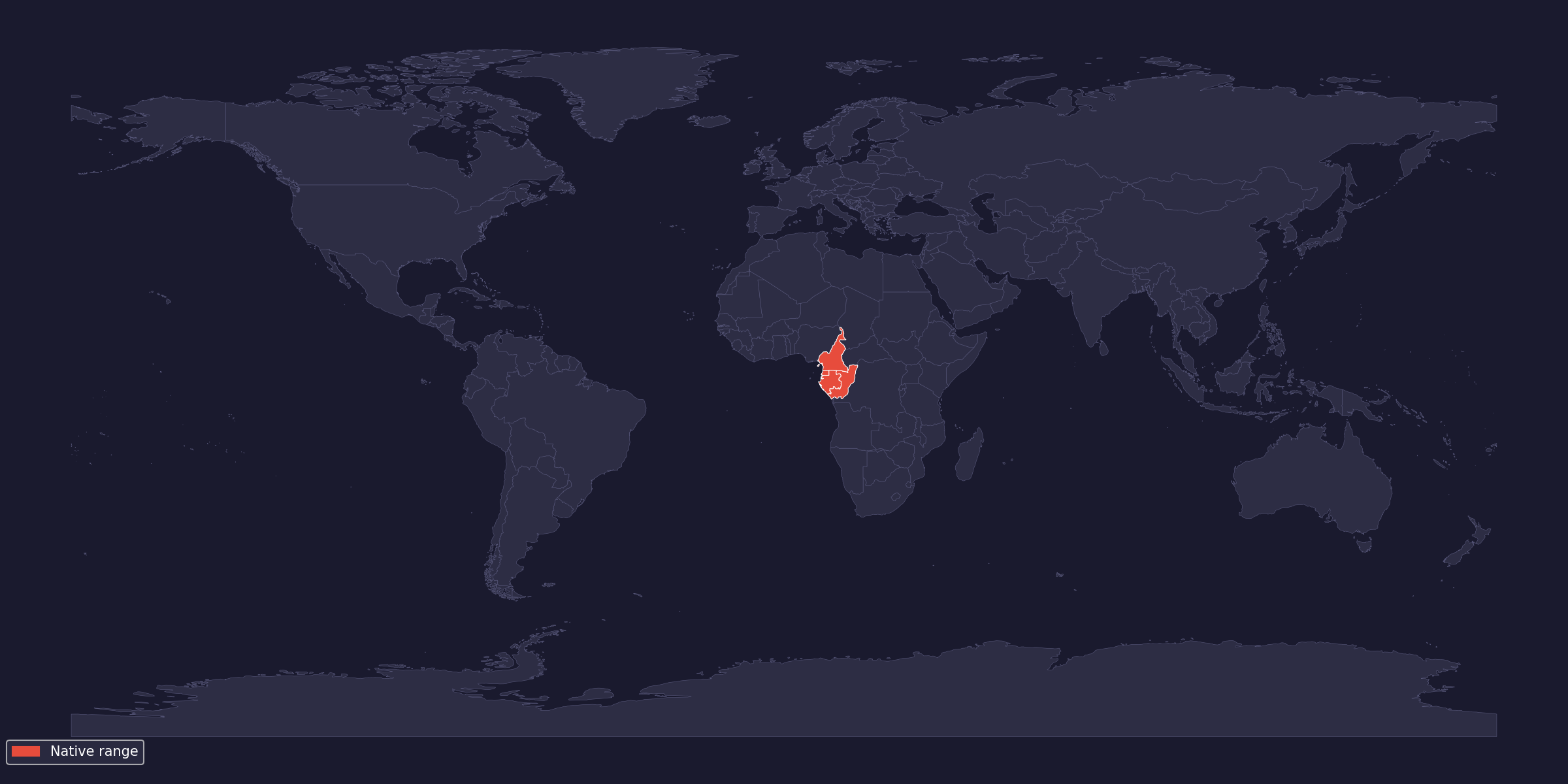
🌡 Climate across the native range
Monthly climate normals from reviewed GBIF occurrence locations in the equatorial forest range:
East Region — Cameroon
| Month | Min °C | Mean °C | Max °C | RH % |
|---|---|---|---|---|
| January | 19.9 | 24.2 | 30.1 | 73 |
| February | 20.7 | 24.7 | 30.5 | 75 |
| March | 20.9 | 24.3 | 29.6 | 83 |
| April | 20.8 | 23.9 | 28.8 | 87 |
| May | 20.5 | 23.7 | 28.5 | 87 |
| June | 20.1 | 23.2 | 28.1 | 85 |
| July | 19.8 | 22.8 | 27.6 | 83 |
| August | 19.9 | 22.9 | 27.8 | 82 |
| September | 20 | 22.8 | 27.7 | 86 |
| October | 19.9 | 22.7 | 27.5 | 88 |
| November | 19.9 | 23 | 27.8 | 87 |
| December | 19.7 | 23.5 | 28.9 | 80 |
Ogooué-Lolo — Gabon
| Month | Min °C | Mean °C | Max °C | RH % |
|---|---|---|---|---|
| January | 22.1 | 25.6 | 30.6 | 83 |
| February | 22.3 | 25.8 | 30.6 | 84 |
| March | 22.4 | 25.7 | 30.4 | 86 |
| April | 22.5 | 25.6 | 30 | 88 |
| May | 22.4 | 25.4 | 29.8 | 88 |
| June | 21.9 | 25.1 | 29.6 | 83 |
| July | 21.6 | 24.9 | 29.5 | 78 |
| August | 21.8 | 25 | 29.6 | 78 |
| September | 22 | 25.1 | 29.8 | 82 |
| October | 21.9 | 24.8 | 29.3 | 86 |
| November | 21.8 | 24.9 | 29.4 | 88 |
| December | 21.9 | 25.2 | 30 | 85 |
Weather data by Open-Meteo.com · CC BY 4.0 · Monthly normals calculated by Herpeton Academy from daily archive values.
Location references use GBIF.org occurrence data where available; original occurrence records retain their source dataset licenses.
⚖️ Legal status
Checked on 2026-08-17: the CITES Appendices list the species as Pandinus dictator in Appendix II, and the EU wildlife-trade annexes retain that name in Annex B. The Bern Convention is not relevant to this Central African scorpion. Appendix II is not a general ban on keeping, but international trade and some EU movements require lawful-origin and trade documentation.
Ask for the exact scientific name, invoice, breeder or importer details, and any required CITES/EU paperwork before purchase. National or local rules may separately regulate venomous invertebrates, import, transport, breeding, sale, or public display.
🤌 Husbandry
House one adult alone. Although some large forest scorpions are marketed as communal, conflict and cannibalism remain possible and are hard to detect inside burrows. Use a securely clipped or latched enclosure with fine ventilation and no cable or lid gap the animal can exploit.
| Parameter | Conservative target |
|---|---|
| Adult enclosure | at least 45 × 30 × 30 cm |
| Day air | 24-28 °C |
| Warm area | 28-30 °C, inaccessible heater |
| Night | 21-24 °C |
| Relative humidity | 75-85% with cross-ventilation |
| Substrate | at least 15 cm, compactable and slightly damp |
| Feeding | suitable invertebrate prey every 7-14 days |
Quarantine a new arrival in a simple secure enclosure in a separate area for at least 60-90 days. Confirm that it feeds, moults, drinks, and produces normal waste; check for mites or injuries without spraying pesticides. Wild-caught or newly imported specimens may be dehydrated, stressed, misidentified, gravid, or carrying hitchhiking invertebrates. A specialist exotic veterinarian should assess persistent decline.
For transfers, close the room, block the door gap, prepare two rigid catch cups, and coax the scorpion with a long soft tool. Never pin it or lift it by the tail. Count and visually locate the animal before reopening the room.
💡 Lighting
UVB is not required. Provide a gentle 10-12-hour light cycle using room light or low-output lighting outside the enclosure. Supply several fully dark retreats and avoid bright lamps that heat or dry the surface. Red or blue night bulbs are unnecessary; observe briefly with dim ambient light.
🌡 Heating and temperature
Maintain most of the enclosure at 24-28 °C, with a modest 28-30 °C warm side and a cooler 22-24 °C area. A night drop to 21-24 °C is appropriate. Measure air and substrate temperatures with digital probes.
If supplemental heat is needed, place a thermostatically controlled heat mat on one side wall, never beneath the substrate: bottom heat can trap a burrowing scorpion against the hottest surface. Protect all heaters from contact and keep the enclosure out of direct sun.
💧 Humidity and water
Aim for 75-85% relative humidity while maintaining cross-ventilation. Add water to part of the substrate, then allow the upper surface to become only slightly damp before watering again. The lower layers should hold a stable burrow without becoming saturated. Persistent condensation, sour odour, fungus, or standing water indicates excessive moisture or inadequate airflow.
Provide a shallow, stable water dish at all times. Clean it regularly and do not rely on mist droplets as the only drinking source. During premoult, maintain the moist lower layer and reduce disturbance rather than flooding the enclosure.
🌿 Enclosure and decoration
An adult needs at least 45 × 30 cm of floor space. Add 15-20 cm of compactable pesticide-free topsoil and coco fibre, optionally reinforced with clay and leaf litter. Pre-form a starter burrow beneath cork bark and provide a second snug hide. Heavy decorations must rest on the enclosure floor before substrate is added so they cannot collapse onto a tunnel.
Keep the layout low, with no sharp mesh or tall climbing points. Secure every lid and ventilation panel. Perform maintenance with the enclosure inside a clear tub or another contained work area, and keep a labelled catch cup beside it.
🪳 Feeding
Offer appropriately sized, well-fed crickets, roaches, locusts, or similar captive-bred invertebrates every 7-14 days. One or two prey of moderate size is usually enough for an adult; juveniles take smaller meals more often. Body condition and prey acceptance matter more than a rigid schedule.
Remove uneaten prey within 24 hours and never leave it with a moulting scorpion or a female carrying young. No calcium or vitamin dusting is normally required for a varied whole-invertebrate diet. Avoid wild-caught prey because of pesticide and parasite risk.
🦂 Breeding and young
Scorpions are viviparous. The female gives birth to live young, which climb onto her back until after their first moult; there are no eggs to incubate. Breeding should be attempted only with confidently identified, unrelated adults, lawful provenance, spare enclosures, and homes arranged for every offspring.
Introduce adults only under continuous supervision in neutral, roomy housing, and separate them promptly after mating. A gravid female needs deep secure substrate, privacy, water, and minimal disturbance. Do not feed loose prey while young remain on her back. After they disperse, house juveniles individually to prevent cannibalism and offer very small prey.
🩺 Common problems
- Desiccation or a failed moult: dry lower substrate, high heat, or poor access to water are common causes.
- Mould and mites: constantly soaked substrate, leftover prey, and weak ventilation create trouble; correct the environment instead of using household chemicals.
- Obesity: an overfed abdomen and prolonged food refusal call for longer feeding intervals, not more prey.
- Collapsed burrows: loose substrate or decorations placed on top of soil can crush tunnels.
- Uncertain identity or missing papers: do not breed, sell, or move the animal internationally until identification and lawful origin are resolved.
After any sting, move away from the enclosure, secure the room, and contact an appropriate poison centre or emergency service for case-specific advice, especially if symptoms spread or breathing, consciousness, or severe allergy is affected. Do not apply unverified home treatments.
📌 Conclusion
Pandinopsis dictator is an impressive but document-sensitive, large forest scorpion. Its needs are straightforward only when deep stable substrate, humid but ventilated air, solitary housing, and tool-based maintenance are provided consistently. Verify the accepted identity and the older name on CITES/EU documents before acquisition.
📚 Selected sources
- GBIF species backbone: Pandinopsis dictator
- Prendini (2004), African scorpions and Gabon records
- Prendini (2003), Scorpionidae phylogeny, taxonomy, and biogeography
- CITES Appendices
- EUR-Lex: Commission Regulation (EU) 2026/1383
- Geoscorps: species-specific captive-care notes