Share

Tanzanian Red-claw Scorpion
🔤 Taxonomy
Pandinoides cavimanus is an accepted Tanzanian species in Scorpionidae. It was long placed in Pandinus and remains widely traded as Pandinus cavimanus. That old combination is a synonym; “red-claw scorpion” is only a trade name and can be applied to misidentified Pandinoides.
📌 Description
Adults are compact, dark scorpions about 9–12 cm long, often with reddish-brown pincers. They are forceful, defensive burrowers. The venom is not generally regarded as medically important, but a sting or strong pinch is painful and allergy remains possible. Slow maturity, import concerns and identification problems make this an advanced display species.
| Quick reference | Target |
|---|---|
| Adult enclosure | At least 45 × 30 × 30 cm |
| Burrowing substrate | 20–25 cm, firmly packed |
| Warm side | 28–30 °C |
| Cool side / night | 21–24 °C / 18–22 °C |
| Humidity | 55–70%, with a damp lower refuge |
| Feeding | 1–2 insects every 7–14 days |
| Social housing | Solitary |
☠️ Venom
This species is venomous. Venom exposure can cause pain, swelling or other systemic effects, and severity varies with species, locality, bite site and the amount delivered. A small wound or apparently dry bite is not proof of safety; every bite or sting requires urgent medical assessment.
If an incident occurs, move away, call emergency services or a poison centre, keep the patient still, remove rings and other constricting items, and follow dispatcher instructions. Do not use a tourniquet, cut or suck the wound, apply ice or electricity, give alcohol or medicines as a home treatment, or attempt to catch the animal. Antivenom choice and dosing are hospital decisions; verify the relevant product and local availability in advance. Sources: WHO snakebite guidance and appropriate species-specific toxinology or medical references listed below.
🌍 Distribution
The revision restricts P. cavimanus to Tanzania, especially central localities in Dodoma, Iringa, Shinyanga and Singida. Records from Kenya and north-eastern Tanzania belong to other Pandinoides. It inhabits arid Acacia–Commiphora savanna and digs in compact clayey to sandy loam, generally around 1,010–1,120 m.
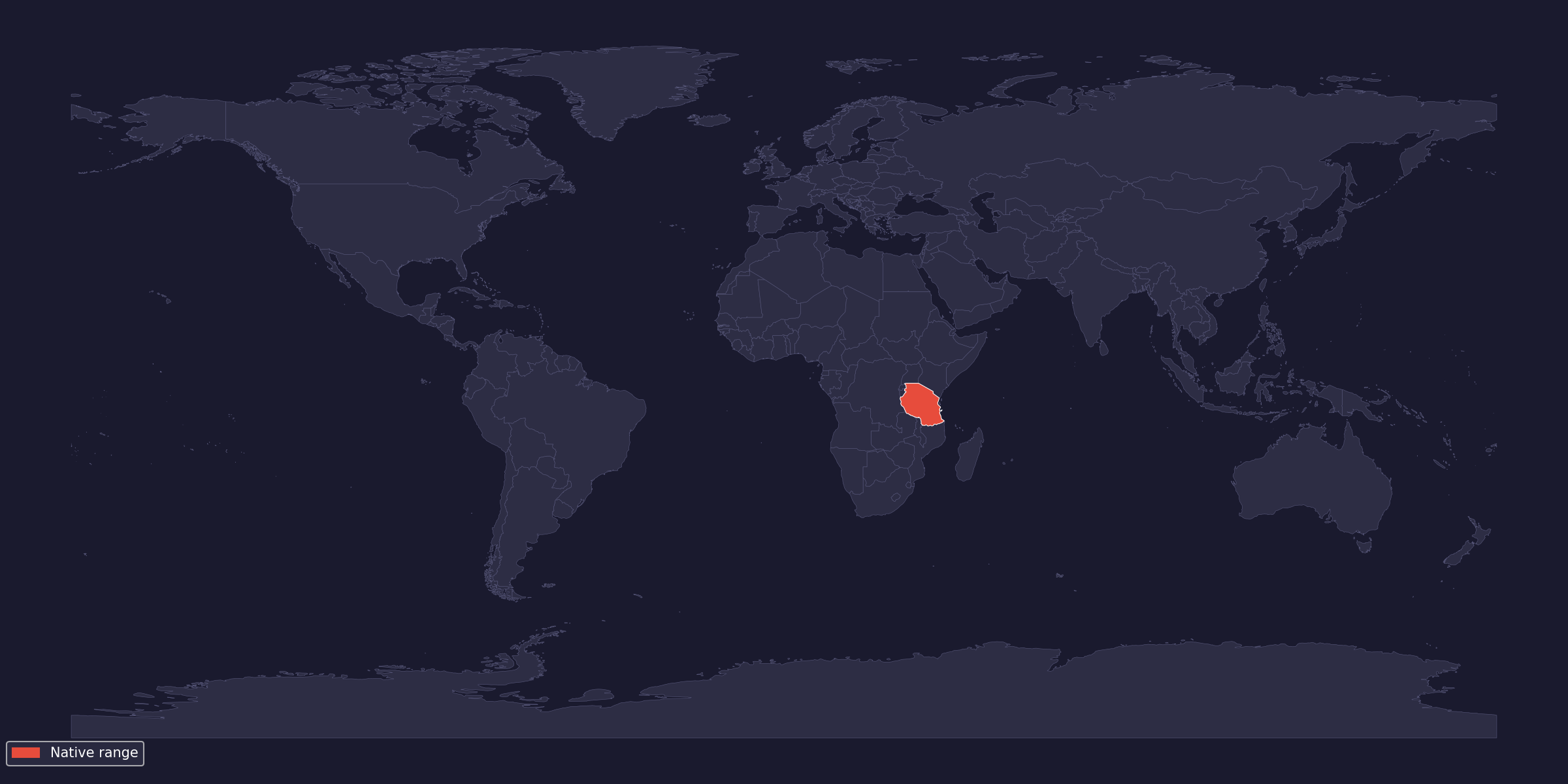
🌡 Climate across the native range
Monthly climate normals from reviewed GBIF occurrences in the central Tanzanian range:
Dodoma — Tanzania (verified central-range occurrence)
| Month | Min °C | Mean °C | Max °C | RH % |
|---|---|---|---|---|
| January | 18.3 | 23.9 | 29.5 | 69 |
| February | 18 | 23.6 | 29.1 | 71 |
| March | 18.1 | 23.8 | 29.4 | 71 |
| April | 17.9 | 23.1 | 28.3 | 72 |
| May | 16.4 | 22.1 | 27.7 | 67 |
| June | 14.3 | 20.7 | 27 | 63 |
| July | 13.4 | 19.7 | 26.1 | 62 |
| August | 13.9 | 20.3 | 26.8 | 61 |
| September | 15 | 21.8 | 28.5 | 58 |
| October | 16.4 | 23.3 | 30.1 | 55 |
| November | 17.6 | 24.4 | 31.2 | 58 |
| December | 18.4 | 24.4 | 30.4 | 64 |
Iringa — Tanzania (verified central-range occurrence)
| Month | Min °C | Mean °C | Max °C | RH % |
|---|---|---|---|---|
| January | 18.7 | 23.4 | 28.1 | 75 |
| February | 18.5 | 23.4 | 28.4 | 77 |
| March | 18.2 | 23.2 | 28.3 | 78 |
| April | 17.9 | 22.9 | 28 | 74 |
| May | 16.2 | 21.8 | 27.4 | 69 |
| June | 14.5 | 20.6 | 26.7 | 62 |
| July | 13.9 | 20 | 26 | 61 |
| August | 14.8 | 20.7 | 26.7 | 62 |
| September | 16.2 | 22.2 | 28.3 | 58 |
| October | 17.7 | 23.7 | 29.7 | 57 |
| November | 18.9 | 24.6 | 30.3 | 59 |
| December | 19.3 | 24.2 | 29.2 | 67 |
Weather data by WorldClim v2.1 · Monthly normals queried by Herpeton Academy from raster values; relative humidity is derived from vapor pressure and mean temperature.
Location references use GBIF.org occurrence data where available; original occurrence records retain their source dataset licenses.
⚖️ Legal status
As checked on 17 August 2026, P. cavimanus was not listed in CITES, the EU wildlife-trade annexes or the Bern Convention appendices. This must not be confused with CITES-listed Pandinus species. Tanzanian wildlife/export rules, destination-country import controls and local venomous-animal rules may still apply. Keep invoices, export/import records and evidence of captive breeding.
🤌 Husbandry
House one adult per enclosure. Quarantine new arrivals for 60–90 days in secure, simple housing with separate tools. Record weight, feeding and moults and inspect imports for dehydration, injury, mites and fungal lesions; confirm that the invoice’s Pandinus cavimanus refers to the accepted Pandinoides cavimanus.
Never free-handle it. Prepare a catch cup before maintenance and work in a closed room. The lid must be clipped or locked and all ventilation and cable openings must exclude a flattened scorpion.
💡 Lighting
UVB is not required. Provide a subdued 10–12-hour light cycle and permanent darkness in the burrow. Direct sunlight can overheat the enclosure rapidly.
🌡 Heating and temperature
Maintain 24–28 °C ambient, 28–30 °C on the warm side, 21–24 °C on the cool side and 18–22 °C at night. Apply thermostat-controlled heat to one side, not beneath the entire substrate. Measure the inhabited lower layers as well as the surface.
💧 Humidity and water
Reproduce a dry savanna burrow gradient, not rainforest saturation. Keep the surface mostly dry and ventilated while one side and the lower substrate remain slightly damp; target roughly 55–70%. Provide a shallow water dish and raise humidity locally before a moult. Both uniformly wet and completely powder-dry substrates are unsafe.
🌿 Enclosure and decoration
Use 20–25 cm of compacted topsoil, clay and some sand or coco fibre that holds a tunnel. Begin a burrow beneath anchored cork or slate. Rest heavy décor directly on the base before filling around it, and leave enough headroom below the secure lid.
🪳 Feeding
Offer captive-reared roaches, crickets or locusts no larger than the carapace. Adults generally take one or two insects every 7–14 days, while juveniles eat smaller prey more frequently. Remove uneaten prey after 24 hours and always before moulting. Do not use wild-caught insects.
🦂 Breeding and young
This slow species may take 4–7 years to mature, so breed only documented adults and plan for decades-long responsibility and many separate containers. Introductions can cause injury. It is viviparous and produces live young; published and institutional accounts indicate a litter in the range of about 20–35, with variation. Leave the mother undisturbed until the young complete their first moult and leave her back. There are no eggs to incubate.
🩺 Common problems
Rainforest-style saturation, weak ventilation and loose collapsing sand are recurring errors. Wild-caught or poorly documented animals may arrive dehydrated or parasitized, and prey can injure a moulting scorpion. Continuing weight loss, spreading dark lesions, poor coordination or an incomplete moult calls for isolation and an arachnid-experienced exotics veterinarian.
📌 Conclusion
P. cavimanus is a Tanzanian dry-savanna burrower, not a generic humid “red-claw.” Correct identity, provenance, compact deep soil and a controlled moisture gradient are central to ethical care.
📚 Selected sources
- GBIF species record: Pandinoides cavimanus
- Prendini (2016), revision of Pandinoides
- Scorpion Files: Scorpionidae
- Veterinary Care of Scorpions
- CITES Appendices
- Bern Convention appendices
- Commission Regulation (EU) 2026/1383