Share

Green Banana Cockroach
🔤 Taxonomy
Panchlora nivea (Linnaeus, 1758) is the accepted name for the green banana or Cuban cockroach. Older literature may use Panchlora cubensis, now treated as a synonym. Green hobby stocks are frequently assigned to P. nivea without examination, so preserve locality and seller-line information and use Panchlora cf. nivea when identification is genuinely uncertain.
📌 Description
Adults are delicate pale-to-bright-green cockroaches about 1.5-2.5 cm long; females are usually broader and larger. Adults climb and can fly, while brown nymphs spend most of their time tunneling through moist decayed substrate. That two-level life history makes a planted display attractive but also difficult to inspect.
| Care point | Practical target |
|---|---|
| Adult size | 1.5-2.5 cm |
| Small colony enclosure | 30 x 30 x 30 cm |
| Temperature | 24-28°C; warm end 27-29°C |
| Humidity | 70-85% with airflow |
| Substrate | 8-12 cm, moist leaves and rotten hardwood |
| Reproduction | live young; published broods 28-60 |
🌍 Distribution
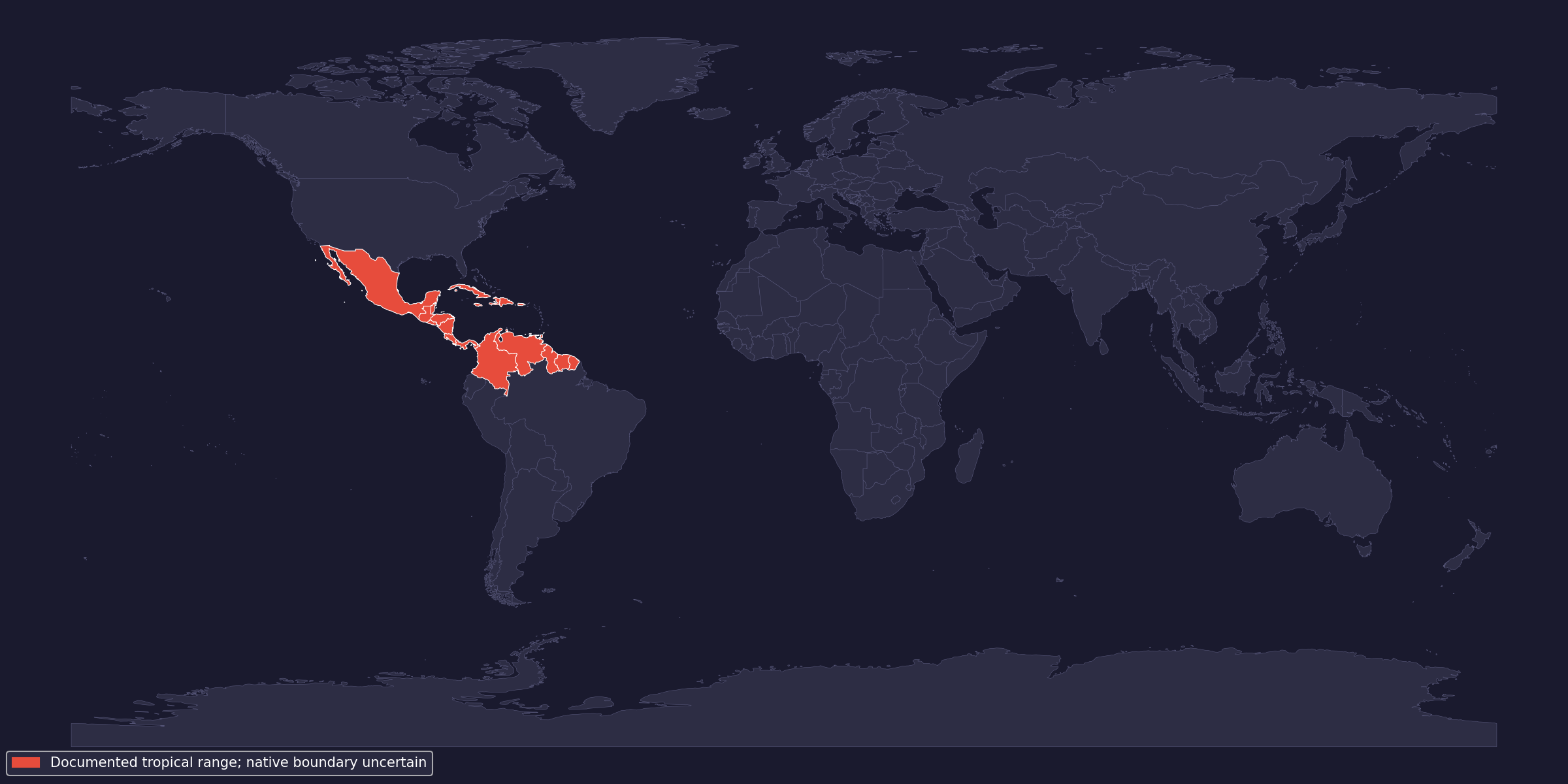
Published records place P. nivea through the Greater Antilles, Mexico, Central America, and northern South America. It has repeatedly traveled with bananas and other produce and is established or adventive beyond parts of that tropical range, including the southern United States.
The map summarizes the documented New World tropical range at country level. It does not imply that every green Panchlora record is correctly identified or that introduced populations are native.
⚖️ Legal status
Checked on 2026-08-22: Panchlora nivea is absent from the CITES Appendices valid from 5 March 2026 and Annexes A-D of Commission Regulation (EU) 2026/1383. The Bern Convention is not relevant to this non-European species.
Local and national agricultural, plant-health, invasive-species, import, tenancy, or school rules may still control live cockroaches. Retain the invoice, scientific identification, seller line, and transport documents. Adults fly and nymphs hide in substrate, so freeze discarded material where lawful and never release any life stage outdoors.
🤌 Husbandry
Use a 30 x 30 x 30 cm gasketed enclosure for a small colony, with fine secured vents and space above the substrate for adult flight and molting. Open it in a closed room inside a larger sorting tub; a startled adult may launch directly from the lid.
Quarantine new stock for 60-90 days using simple furniture and separate tools. Track adult color and size, live births, molts, flies, mites, and mortality before combining lines. Do not mix green Panchlora stocks of uncertain identity.
💡 Lighting
UVB is not required. Provide indirect light for 10-12 hours and shade over most bark and substrate. A dimly lit planted enclosure can show adults at night, but direct sun and hot lamps rapidly desiccate them.
🌡 Heating and temperature
Maintain 24-28°C with a warm zone at 27-29°C and a 21-24°C retreat. Published laboratory breeding succeeded at 24°C, while warmer hobby colonies develop faster. Do not trade speed for a uniformly hot enclosure.
Heat one outside wall with thermostat control and measure both air and moist substrate. Persistent temperatures above 30°C increase drying and reduce the margin for error.
💧 Humidity and water
Keep the lower substrate evenly moist and the top layer damp-to-nearly-dry, aiming broadly for 70-85% humidity with cross-ventilation. Nymphs and internal egg development need reliable moisture, but stagnant saturated soil causes mold and fly outbreaks.
Fresh foods and moist substrate usually supply water. If a dish is used, make it shallow with textured exits. Do not allow a deep open surface where light adults or nymphs can drown.
🌿 Enclosure and decoration
Provide 8-12 cm of pesticide-free topsoil or coir blended generously with decomposed hardwood leaves and soft white-rotted hardwood. Nymphs live and feed within this layer. Add cork tubes and vertical bark for adult shelter and molting, keeping them clear of the lid.
Plants are optional and should be pesticide-free. Avoid perlite-rich potting mixes, conifer chips, treated timber, and routine total substrate changes. Replace sections gradually so the colony retains food-rich decomposed material.
🪳 Feeding
Rotten palm or hardwood fibers, decayed hardwood leaves, and soft white-rotted wood form the long-term base. Add small portions of banana, apple, pear, carrot, squash, mushroom, and leafy vegetables, plus a modest dry insect food or fish flake.
Feed every one to three days in several shallow spots and remove leftovers early. Fruit is useful but not a complete diet; too much quickly ferments in a warm humid enclosure.
🥚 Breeding
Females form and retract an ootheca into the brood sac, then give birth to live nymphs. A classic 24°C study recorded broods of 28-60, averaging about 46, with first births roughly 50-62 days after mating. Males matured in about 144 days and females in about 181 days under those laboratory conditions.
Brown nymphs vanish into the substrate after birth. Confirm recruitment by inspecting food and leaf layers gently rather than digging through the entire colony. Plan capacity before raising temperatures.
🩺 Common problems
- Adult escapes: use a gasket lid, fine vents, a closed work room, and a sorting tub; expect flight as well as climbing.
- No visible nymphs: check within the moist substrate before assuming breeding failed.
- Mold and fungus gnats: reduce fruit, remove waste, and improve airflow without drying the lower layer.
- Failed molts: restore humid retreats and vertical clearance.
- Misidentification: keep lines separate and do not turn a trade resemblance into a certain species name.
- Allergy: use ventilation and gloves if frass or shed skins cause symptoms.
📌 Conclusion
The green banana cockroach is best for a keeper who wants a vivid nocturnal display and accepts that the adults fly while the nymphs remain underground. A deep living substrate and a flight-proof lid must be ready before the colony arrives.
📚 Sources and further reading
- GBIF: Panchlora nivea
- Roth & Willis 1957: biology, reproduction, and development
- WHO: distribution and identification summary
- Estrada-Álvarez et al. 2021: Mexican records
- ReptiFiles — checked first; no species-specific guide was found
- CITES Appendices, valid from 5 March 2026
- Commission Regulation (EU) 2026/1383: current wildlife-trade annexes
- Council of Europe: Bern Convention text and appendices