Share

Orange Domino Cockroach
🔤 Taxonomy
Therea regularis Grandcolas, 1993 is the accepted scientific name. Grandcolas described it from the Coromandel region and retained it as distinct from T. petiveriana and T. nuptialis. No taxonomic synonym is currently recorded by the Blattodea Species File.
“Orange domino cockroach” refers to the warm orange or yellow-orange forewing marks of the established hobby culture. Colour can fade in old adults and images shift with lighting, so it must not replace adult morphology or culture provenance. Do not mix it with white-marked domino species.
📌 Description
Adults are about 2.5-3.2 cm, broad and black with paired orange to yellow-orange marks. Nymphs are dark brown soil dwellers and look too similar to other Therea for reliable visual separation. Adults surface around dusk, climb well and are best watched rather than handled.
Among cultured Therea, this species is reported as the slowest and least prolific. It also performs poorly in stale, dirty substrate, so warmth and measured feeding must be more consistent than for the hardier question-mark culture.
| Care point | Practical target |
|---|---|
| Adult size | 2.5-3.2 cm |
| Colony enclosure | 40 x 30 x 30 cm |
| Temperature | 25-29°C, stable |
| Substrate | 8-12 cm with a vertical moisture gradient |
| Reproduction | buried oothecae, slow colony growth |
| Main risk | cohort gaps and fouled egg substrate |
🌍 Distribution
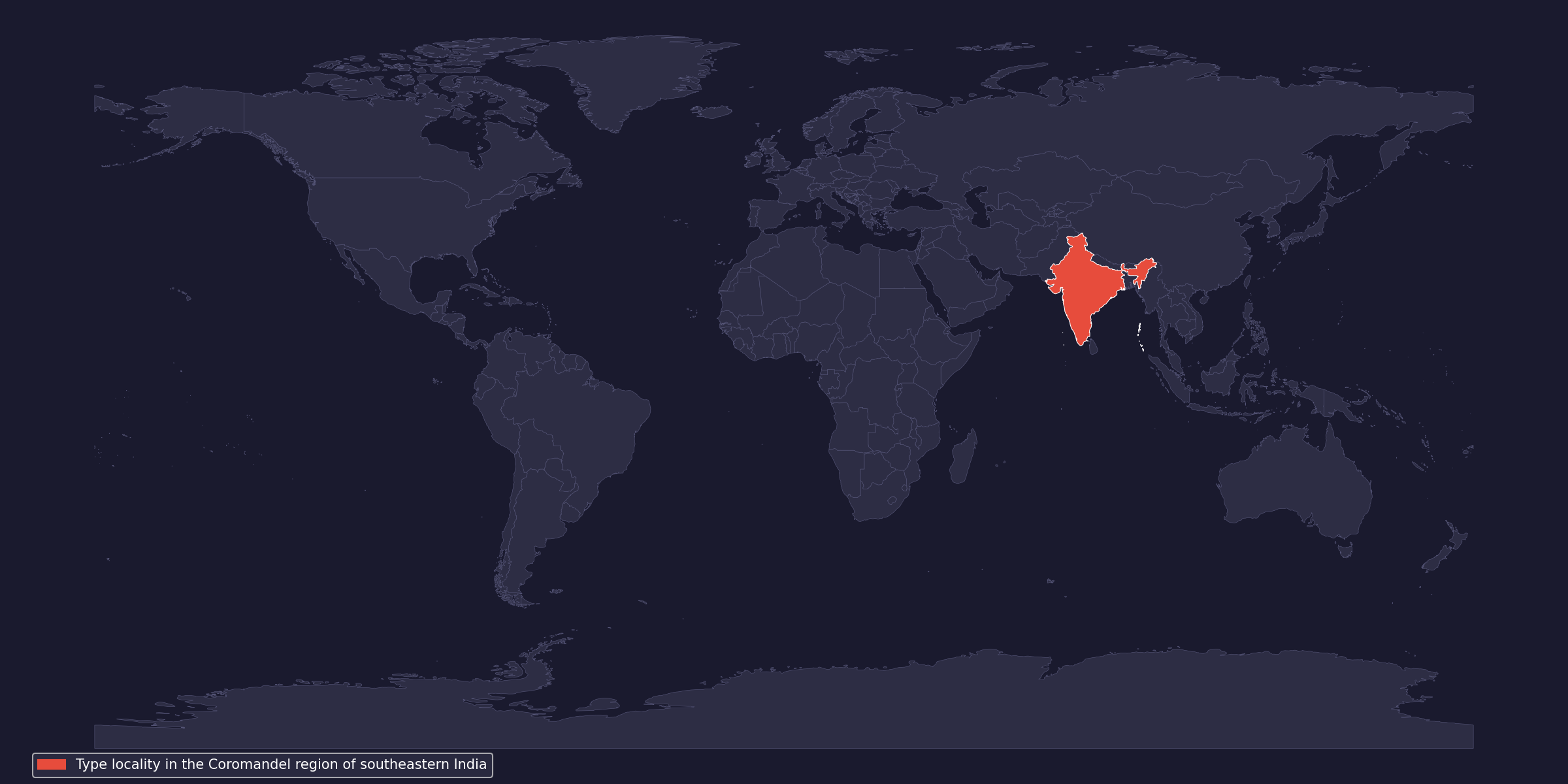
The firm taxonomic record is southeastern India: the type locality is Coromandel, the historical name for the Tamil Nadu coast. Later literature places the genus across dry to humid Indian woodland, but unverified Sri Lankan and broad South Asian statements should not be transferred automatically to T. regularis. The map marks India.
⚖️ Legal status
Local and national rules for keeping, importing, transporting, or selling live insects may still apply.
Checked on 2026-08-22: T. regularis is absent from the CITES Appendices and Annexes A-D of Commission Regulation (EU) 2026/1383. Bern Convention protection is not relevant to this Indian species, and the appendices contain no specific listing. It is also absent from the EU Union list of invasive alien species.
Country-level biosecurity, import, transport, sale and tenancy provisions still apply. Retain transfer papers and the culture-line name, verify rules at both ends of a shipment, and never discard live eggs outdoors.
🤌 Husbandry
House a starter colony in a gasketed 40 x 30 x 30 cm box with fine cross-ventilation. Adults climb, so fasten mesh permanently and keep the upper rim clear. Work over a catch tub and count visible adults before closing.
Do not add another Therea to “increase numbers.” Hybridization and label loss would destroy the value of a slow pure culture. Quarantine additions for 60 days and use separate feeding tools.
💡 Lighting
No UVB is required. Provide a 10-12-hour photoperiod with indirect light and shaded surface cover. Adults are most active near dusk; leave a dark interval rather than illuminating the colony through the night.
🌡 Heating and temperature
Keep 25-29°C across most of the culture, with a 27-30°C warm strip and a 23-25°C refuge. Avoid nights below 22°C for breeding adults. Specialist experience indicates that irregular or cool warmth causes especially poor growth and reproduction in this species.
Use thermostated side heat and two probes. Stability does not mean heating every centimetre: the animals still require a cooler choice.
💧 Humidity and water
Maintain a damp lower substrate and a mostly dry leaf surface, roughly 55-75% ambient RH with good airflow. Add a measured amount of water to one side and let the colony choose along both vertical and horizontal gradients.
Do not chase humidity with daily whole-box spraying. Saturated warm soil turns anaerobic, while a dry bottom layer stops ootheca development. Use vegetables for water and protect any tiny dish against hatchlings.
🌿 Enclosure and decoration
Build an 8-12 cm layer from pesticide-free soil or coir, crushed hardwood leaf mold and well-rotted white wood. Top it with leaf litter and several low cork pieces. Reserve one bare area for food dishes and inspection.
This culture needs cleanliness without destructive substrate replacement. Lift food dishes weekly, remove localized fouling, and retain all discarded substrate securely for six months in case oothecae remain.
🪳 Feeding
Keep hardwood leaves available. Every two or three days provide small portions of fine fish food, chick feed or balanced dry roach diet. Offer carrot, squash or apple sparingly for moisture.
Remove wet material the following day and reduce the ration if dry food remains. Overfeeding does not accelerate a slow life cycle; it degrades the exact substrate in which the eggs must develop.
🥚 Breeding
Females deposit oothecae in the substrate, generally containing about 8-15 eggs. Genus-level culture records suggest 90-180 days to hatch and 9-18 months or more to maturity at 25-29°C. T. regularis females lay fewer oothecae than commonly cultured congeners, so these numbers are planning ranges rather than a production promise.
Keep several cohorts and do not sell the last juvenile group while adults are present. Stable warm soil, modest food and time are the breeding method; routine egg excavation adds risk.
🩺 Common problems
- Adults but no next generation: verify sustained lower-layer moisture and 25-29°C warmth; wait the full incubation window.
- Culture dwindles between cohorts: retain more nymphs and avoid starting with adults only.
- Sour smell or mites: remove rich food, replace only the fouled patch and improve ventilation.
- Pale or unusual spots: age and lighting alter colour; isolate questionable stock rather than merging it.
- Allergic symptoms: minimize airborne dust, damp-clean equipment and use suitable personal protection.
📌 Conclusion
The orange domino cockroach is for a keeper who values a slow culture enough to keep it warm, clean and traceable. Its main challenge is not a complicated enclosure but maintaining continuity across long, sparse generations.
📚 Sources and further reading
- GBIF: Therea regularis
- Blattodea Species File: type and current nomenclature
- Grandcolas 1993: original revision and description
- Zoological Survey of India: 2024 Blattodea checklist
- Invertebrate Dude: species-specific culture notes for T. regularis
- ReptiFiles — checked; no species care guide was found
- CITES Appendices, valid from 5 March 2026
- Commission Regulation (EU) 2026/1383
- EU list of invasive alien species of Union concern
- Bern Convention appendices