Share

Shiny Burrowing Scorpion
🔤 Taxonomy
Opistophthalmus glabrifrons is an accepted species in Scorpionidae. “Shiny burrowing scorpion”, “yellow-legged burrowing scorpion” and “rough burrower” occur in references and trade. The large genus contains many similar regional species, so a vague “African burrowing scorpion” label is not adequate identification.
📌 Description
Adults are usually 9–11.5 cm, with a brown to rusty body, paler legs and powerful pincers. When disturbed they can stridulate audibly and adopt a strong defensive posture. Correctly housed animals spend much of their time inside a permanent tunnel and may be visible mainly at the entrance after dark.
The sting is not generally regarded as medically significant to a healthy adult, but published clinical data are sparse. The pinch is strong and the species can sting readily when confined. Treat both as preventable injuries and use tools only.
| Quick reference | Target |
|---|---|
| Adult enclosure | At least 45 × 30 × 35 cm |
| Burrowing substrate | 25–30 cm, firm soil-clay mixture |
| Warm side | 28–31 °C |
| Cool side / night | 21–24 °C / 18–23 °C |
| Humidity | 40–60%; damp lower refuge |
| Feeding | 1–2 suitable insects every 7–14 days |
| Social housing | Solitary |
☠️ Venom
This species is venomous. Venom exposure can cause pain, swelling or other systemic effects, and severity varies with species, locality, bite site and the amount delivered. A small wound or apparently dry bite is not proof of safety; every bite or sting requires urgent medical assessment.
If an incident occurs, move away, call emergency services or a poison centre, keep the patient still, remove rings and other constricting items, and follow dispatcher instructions. Do not use a tourniquet, cut or suck the wound, apply ice or electricity, give alcohol or medicines as a home treatment, or attempt to catch the animal. Antivenom choice and dosing are hospital decisions; verify the relevant product and local availability in advance. Sources: WHO snakebite guidance and appropriate species-specific toxinology or medical references listed below.
🌍 Distribution
The documented range includes Botswana, Mozambique, South Africa, Tanzania and Zimbabwe. It occurs in dry southern and eastern African habitats across a wide temperature range. Suitable soil structure appears more important than a single soil type: the animal needs ground firm enough to support a long tunnel and tends to avoid loose sand.
Wild burrows may begin beneath a stone and spiral deeply into the ground, buffering surface heat, frost and drought. A captive enclosure cannot reproduce a metre-long burrow, but it must provide enough depth for stable excavation.
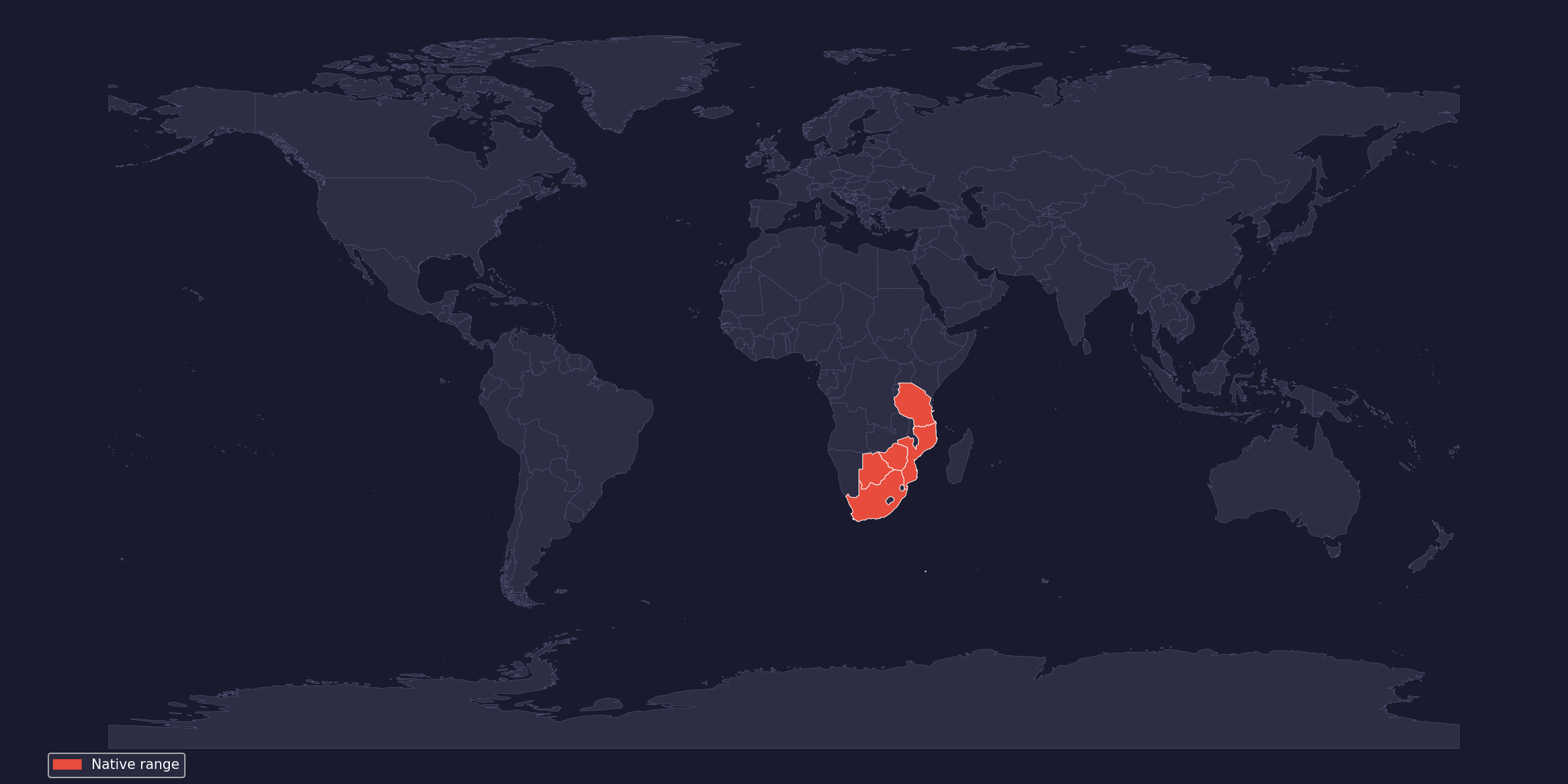
🌡 Climate across the native range
Monthly climate normals from reviewed GBIF occurrences across the southern African range:
Limpopo — South Africa (verified occurrence)
| Month | Min °C | Mean °C | Max °C | RH % |
|---|---|---|---|---|
| January | 20.5 | 26.1 | 31.7 | 66 |
| February | 20.2 | 25.7 | 31.2 | 69 |
| March | 19.4 | 25 | 30.6 | 68 |
| April | 16.3 | 22.6 | 28.9 | 70 |
| May | 12.4 | 19.9 | 27.5 | 63 |
| June | 9.1 | 17.2 | 25.3 | 61 |
| July | 9.1 | 17.1 | 25.1 | 59 |
| August | 10.9 | 18.8 | 26.8 | 58 |
| September | 14.1 | 21.5 | 28.9 | 57 |
| October | 16.5 | 23.1 | 29.6 | 62 |
| November | 18.2 | 24.4 | 30.5 | 65 |
| December | 19.7 | 25.6 | 31.5 | 65 |
Sofala — Mozambique (verified occurrence)
| Month | Min °C | Mean °C | Max °C | RH % |
|---|---|---|---|---|
| January | 22 | 27 | 31.9 | 74 |
| February | 21.7 | 26.5 | 31.2 | 77 |
| March | 20.9 | 26 | 31.1 | 75 |
| April | 18.9 | 24.6 | 30.3 | 73 |
| May | 15.3 | 22 | 28.7 | 72 |
| June | 13.1 | 19.8 | 26.5 | 74 |
| July | 12.5 | 19.5 | 26.4 | 74 |
| August | 14 | 21 | 27.9 | 72 |
| September | 16.3 | 23 | 29.7 | 68 |
| October | 19 | 25 | 31.1 | 66 |
| November | 21 | 26.3 | 31.7 | 67 |
| December | 21.5 | 26.5 | 31.6 | 71 |
Masvingo — Zimbabwe (verified occurrence)
| Month | Min °C | Mean °C | Max °C | RH % |
|---|---|---|---|---|
| January | 20.8 | 26.9 | 33 | 66 |
| February | 20.4 | 26.3 | 32.2 | 69 |
| March | 19.2 | 25.5 | 31.7 | 68 |
| April | 16.7 | 23.6 | 30.5 | 66 |
| May | 12.9 | 20.8 | 28.8 | 62 |
| June | 10.3 | 18.4 | 26.5 | 61 |
| July | 9.8 | 18.2 | 26.5 | 59 |
| August | 11.9 | 20.3 | 28.7 | 56 |
| September | 15.1 | 23.3 | 31.5 | 52 |
| October | 17.8 | 25.2 | 32.7 | 55 |
| November | 19.5 | 26.3 | 33 | 58 |
| December | 20.3 | 26.7 | 33.1 | 63 |
Weather data by WorldClim v2.1 · Monthly normals queried by Herpeton Academy from raster values; relative humidity is derived from vapor pressure and mean temperature.
Location references use GBIF.org occurrence data where available; original occurrence records retain their source dataset licenses.
⚖️ Legal status
As checked on 17 August 2026, O. glabrifrons was not listed in the CITES Appendices or the EU wildlife-trade annexes; the Bern Convention is not relevant to its range. Collection and export rules in range countries, import controls and local venomous-animal laws may still apply. Because wild-collected specimens occur in trade, obtain written origin details and prefer documented captive-bred animals.
🤌 Husbandry
House one animal per enclosure. Opistophthalmus are strongly cannibalistic outside courtship and maternal care. Quarantine every new arrival for 60–90 days with dedicated tools; monitor weight, feeding, hydration, injuries and mites. Wild-collected animals should not go directly into an established collection.
Use a clipped or locked lid and prepare a catch tub before opening. Never dig out an occupied burrow casually: first isolate the enclosure inside a larger empty container and remove substrate gradually with long tools. Do not lift the scorpion by its tail.
💡 Lighting
UVB is not required. Give 10–12 hours of diffuse light and keep the complete burrow dark. A dim red observation light used briefly after dark is less disruptive than bright illumination, although no visible light should stay on overnight.
🌡 Heating and temperature
Provide 28–31 °C at one side, 21–24 °C at the cool side and 18–23 °C at night. Warm the side of the enclosure with a thermostat; never heat the full base beneath the burrow. Measure temperatures at the surface and at depth.
The broad field range includes occasional cold and extreme surface heat, but the animal avoids both inside its tunnel. Do not copy exposed weather or impose winter cooling on a new, thin or sick specimen.
💧 Humidity and water
Keep the upper substrate mostly dry, supply a shallow water dish and maintain a slightly damp lower zone at one end. Relative humidity around 40–60% is a useful room-level guide, but substrate choice is more important than chasing one gauge reading.
Water should bind the lower soil without making it sticky or airless. Persistent condensation, mould and a sour smell mean the enclosure is too wet; an entirely dusty substrate column removes the humid refuge needed for moulting.
🌿 Enclosure and decoration
Provide 25–30 cm of packed topsoil, clay and a modest amount of sand. Test a sample: it should hold a tunnel after compression. Start a passage under a flat stone or cork slab fixed against collapse. Place all heavy objects on the enclosure base before filling.
Loose pure sand, gravel and fluffy coconut fibre cannot support the architecture this species builds. Leave safe clearance above the substrate and direct ventilation across both low and high parts of the enclosure.
🪳 Feeding
Offer captive-reared roaches, crickets, locusts and similar insects no larger than the carapace. Adults commonly take one or two prey every 7–14 days; juveniles take smaller prey more often. Drop prey near the tunnel entrance rather than excavating the animal to feed it.
Remove leftovers within 24 hours and all prey before a moult. Avoid wild prey and routine supplement powder.
🦂 Breeding and young
Captive breeding is difficult and introductions carry a real cannibalism risk. Attempt it only with sexed, healthy adults, a neutral pairing space and a plan to separate them without hands entering the enclosure. Never leave a pair together unsupervised.
The species is viviparous. Published captive information is limited, so a planning range of 15–30 young should not be treated as a precise expectation. Young remain on the female through their first moult and should not be fed or disturbed during that stage.
🩺 Common problems
Collapsed tunnels, heat from below, chronic saturation and desiccation are the central husbandry failures. Wild imports may arrive thin, damaged or parasitised. Watch for fungal lesions, mites, incomplete moults, declining coordination or sustained abdominal thinning. Do not pour water into an occupied tunnel or use household medications; seek an exotics veterinarian familiar with arachnids.
📌 Conclusion
This is an advanced fossorial display species for a keeper comfortable seeing only a tunnel entrance. The enclosure should be designed around safe excavation and maintenance before any decorative features are considered.
📚 Sources and further reading
- GBIF species record: Opistophthalmus glabrifrons
- Prendini et al. (2003), Scorpionidae systematics, ecology and burrowing behaviour
- The Scorpion Files: O. glabrifrons
- African Snakebite Institute: rough burrower
- Veterinary Care of Scorpions
- CITES Appendices
- European Commission: EU wildlife trade