Share

Common Shiny Woodlouse
🔤 Taxonomy
Oniscus asellus Linnaeus, 1758 is the accepted species. Older names such as Oniscus murarius, O. fossor and O. lamperti are synonyms. The western subspecies O. a. occidentalis was described from Britain, Ireland and France; locality and adult male characters matter when a culture is sold to subspecies level.
📌 Description
The common shiny woodlouse is broad, flat and oval, usually mottled slate-grey or brown with pale lateral marks. Adults commonly reach 12–18 mm. Its smooth glossy back and sharply projecting rear corners help separate it from the rougher Porcellio scaber. It cannot conglobate fully.
It is one of the best-documented European woodlice. British habitat data associate it strongly with stones, dead wood, litter and moist environments, including woodland, gardens, parks and glasshouses. It tolerates calcium-poor places unusually well but dehydrates readily and does not thrive in dry culture.
🌍 Distribution
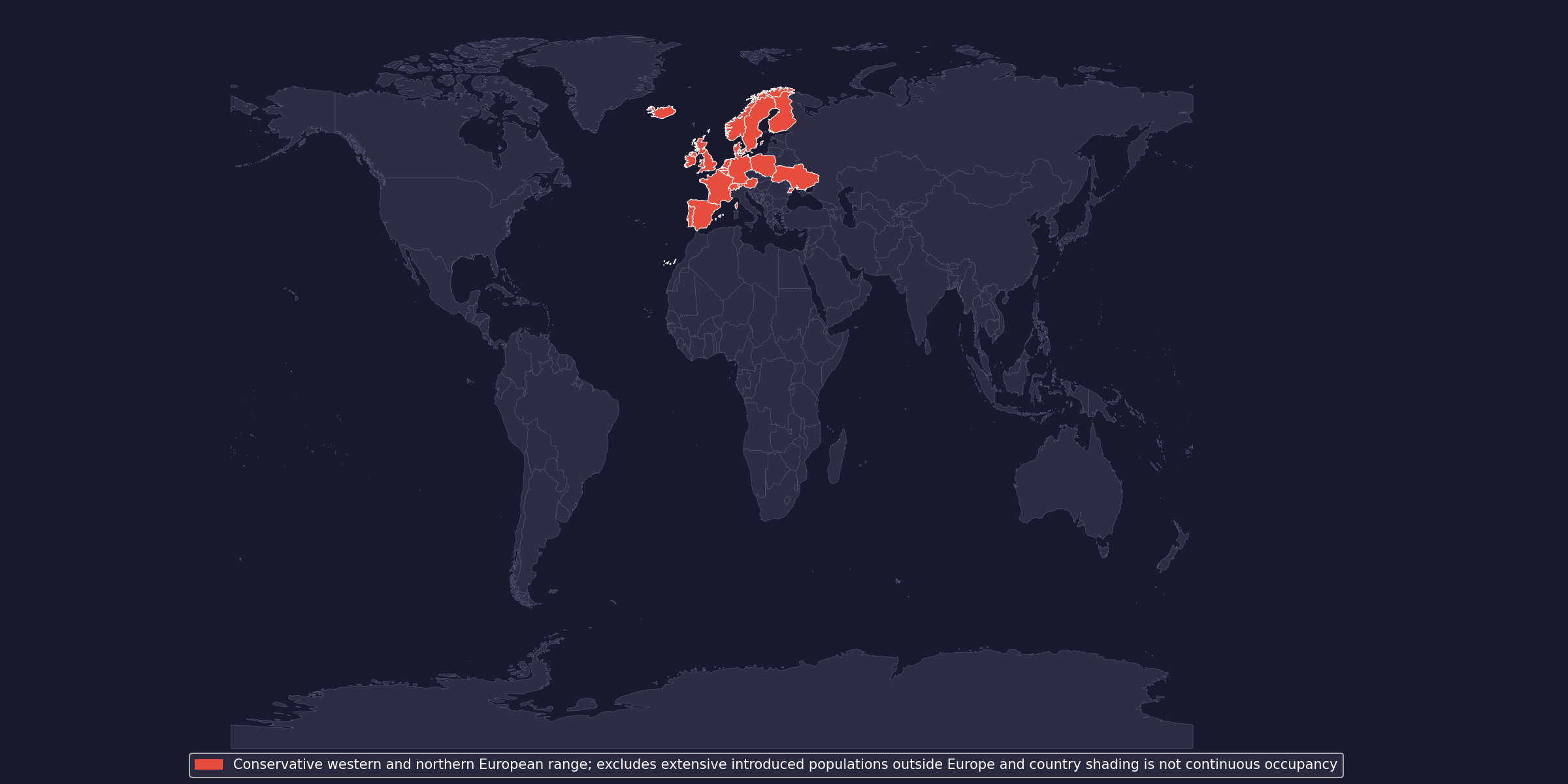
The species is native or long-established through western and northern Europe, from Portugal to Scandinavia and east toward Poland and Ukraine, with the Azores and Madeira included in the cataloged range. It is scarce through genuinely Mediterranean and continental southeastern climates. Human transport has established it widely in North America and elsewhere.
The map shows a conservative western and northern European core and excludes introduced populations outside Europe. Country shading cannot show regional absences or the more synanthropic character of eastern records.
⚖️ Legal status
Checked on 2026-08-29: O. asellus was not found in CITES, EU wildlife-trade Annexes A–D under Regulation (EU) 2026/1383, or Bern Appendices II–III. Local collection limits, landowner permission, protected-site rules, animal-health law and invasive-species controls can still apply.
Prefer established captive stock. Never release a culture, even within the apparent native range: lineages, pathogens and companion organisms may not be local.
🤌 Husbandry
A 30 × 20 × 15 cm ventilated box suits a starter colony. Provide at least 6 cm of moisture-retentive substrate, broad hides and deep leaf litter.
| Parameter | Recommended range |
|---|---|
| Adult length | 1.2–1.8 cm |
| Ambient temperature | 15–22 °C |
| Moisture | most substrate damp; small merely-moist sector |
| Staple food | deciduous leaves and rotten wood |
| Evidence quality | strong field ecology; moderate culture evidence |
Quarantine additions for 60 days. Keep cultures away from warm reptile racks; heat is a more common danger than cool nights.
💡 Lighting
UVB is unnecessary. Indirect room light for 10–14 hours is enough, with dark retreats always available. Seasonal day length may be allowed naturally, but direct sunlight must never reach the container.
🌡 Heating and temperature
Keep the main zone at 15–22 °C and provide a 12–18 °C cool retreat or night drop. Laboratory studies have maintained feeding animals at 10, 15 and 20 °C, consistent with a cool-temperate species. No basking lamp is needed; the structured “basking” values merely describe the warmer usable zone.
Sustained warmth above 24–25 °C is risky, especially with stagnant air. Cool the room or move the enclosure before adding more water.
💧 Humidity and water
Keep about two-thirds to three-quarters of the substrate damp, including moist rotten wood, and let a small ventilated sector become only lightly moist. A 75–95% RH reading is useful as a reference, but moisture at the animal level matters more. Add water to substrate; do not provide an open dish.
Incomplete moults and persistent tight groups under the wettest bark signal dryness. Heavy condensation, odour, flies and wall climbing indicate saturation or weak ventilation.
🌿 Enclosure and decoration
Use pesticide-free topsoil, deciduous leaf mould and generous rotten hardwood. Cover much of the surface with oak, beech, maple or similar leaves, then add cork or bark flats and a moss patch. Keep calcium available even though the species tolerates relatively acidic habitats.
Avoid pure coir, fresh resinous wood, fertilizer, and leaves from sprayed roadsides. Heavy stones should rest on the enclosure floor before substrate is added so burrowing cannot undermine them.
🪳 Feeding
Leaves and soft rotten wood are continuous staples. Offer mushroom, squash, carrot, dried nettle or balanced isopod food two or three times weekly. Add a modest protein portion weekly and provide limestone, oyster shell or cuttlebone.
Experiments confirm that temperature and leaf species influence consumption, so appetite changes are not automatically illness. Remove wet leftovers within 24–36 hours and avoid feeding faster than the colony processes food.
🥚 Breeding
Females brood embryos in a marsupium and release mancae; metadata records the mode as viviparous. Healthy mixed-age colonies usually reproduce without artificial triggers. Cooler seasonal variation may slow growth without indicating failure.
Do not isolate gravid females. Protect fine leaf fragments and humid pores for mancae. Split the culture only after several age classes are established, moving damp substrate and wood with each group.
🩺 Common problems
- Deaths during summer: reduce room temperature and improve airflow; do not compensate for heat by flooding.
- Failed moults: restore deep moisture and calcium.
- Few juveniles: check heat, pesticide exposure and lack of fine decomposed food.
- Mould or mites: feed less rich food and remove leftovers while retaining leaf litter.
- Misidentification: compare surface texture and rear corners, then seek adult examination if locality matters.
📌 Conclusion
Oniscus asellus is beginner-friendly when treated as a cool, moisture-dependent woodland detritivore. Its simple requirements are easy to meet, but a hot or partly arid isopod box is unsuitable. Deep damp litter, rotten wood and ventilation are the foundation of a stable colony.
📚 Sources and further reading
- GBIF: Oniscus asellus
- World List of Isopoda: Oniscus asellus
- Schmalfuss world catalog: synonymy and distribution
- Woodlice in Britain and Ireland: distribution and habitat
- Bilton (1994): intraspecific variation and western subspecies
- Temperature and litter-quality feeding experiment
- Moisture and water exchange
- ReptiFiles site search completed; no species-specific guide found
- CITES Appendices
- EU wildlife-trade Annexes: Regulation (EU) 2026/1383
- Bern Convention appendices