Share

Unidentified Nocticola Micro Cockroach
🔤 Taxonomy
Nocticola sp. means that the animals have been assigned only to the genus Nocticola. It is not a species name. With no locality, diagnostic characters, voucher, or supplier line attached to the listing, this guide cannot equate the stock with N. vagus, the Malaysian hobby line, or the unidentified stock studied in reproductive research.
GBIF supports Animalia → Arthropoda → Insecta → Blattodea → Nocticolidae → Nocticola for the lowest defensible tree. There is deliberately no invented species row.
📌 Description
Nocticolids are minute, cryptic cockroaches; described Nocticola are generally under 1 cm and some cultured forms are only about 4 mm. They disappear into bark seams and substrate, so a healthy colony can be difficult to count. This is a specialist micro-culture, not a handling insect.
| Care point | Conservative starting target |
|---|---|
| Adult size | roughly 3-8 mm; confirm from the actual line |
| Starter enclosure | about 20 x 15 x 15 cm |
| Temperature | 22-26°C with a cooler pocket |
| Humidity | 70-85% with ventilation |
| Substrate | 3-5 cm, moist but airy |
| Identity | genus only; retain supplier and line records |
🌍 Distribution
The genus occurs across parts of the Old World tropics, and its members include surface, nest-associated, and cave-adapted forms. That genus-wide context is not a range for this particular culture.
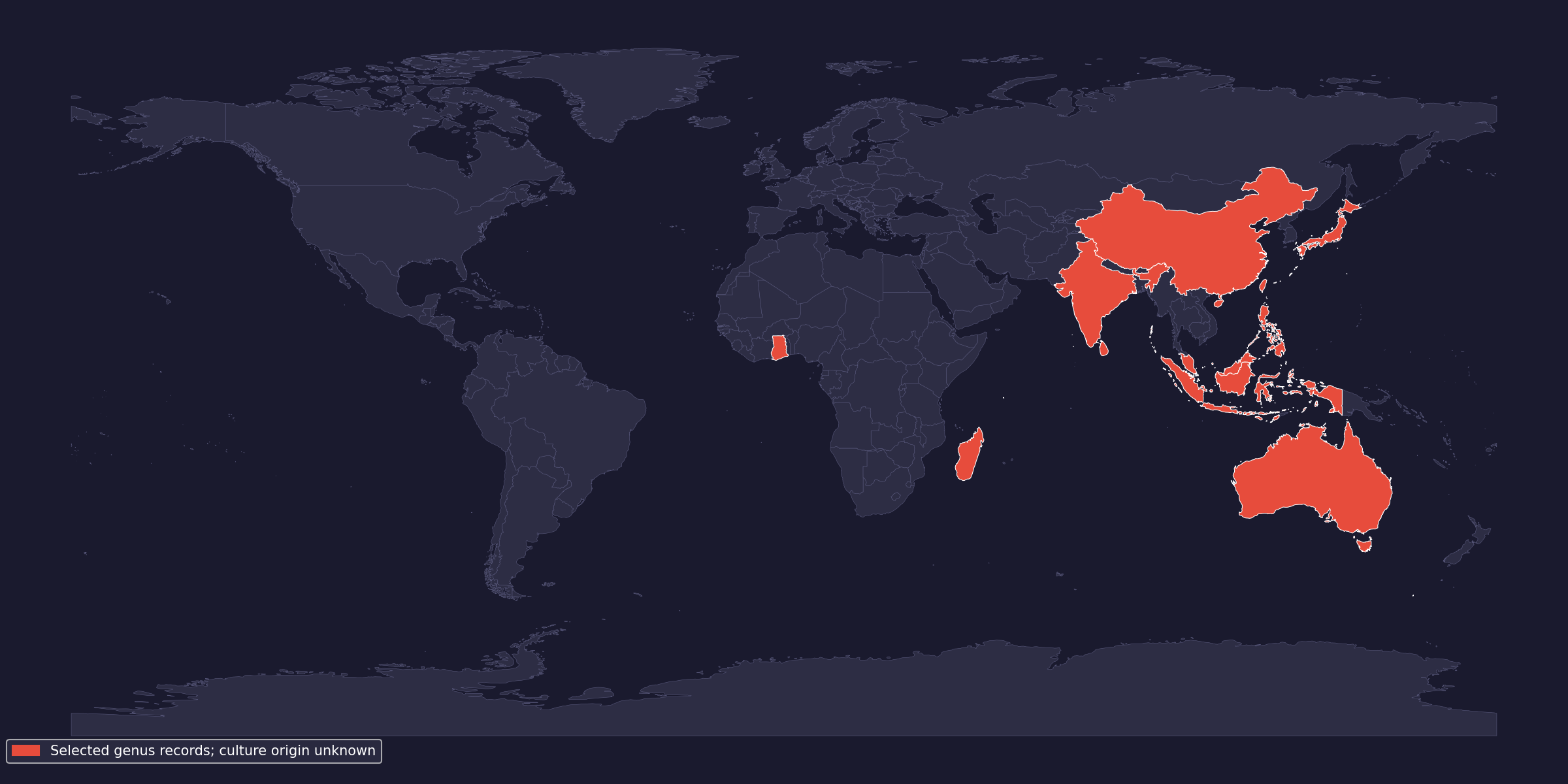
No locality was supplied with the bare label Nocticola sp. The map below is deliberately contextual: it highlights selected countries with published records for the genus across tropical Africa, South, East, and Southeast Asia, and Australia. It is not the native range of this culture and cannot identify its origin. Add a culture-specific map only if traceable locality or species evidence becomes available; do not retroactively attach “Malaysia” because some superficially similar hobby cultures use that label.
⚖️ Legal status
Checked on 2026-08-22 at genus level: Nocticola is absent from the CITES Appendices valid from 5 March 2026, no genus-specific listing appears in Annexes A-D of Commission Regulation (EU) 2026/1383, and the Bern Convention is not relevant to an unidentified non-European tropical cockroach.
Unidentified live invertebrates can be harder to import or transfer than named captive stock. Keep the invoice, the exact supplier label, photographs, acquisition date, and any origin or import documents. Local and national agricultural, invasive-species, tenancy, school, transport, and destination rules may still apply. Never release animals or substrate outdoors.
🤌 Husbandry
Start a small group in a gasketed 20 x 15 x 15 cm container rather than a large display tank; tiny animals find food more reliably and are easier to monitor in compact quarters. Cover vents with fabric or mesh fine enough to retain hatchlings, and open the culture inside a second empty tub.
Quarantine the line for 60-90 days with separate tools. Record adult form, climbing ability, ootheca shape, incubation, brood size, molts, and mortality. Those observations help refine care without pretending they establish a formal identification.
💡 Lighting
UVB is not required. Provide a 10-12-hour indirect room-light cycle and abundant darkness under bark. Avoid direct sunlight, bright lamps, and observation lights that warm the small container.
🌡 Heating and temperature
Use 22-26°C as a cautious starting range, with a 20-23°C retreat. This overlaps published and successful culture conditions for some unidentified or named Nocticola, but cave-specialized species may prefer cooler conditions. Adjust only from measured line response.
If heating is needed, warm one outside wall through a thermostat. A tiny container can overheat quickly; sustained 28°C or more should not be assumed safe for an unidentified line.
💧 Humidity and water
Keep the lower substrate consistently moist while the exposed surface remains merely damp, not saturated. A 70-85% air-humidity range is a useful starting point, but clean smell, normal molts, and lack of condensation are better controls than chasing one number.
Do not use an open water dish. Moist substrate and small portions of fresh food provide water without a drowning trap. Drying can kill eggs and nymphs; waterlogging encourages mold and mites.
🌿 Enclosure and decoration
Use 3-5 cm of fine pesticide-free coir or topsoil mixed with crumbly decayed hardwood, decomposed leaves, small bark pieces, and a little sphagnum. Partly bury thin cork and hardwood slivers to create tight humid galleries.
Avoid conifer wood, fertilized potting soil, coarse mesh, and decorations that cannot be inspected. Do not house this unidentified line with another species: mixing makes both population control and later identification less reliable.
🪳 Feeding
Keep decomposed hardwood leaves and soft rotten hardwood available. Add pinhead-sized portions of carrot, squash, apple, or mushroom and a small amount of finely ground balanced insect food every two to four days. Remove fresh food before it molds.
Use several tiny feeding points. Large protein portions foul the enclosure and favor mites; complete dryness is a greater danger than a temporarily empty food dish.
🥚 Breeding
The published unidentified Nocticola stock produced exposed oothecae containing four eggs and hatched after about 47 days at 25°C. That supports the provisional 24-26°C and 40-55-day metadata here, but it is comparative genus-level evidence, not proof for this culture. Inspect without handling oothecae.
Until males, mating, and repeated hatch records are documented, do not advertise the line as parthenogenetic. Retain several generations before distributing stock, and pass the original provisional label unchanged.
🩺 Common problems
- Invisible decline: check food, moisture, mites, and hatchlings under bark rather than assuming a hidden colony is thriving.
- Desiccation: curled bodies, failed molts, and empty oothecae call for a better moist lower layer, not stagnant air.
- Mold or mites: reduce fresh-food volume, remove affected pieces, and improve fine cross-ventilation.
- Escape: replace loose lids and coarse mesh; a rim barrier is unreliable at this size.
- Identity drift: never add a species or locality to labels from resemblance or seller repetition alone.
- Allergy: cockroach debris may sensitize keepers; work in ventilation and wash hands after maintenance.
📌 Conclusion
This culture suits a keeper who can manage a nearly microscopic colony and keep meticulous provenance. Stable moisture and hatchling-proof vents come first; its name should remain Nocticola sp. until diagnostic evidence says otherwise.
📚 Sources and further reading
- GBIF genus record: Nocticola
- Fujita et al. 2020: reproductive biology and embryonic development of an unidentified Nocticola
- Lo et al. 2007: phylogenetically divergent Nocticola
- Li et al. 2025: species diversity and cave/surface ecology in Nocticola
- Wang, Jeon & Cognato 2025: distribution context and the adventive species N. vagus
- Foo & Lucanas 2023: a surface-dwelling Nocticola from Singapore
- ReptiFiles — checked first; no taxon-specific guide was found
- CITES Appendices, valid from 5 March 2026
- Commission Regulation (EU) 2026/1383: current wildlife-trade annexes
- Council of Europe: Bern Convention text and appendices