Share

Nagurus sundaicus
🔤 Taxonomy
Nagurus sundaicus (Dollfus, 1898) is accepted by GBIF and the World List of Isopoda. Porcellio sundaicus is the original combination and Nagara insularum is a synonym. Some databases repeat a 1907 authority date; the current specialist catalog and WoRMS use 1898.
📌 Description
This is a small trachelipodid woodlouse from tropical eastern and southeastern Asia and Pacific islands. Published revisions illustrate diagnostic male structures, but concise field descriptions and measured captive performance are scarce. The 0.6–0.9 cm size band in metadata is a practical identification and housing reference, not a robust species-wide maximum.
No replicated species-specific husbandry study and no ReptiFiles species guide were found. The following protocol is deliberately conservative and derived from tropical litter ecology, collection records, and general care of small Nagurus-like detritivores. It must be tested with observation and good records.
🌍 Distribution
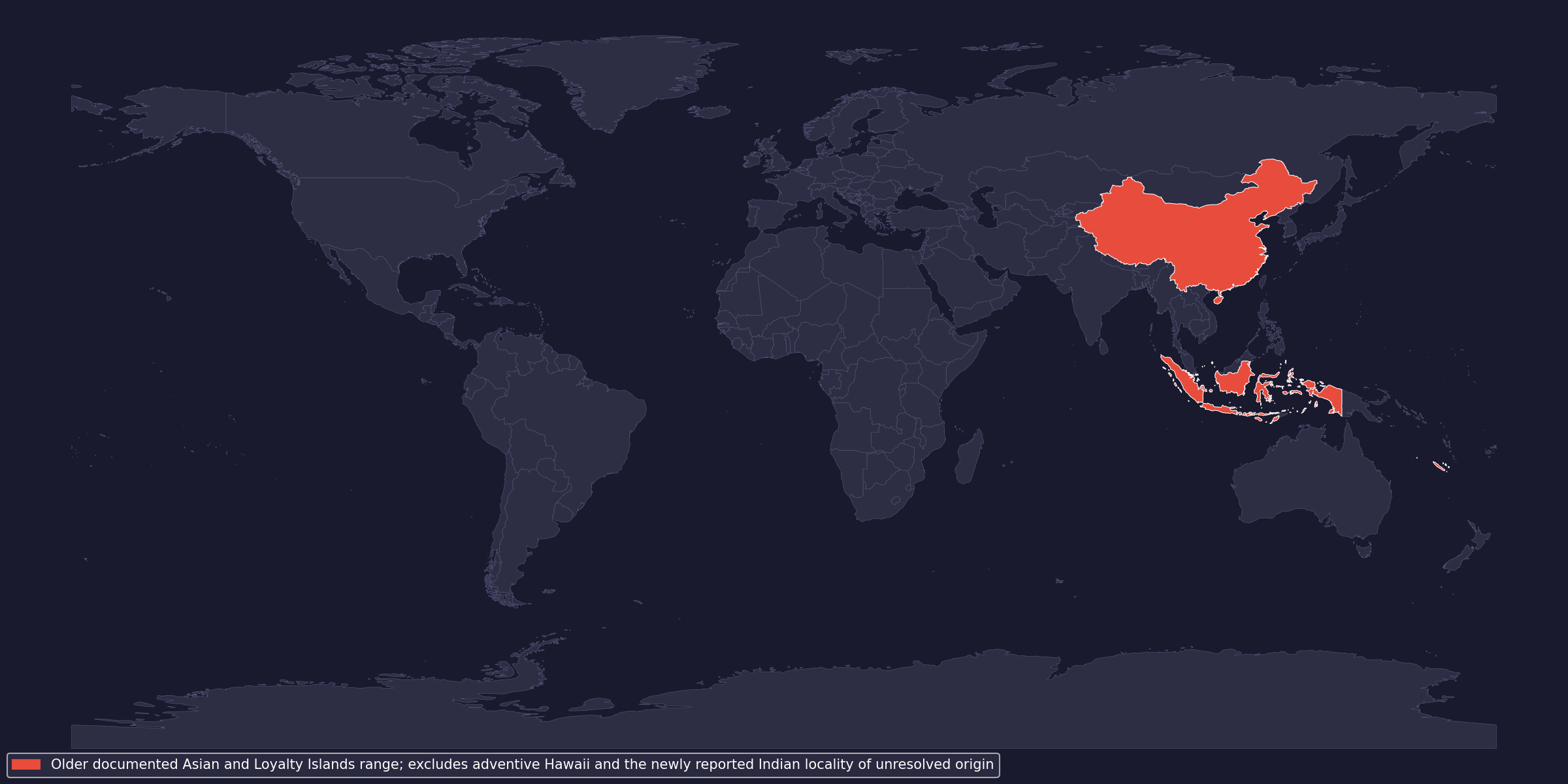
The world catalog reports China, Indonesia (Sumatra, Java and Sulawesi), the Loyalty Islands of New Caledonia, and Hawaii. A 2026 paper added a park record from West Bengal, India, but a first regional report does not by itself resolve whether the population is native or transported. The Hawaiian review classed its record as adventive.
The map shows the older documented Asian–Loyalty range and excludes introduced Hawaii and the newly reported Indian locality. Country shading is not continuous occupancy.
⚖️ Legal status
Local and national rules may still apply.
Checked on 2026-08-29: N. sundaicus was not found in CITES, EU wildlife-trade Annexes A–D under Regulation (EU) 2026/1383, or Bern Appendices II–III. Import, plant-health, soil, protected-area, and invasive-organism rules may still control possession or movement.
Acquire only traceable captive stock. Do not move leaf litter across borders, collect from parks without permission, or release the culture.
🤌 Husbandry
Use a secure 20 × 15 × 12 cm container for a small verified group, with at least 6 cm of biologically active substrate and fine cross-ventilation.
| Parameter | Conservative starting point |
|---|---|
| Adult length | provisionally 0.6–0.9 cm |
| Temperature | 21–27 °C |
| Moisture | about two-thirds damp, never stagnant |
| Main food | leaves and decomposed hardwood |
| Evidence quality | distribution and taxonomy good; captive data very sparse |
Quarantine for at least 60 days. Photograph adults and preserve lawful voucher material because similar Nagurus species and historic misidentifications make trade names unreliable.
💡 Lighting
UVB is unnecessary. Use an indirect 10–12 hour light cycle and keep cork and leaf retreats shaded. Avoid direct sunlight.
🌡 Heating and temperature
Start at 21–27 °C with a cooler 19–23 °C side or lower layer. These values are ecology-level estimates for tropical litter animals, not measured thermal limits for N. sundaicus. A stable room at the lower half of the range is preferable to untested high heat.
If warming is necessary, heat one side wall with thermostat control. Stop and reassess if animals crowd the cool end, climb continuously or disappear into the deepest wet layer.
💧 Humidity and water
Maintain roughly two-thirds of the substrate damp and one-third merely moist to the touch. A 70–90% RH display reading is secondary to continuous moisture within litter and rotten wood. Add water to one corner and retain cross-ventilation; no dish is needed.
Drought can cause failed moults quickly in small species, while sealed saturated boxes lose oxygen and favour mites. Correct the substrate gradient, not just the hygrometer number.
🌿 Enclosure and decoration
Use pesticide-free topsoil, leaf mould and finely crumbled white-rotten hardwood, with cork flats, deep leaf litter, calcium and a small moss patch at the wet end. Fine mesh or very small holes are essential around lids.
Do not use coir alone, waterlogged compost, fertilizer, aromatic wood, or unsterilized imported forest material. Keep springtails only after quarantine shows they do not overwhelm the tiny colony.
🪳 Feeding
Leaves and rotten wood remain the constant diet. Offer tiny portions of mushroom, squash, dried nettle or balanced isopod food two or three times weekly. Add a pinhead-sized protein portion about weekly and keep calcium available.
Remove fresh leftovers within 24 hours. Population size is easy to overestimate in a secretive culture, so scale food to disappearance rather than the amount offered previously.
🥚 Breeding
Females are expected to brood embryos in a marsupium and release mancae, as other terrestrial isopods do; metadata records this as viviparous. Species-specific brood size, maturity, seasonality and captive generation time were not found.
Do not isolate gravid females. Preserve humid pore spaces and finely divided food. Treat reproduction as a monitored experiment and split only after several age classes are established.
🩺 Common problems
- Unexplained disappearance: inspect deep leaf layers gently and verify the lid and mesh before assuming a crash.
- Incomplete moults: restore moisture through the lower substrate and supply calcium.
- Mites and mould: reduce rich food, remove residues and increase cross-flow without drying the damp sector.
- Heat stress: move the culture cooler before changing humidity.
- Dubious label: pause distribution and obtain specialist identification.
📌 Conclusion
Nagurus sundaicus should be treated as a documentation-focused expert culture. A warm, humid but oxygenated litter system is a reasonable starting point; its exact size, thermal optimum and breeding performance remain uncertain and must not be advertised as established facts.
📚 Sources and further reading
- GBIF: Nagurus sundaicus
- World List of Isopoda: Nagurus sundaicus
- Schmalfuss world catalog: synonyms and distribution
- Kwon & Taiti: China, Macao and Hong Kong revision
- Taiti & Howarth: Hawaiian record classed as adventive
- 2026 West Bengal record
- ReptiFiles site search completed; no species-specific guide found
- CITES Appendices
- EU wildlife-trade Annexes: Regulation (EU) 2026/1383
- Bern Convention appendices