Share

Merulanella sp. “Ember Bee”
🔤 Taxonomy
“Ember Bee” is an undescribed captive culture, not a valid species name. It remains widely sold as Merulanella sp. “Ember Bee”, so that label is retained here for traceability. A 2025 revision restricted true Merulanella to New Caledonia and erected Ardentiella for related Indomalayan forms; the paper also found that several colourful hobby cultures were distinct, undescribed morphospecies. Without a deposited voucher or diagnostic study, this culture cannot safely be assigned to a described species.
The taxonomy widget therefore stops at the last genus accepted by the current GBIF match for the trade label. It must not be read as a species identification.
📌 Description
Ember Bees are dark, strongly patterned pill isopods sold with yellow, orange, and red markings. Captive adults are commonly around 1.8-2.2 cm, but this is a culture estimate rather than a published species measurement. They climb cork and enclosure walls readily and are most visible in dim light.
This is an advanced colony. Its narrow tolerance for stale, saturated conditions, heat, and abrupt drying matters more than any single hygrometer number. Individual lifespan and brood size have not been established scientifically; the ranges in the quick profile are conservative captive planning values, not species-level natural-history claims.
🌍 Distribution
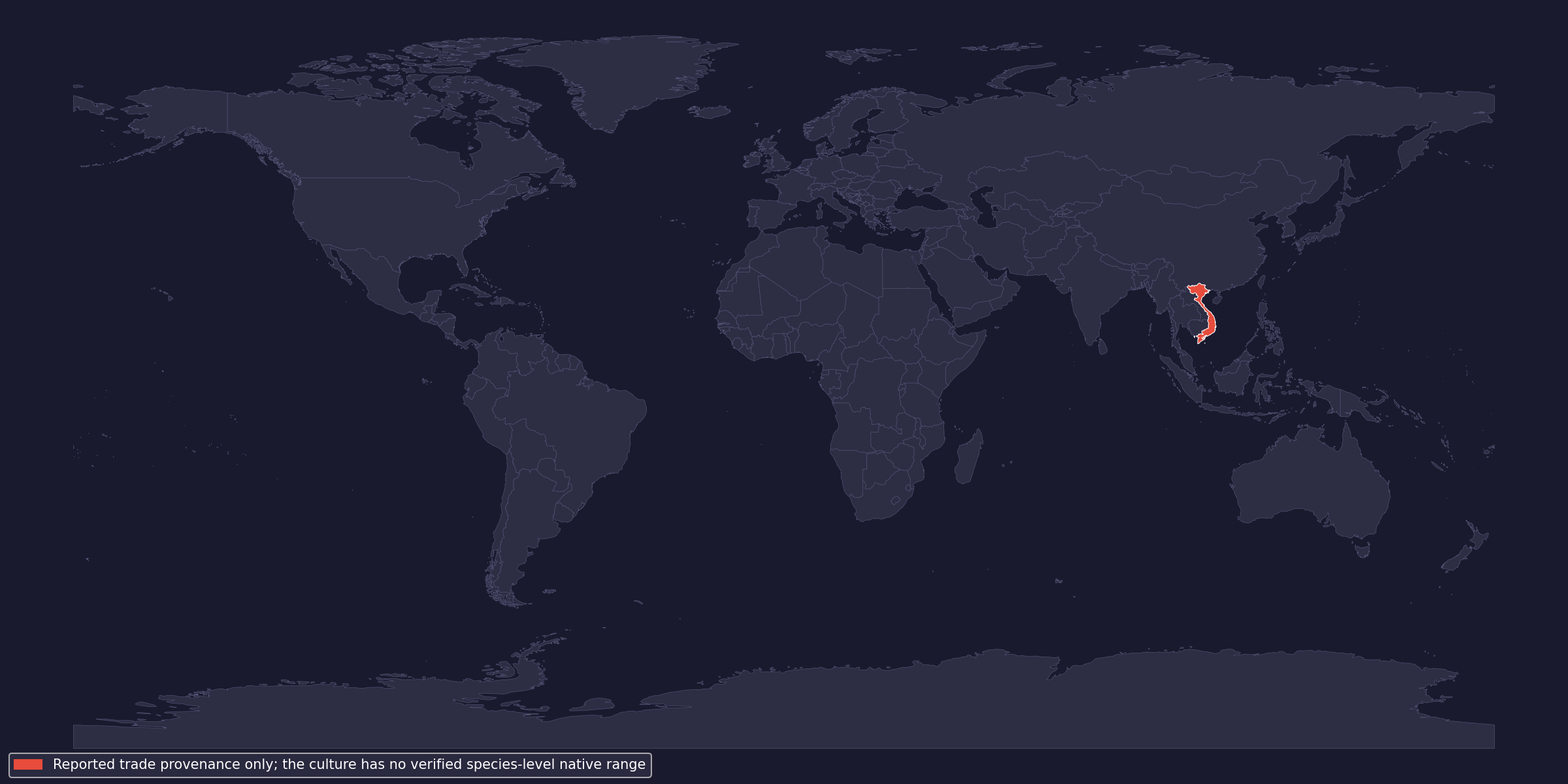
The trade associates Ember Bee stock with Vietnam, but no published collection locality, type series, or verified occurrence record ties the captive name to a wild population. Vietnam on the map represents reported trade provenance only, not a proven native range. Do not turn a seller locality into a conservation or climate claim.
⚖️ Legal status
Checked on 2026-08-23: no listing for Merulanella, Ardentiella, or the Ember Bee trade culture was found in the CITES Appendices or EU wildlife-trade Annexes A-D under Regulation (EU) 2026/1383. The Bern Convention does not provide a relevant listing for this non-European provisional culture.
That does not establish legal wild collection or export from Vietnam. Import, plant-health, wildlife, transport, and national possession rules can still apply. Buy demonstrably captive-bred stock, retain invoices and the full culture label, and ask for breeding history rather than an unverifiable “wild locality.” The 2025 revision specifically raises concern about collection pressure on undescribed Vietnamese isopods.
🤌 Husbandry
A sealed but cross-ventilated 30 × 20 × 20 cm box is a practical minimum for a starter colony. Use fine metal mesh or holes too small for mancae, and keep ventilation on opposing sides rather than only in the lid. Provide a deep moisture buffer at one end, a merely moist middle, and a less-wet end; none of the substrate should become dusty dry.
Quarantine new stock for 60-90 days in a separate room or at least with separate tools. Track deaths, activity, feeding, molts, mites, and any sour or fungal smell before bringing the colony near other isopods. Never mix trade lines: appearance alone cannot establish that two Ember Bee cultures are the same biological species.
💡 Lighting
UVB is not required. Give 10-12 hours of diffuse room or plant light and ample shade under bark and litter. Direct sun and high-output lamps can overheat a small tub within minutes. Low evening light is best for observation.
🌡 Heating and temperature
Keep most of the colony at 20-25 °C, with a retreat around 18-21 °C. Avoid sustained temperatures over 26 °C. If a cold room requires heat, warm one outer side under thermostat control; never heat the base, which removes the animals’ ability to retreat into cooler substrate.
Published species-specific thermal limits do not exist. These values are a conservative overlap of detailed specialist culture practice, not a wild climate reconstruction. Heat-related losses can resemble a humidity problem because warm substrate dries quickly and oxygen availability falls in waterlogged pockets.
💧 Humidity and water
Maintain humid air, roughly 65-80%, while preserving airflow and a visible substrate gradient. Pour a small amount of dechlorinated water into moss and substrate at one end; do not spray the entire box on a fixed schedule. The dry-side surface may lose its sheen, but deeper material should retain slight moisture.
No water dish is needed. Standing water drowns mancae, and constant condensation signals insufficient ventilation. Crowding at the wet end suggests dehydration; persistent surface activity at the vents, sour substrate, or repeated deaths after molts suggests excessive wetness or heat.
🌿 Enclosure and decoration
Use 6-8 cm of pesticide-free deciduous leaf mould, rotten hardwood, and mineral soil, with coir only as a minor moisture-holding component. Cover most of the surface with several layers of dry and partly decayed oak, beech, maple, or similar hardwood leaves. Stand cork flats and branching wood securely so animals can climb and find airier retreats.
Keep one patch of sphagnum at the hydrated end and a permanent piece of cuttlebone or clean calcium carbonate. Avoid conifer litter, aromatic wood, fertilizer, pesticide residues, charcoal briquettes, and substrate built mainly from nutritionally empty coir.
🪳 Feeding
Decaying hardwood leaves and soft white-rotted wood are the staple, not decoration. Supplement two or three times weekly with tiny portions of mushroom, carrot, squash, sweet potato, or a balanced isopod food. Offer a small protein portion such as dried gammarus, shrimp, or quality fish food about weekly, especially in a growing colony.
Keep calcium continuously available. Remove moist supplements before mold spreads, usually within 24 hours in warm conditions. If food remains untouched, reduce the portion rather than adding more varieties on top of it.
🥚 Breeding
Terrestrial isopods do not lay a clutch into the substrate. The female carries eggs and embryos in a fluid-filled ventral marsupium; mancae emerge after development. The repository’s coarse reproductive field records this as “viviparous,” although marsupial brooding is the more exact description.
Do not isolate gravid females or sift a breeding colony. Stable moisture, leaf litter, calcium, gentle protein feeding, and very small ventilation openings protect mancae. Because no reliable Ember Bee brood-size or development study exists, record dates and counts for your own line without presenting them as universal species data.
🩺 Common problems
- Sudden losses in summer: check the warmest substrate, not only room temperature; improve safe airflow and move the enclosure away from sun.
- Failed molts: restore the moist retreat, calcium access, and rotten leaf/wood diet without saturating the whole box.
- Mold and sour odor: remove surplus food, increase cross-flow, and replace only the fouled portion so the colony retains its microbial substrate.
- Mancae disappearing: inspect vent size, damp refuge stability, and competing springtail or mite populations.
- Line confusion: keep labels and tools separate and never sell offspring under a species name that has not been demonstrated.
📌 Conclusion
Ember Bee suits an experienced isopod keeper who can manage cool humid substrate with active ventilation and accept unresolved taxonomy. Secure captive-bred provenance before purchase; heat and stagnant wetness are the setup’s main practical risks.
📚 Sources and further reading
- GBIF genus record: Merulanella
- World List of Isopoda: Merulanella
- Kästle & Regalado Fernández 2025: reassessment of Merulanella
- Histological study of the terrestrial-isopod marsupium
- ReptiFiles clean-up-crew overview checked before drafting
- Detailed Ember Bee culture guidance
- CITES Appendices
- Current EU wildlife-trade Annexes: Regulation (EU) 2026/1383
- Bern Convention documents and appendices